


Taiwanese civic groups yesterday held a rally in Taipei to back jailed Hong Kong democracy advocates Lee Cheuk-yan (李卓人) and Chow Hang-tung (鄒幸彤), urging the Hong Kong government to immediately and unconditionally release them.
Lee and Chow, former chairperson and vice chairperson of the Hong Kong Alliance in Support of Patriotic Democratic Movements of China, have been held in pre-trial detention since Sept. 9, 2021, on charges of “inciting subversion of state power” under Hong Kong’s National Security Law, which was imposed in 2020.
They allegedly incited people to participate in an unauthorized assembly commemorating people who were killed during the June 4, 1989, Tiananmen Square Massacre.
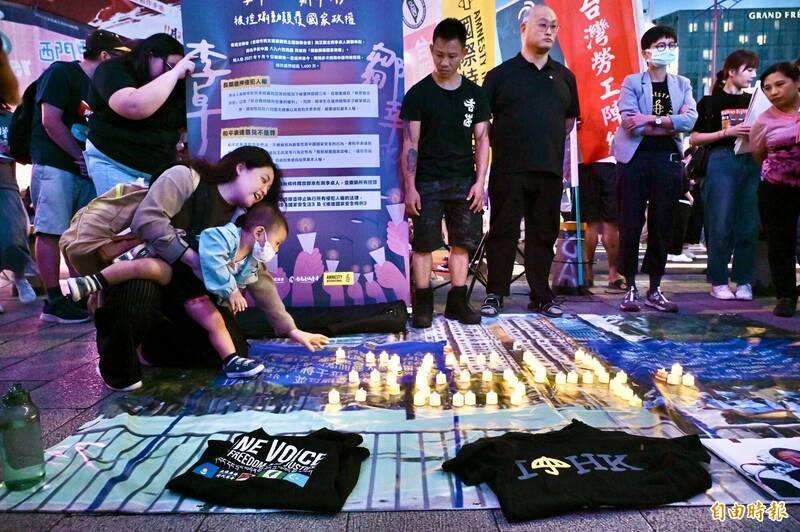
Photo: George Tsung, Taipei Times
The alliance held the assembly annually on June 4 from 1990 to 2020 at Victoria Park in Hong Kong’s Wan Chai District until the Hong Kong government began to lock down the park.
Lee’s and Chow’s trials were due to begin in May, but were postponed to tomorrow and delayed again to Jan. 22 next year.
Nonprofit organizations in Taiwan and supporters of Hong Kong democracy yesterday gathered in Taipei’s Ximending (西門町) to show their support for the pair and other political prisoners in Hong Kong.
They called on the Hong Kong government to immediately and unconditionally release Lee and Chow, and drop all charges against them, as well as abolish all statutes that infringe on human rights in Hong Kong, including the National Security Law, the Safeguarding National Security Ordinance and Article 23 of the Basic Law.
Taiwanese human rights advocate Lee Ming-che (李明哲) — the first Taiwanese arrested and imprisoned in China for “subverting state power” — said the alliance and Hong Kong pro-democracy party League of Social Democrats in 2017 marched to the Chinese Liaison Office of the Central People’s Government in the Hong Kong Special Administrative Region to protest his arrest.
Lee Ming-che cited Lee Cheuk-yan as saying at the time that the Chinese government considers any criticism about its human rights records “subversive of state power.”
It was ironic that he returned to Taiwan in 2022 after serving prison time in China and attended the rally yesterday to advocate for releasing Lee Cheuk-yan and Chow, Lee Ming-che said.
“If peacefully holding a candlelight vigil for the June 4 incident in Hong Kong can be charged with subversion, it is evident that a regime like the People’s Republic of China should not exist in modern civilized society,” he said.
Taiwan Association for Human Rights executive committee member Chiu Yu-bin (邱毓斌) said what Lee Cheuk-yan and Chow did in Hong Kong was legal in Taiwan.
Taiwanese should not forget that social movements in Hong Kong supported democracy movements in Taiwan for more than 40 years, he said.
Taiwan used to have a lot of prisoners of conscience during its martial law period from 1949 to 1987 and Taiwanese’s calls for human rights were mostly voiced to the world by Hong Kongers, as it had more freedom than Taiwan, despite the lack of democracy, Chiu said.
Workers in Taiwan should also be grateful to Hong Kong’s labor movements, as many legal protections for Taiwanese workers such as minimum wages followed the example of Hong Kong, he said.
New School for Democracy project manager Hu Chia-ying (胡嘉穎) said all of Lee Cheuk-yan’s and Chow’s bail applications had been denied, so their imprisonment was an endless punishment for them.
When the Chinese government extended its oppression of freedom of speech beyond its borders, what it challenged was not only Hong Kong, but the boundaries of the entire free world, she said.
“We are paying attention to Hong Kong not just out of sympathy, but also to bolster Taiwan’s democracy defense,” Hu said.
Hong Kong’s inability to tell its own story today is a reminder to Taiwanese that we must improve our social resilience, she said.
“We must defend against authoritarianism and safeguard pluralistic society and freedom of speech,” Hu said. “If we get used to staying silent, silence would one day envelop Taiwan again.”

The military has spotted two Chinese warships operating in waters near Penghu County in the Taiwan Strait and sent its own naval and air forces to monitor the vessels, the Ministry of National Defense (MND) said. Beijing sends warships and warplanes into the waters and skies around Taiwan on an almost daily basis, drawing condemnation from Taipei. While the ministry offers daily updates on the locations of Chinese military aircraft, it only rarely gives details of where Chinese warships are operating, generally only when it detects aircraft carriers, as happened last week. A Chinese destroyer and a frigate entered waters to the southwest

The eastern extension of the Taipei MRT Red Line could begin operations as early as late June, the Taipei Department of Rapid Transit Systems said yesterday. Taipei Rapid Transit Corp said it is considering offering one month of free rides on the new section to mark its opening. Construction progress on the 1.4km extension, which is to run from the current terminal Xiangshan Station to a new eastern terminal, Guangci/Fengtian Temple Station, was 90.6 percent complete by the end of last month, the department said in a report to the Taipei City Council's Transportation Committee. While construction began in October 2016 with an

NON-RED SUPPLY: Boosting the nation’s drone industry is becoming increasingly urgent as China’s UAV dominance could become an issue in a crisis, an analyst said Taiwan’s drone exports to Europe grew 41.7-fold from 2024 to last year, with demand from Ukraine’s fight against Russian aggression the most likely driver of growth, a study showed. The Institute for Democracy, Society and Emerging Technology (DSET) in a statement on Wednesday said it found that many of Taiwan’s uncrewed aerial vehicle (UAV) sales were from Poland and the Czech Republic. These countries likely transferred the drones to Ukraine to aid it in its fight against the Russian invasion that started in 2022, it said. Despite the gains, Taiwan is not the dominant drone exporter to these markets, ranking second and fourth

Japanese Prime Minister Sanae Takaichi’s comment last year on Tokyo’s potential reaction to a Taiwan-China conflict has forced Beijing to rewrite its invasion plans, a retired Japanese general said. Takaichi told the Diet on Nov. 7 last year that a Chinese naval blockade or military attack on Taiwan could constitute a “survival-threatening situation” for Japan, potentially allowing Tokyo to exercise its right to collective self-defense. Former Japan Ground Self-Defense Force general Kiyofumi Ogawa said in a recent speech that the remark has been interpreted as meaning Japan could intervene in the early stages of a Taiwan Strait conflict, undermining China’s previous assumptions


 RSS
RSS