


Premier Cho Jung-tai (卓榮泰) has instructed that proposed changes to National Health Insurance (NHI) supplementary premium rates be suspended after a severe public backlash, Executive Yuan spokeswoman Michelle Lee (李慧芝) said on Thursday.
Under the current system, rental income, interest and stock dividends exceeding NT$20,000 (US$644) are subject to an additional 2.11 percent supplementary premium rate.
The Ministry of Health and Welfare was mulling calculating such income on an annual basis to prevent people from evading such payments by settling accounts under the stated standard.
Photo: Taipei Times
The mulled changes were also intended to increase the ceiling for the income-based supplementary premium rate up to NT$50 million from NT$10 million.
The changes, had they been approved and implemented, would have affected up to 4.8 million people and increased NHI income by about NT$10 billion to NT$20 billion, the ministry said.
Following a backlash, Lee on Thursday evening quoted Cho as saying that the ministry should initiate a dialogue with the public to arrive at acceptable reform measures.
The ministry had planned to have the proposed changes undergo the legislative process next year before their implementation the following year.
An aging population and a decline in the birthrate are cutting into the NHI’s primary source of income — salaried wages — and prompting the ministry to consider changes to supplementary premium rates, Lee said.
Ministry of Health and Welfare Department of Information Management Director Parng I-ming (龐一鳴) said that the NHI program had annual income of NT$800 billion, with NT$15 billion derived from stock dividends.
The NHI program is a social welfare program and those with means should endeavor to help those who are disadvantaged, Parng said, adding that the proposed amendments were still under discussion.
Analysts said that if the calculation method is changed, investors in high-dividend exchange-traded funds (ETFs) could be affected.
KGI Securities Ltd (凱基證券) on Thursday released its latest fourth-quarter ETF report, which showed that as of Sept. 30, there were 287 Taiwan ETFs, of which 68 were income-distribution products, benefiting 15.53 million individuals, with more than 2 million accounts using regular investment plans.
If the supplementary health insurance premium is changed from a “single payment exceeding NT$20,000” to an annual cumulative basis, the greatest impact would be on investors who have concentrated their assets in high-dividend Taiwanese ETFs, it said.
Separately yesterday, Minister of Health and Welfare Shih Chong-liang (石崇良) said that all NHI-related polices have only one goal and that is to ensure that the program’s finances are sustainable and ready to help more people.
The program’s finances are in need of reform, he said, adding that reforms had been steadily applied over three decades.
“It [public disclosure of the proposed changes] was actually somewhat accidental; it was revealed during a media interview,” he said.
The proposed amendments would involve cross-ministry discussions and public hearings, he added.
Additional reporting by Lee Ching-huis

Eight Chinese naval vessels and 24 military aircraft were detected crossing the median line of the Taiwan Strait between 6am yesterday and 6am today, the Ministry of National Defense said this morning. The aircraft entered Taiwan’s northern, central, southwestern and eastern air defense identification zones, the ministry said. The armed forces responded with mission aircraft, naval vessels and shore-based missile systems to closely monitor the situation, it added. Eight naval vessels, one official ship and 36 aircraft sorties were spotted in total, the ministry said.
The Ministry of Foreign Affairs (MOFA) today said that if South Korea does not reply appropriately to its request to correct Taiwan’s name on its e-Arrival card system before March 31, it would take corresponding measures to alter how South Korea is labeled on the online Taiwan Arrival Card system. South Korea’s e-Arrival card system lists Taiwan as “China (Taiwan)” in the “point of departure” and “next destination” fields. The ministry said that it changed the nationality for South Koreans on Taiwan’s Alien Resident Certificates from “Korea” to “South Korea” on March 1, in a gesture of goodwill and based on the
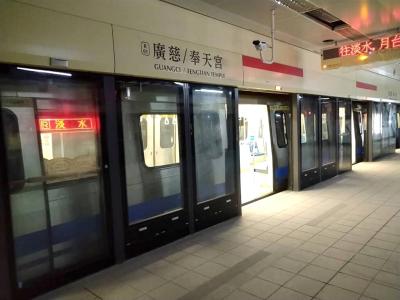
The New Taipei Metro's Sanyin Line and the eastern extension of the Taipei Metro's Tamsui-Xinyi Line (Red Line) are scheduled to begin operations in June, the National Development Council said today. The Red Line, which terminates at Xiangshan Station, would be connected by the 1.4km extension to a new eastern terminal, Guangci/Fengtian Temple Station, while the Sanyin Line would link New Taipei City's Tucheng and Yingge stations via Sanxia District (三峽). The council gave the updates at a council meeting reviewing progress on public construction projects for this year. Taiwan's annual public infrastructure budget would remain at NT$800 billion (US$25.08 billion), with NT$97.3

Taiwanese officials were shown the first of 66 F-16V fighter jets purchased by Taiwan from the United States, the Ministry of National Defense said yesterday, adding the aircraft has completed an initial flight test and is expected to be delivered later this year. A delegation led by Deputy Minister of National Defense Hsu Szu-chien (徐斯儉) visited Lockheed Martin’s F-16 C/D Block 70 (also known as F-16V) assembly line in South Carolina on March 16 to view the aircraft. The jet will undergo a final acceptance flight in the US before being delivered to Taiwan, the


 RSS
RSS