


Lawmakers today called for amendments to veterinarian regulations to prevent unethical practices, after a kennel in Miaoli County was found to have cut most of its dogs’ vocal cords and bred infirm female dogs.
Earlier this year, a veterinarian surnamed Hsieh (謝) who operates a kennel in Miaoli was discovered to have cut the vocal chords of more than 90 percent of its dogs and used elderly and sick female dogs for breeding.
The Miaoli Country Government last month imposed the maximum fine allowed under the Animal Protection Act (動物保護法) and revoked Hsieh’s business license.
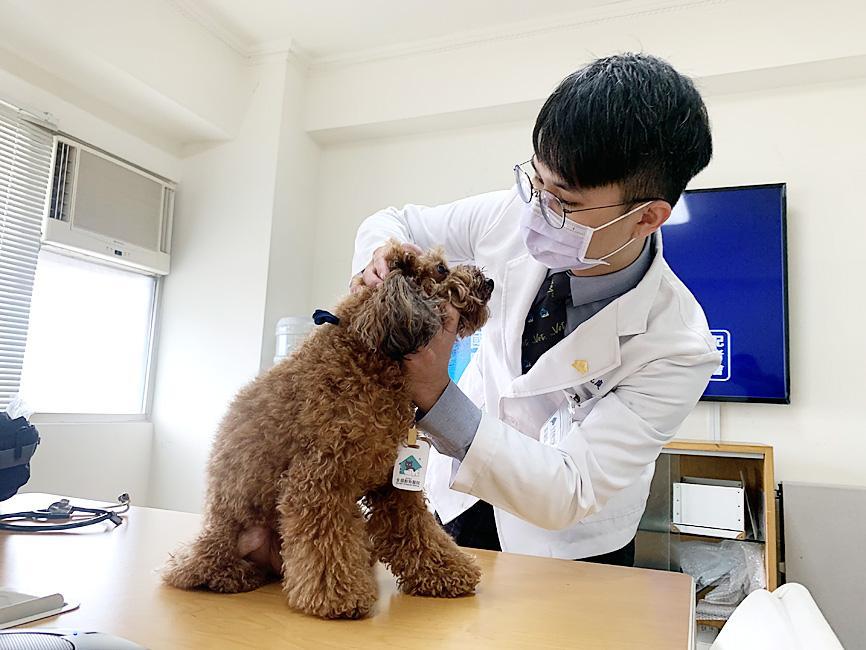
Photo: Tsai Shu-yuan, Taipei Times
Democratic Progressive Party (DPP) legislators Jean Kuo (郭昱晴) and Lee Kuen-cheng (李坤城), along with Miaoli County Councilor Chen Kuang-hsuan (陳光軒), hosted a news conference today calling on the Ministry of Agriculture to amend the Animal Protection Act and Veterinarian Act (獸醫師法) to strengthen professional ethics and curb unethical veterinarians and breeders.
Kuo said there have been other cases like this that reveal loopholes, which could be filled by regulating the number of breeding facilities and improving their conditions.
The current Veterinarian Act lacks clear ethical standards and disciplinary measures, and should be amended to stipulate professional ethics and prohibited conduct, Kuo said.
Contraventions of the Animal Protection Act, including abuse or improper medical treatment, should be grounds to revoke veterinary licenses to safeguard the profession’s integrity, she said.
There is no quota on the current 1,679 designated pet businesses in Taiwan, which affects the industry’s quality, Lee said.
Inspections are conducted once a year under the current system, and confusion over microchip registration and tracking gives illegal operators opportunities to exploit, Lee said.
The kennel in this case was rated as excellent in 2023, but dropped in rating last year, yet the Miaoli Country Government took no follow-up action, he said.
According to the Regulations for the Management of Designated Pet Industries (特定寵物業管理辦法), animal breeders and traders are required to submit microchip data to local authorities in January, April, July and October each year, Kuo added.
However, this practice is largely a formality, as data are submitted, but not checked, Kuo said, adding that kennels like the one in Miaoli can take advantage of the oversight.
Chen said that this kennel could only face suspension and fines under current regulations, and called on the government to amend the law to allow revoking veterinarians’ licenses for animal abuse or serious ethical violations.

FUKUOKA SITUATION: Japanese media reported that the pathogen is expected to be identified by the summer, while the CDC downplayed the idea that it was hMPV A “mysterious cold-like illness” reported in Japan’s Fukuoka Prefecture does not seem to be a new disease, but Japanese authorities have been asked about the situation, the Centers for Disease Control (CDC) said yesterday. The Fukuoka Prefectural Medical Association on Wednesday told a news conference that a “mystery cold” that has become a hot topic on social media is “highly likely to be caused by some kind of viral infection,” Japan’s KBC News reported. “Many people are experiencing symptoms starting with a sore throat, followed by a runny nose, phlegm and a severe cough,” KBC News reported, citing association officials. Health authorities are

Nvidia Corp CEO Jensen Huang (黃仁勳) arrived in Taiwan yesterday ahead of upcoming AI and technology events, saying he plans to meet with clients and Taiwan Semiconductor Manufacturing Co Chairman C.C. Wei (魏哲家) during his visit. After landing at Taipei Songshan Airport, Huang posed for photos with fans and handed out Yakult drinks to reporters and supporters waiting at the scene, saying he has “a lot to do” during the trip. Asked about reports that Nvidia’s planned headquarters site in Taipei’s Beitou Shilin Technology Park could break ground on May 27, Huang said that if the company holds an event, he would

The Ministry of Finance this afternoon announced the winning numbers for the March-April uniform invoice lottery. The winning number for the NT$10 million (US$318,060) special prize is 19531471, and the winning number for the NT$2 million grand prize is 85941329. Three numbers were drawn for the NT$200,000 first prize: 07225810, 20231230 and 83518781. Those with receipts matching the last seven digits of any of the first-prize numbers will win the NT$40,000 second prize, while those matching the last six digits will win the NT$10,000 third prize. Those whose receipts match the last five digits of the first-prize numbers can claim the NT$4,000 fourth prize,

SIX SUBSIDIES: The monthly allowance for older farmers is to increase to NT$10,000, and NT$5,000 is to be given to homemakers under the national pension system, Lai said The government is to implement major welfare policies for disadvantaged groups, including raising the monthly allowance for older farmers to NT$10,000 and providing homemakers with NT$5,000 per month, President William Lai (賴清德) said yesterday. Lai made the remarks during a visit to Wangling Temple in Chiayi County, saying that the planned increases were being introduced amid economic growth and an increase in tax revenue. Touting a policy, in which the government plans to provide a monthly allowance of NT$5,000 for every child under the age of 18 in a bid to address Taiwan’s low birthrate, Lai said that if received for the


 RSS
RSS