


The Legislative Yuan yesterday unanimously passed a third reading of a special bill under which up to NT$30 billion (US$975.6 million) would be allocated for restoration work in parts of Hualien County devastated by floods from a barrier lake that burst in September.
On Sept. 23, a natural dam upstream on the Mataian River (馬太鞍溪) burst after record rainfall brought by Typhoon Ragasa, sending 60 million cubic meters of water and debris rushing through Guangfu Township (光復) within two hours, killing at least 19 people.
The flooding also left more than 600 hectares of land in Guangfu, as well as Fonglin (鳳林) and Wanrong (萬榮) townships, covered in mud.
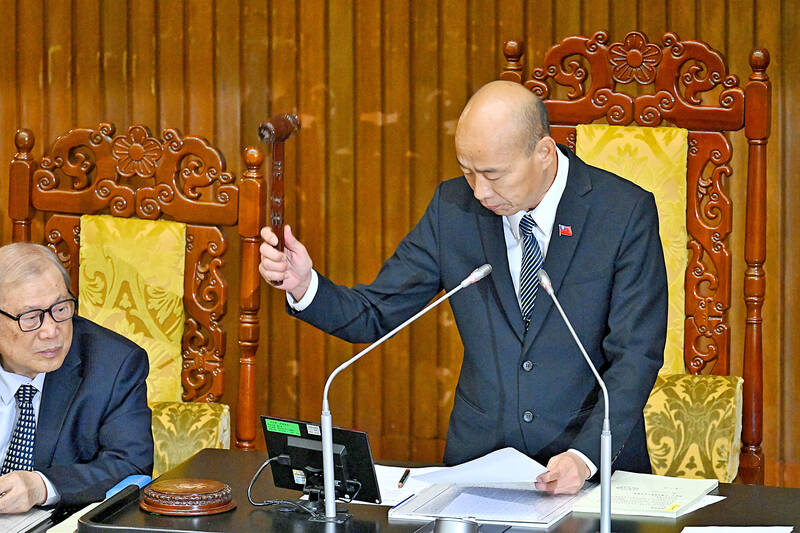
Photo: Chen Yi-kuan, Taipei Times
The NT$30 billion would be allocated in stages to cover areas including agricultural recovery, power systems, telecommunications, social rehabilitation, transportation infrastructure and facilities related to water, gas and fuel.
In terms of flood relief, the act specifies that aid would be based on the number of affected households, rather than limited to one household per address, and would not be subject to restrictions on disaster relief categories or standards.
The bill states that the Public Construction Commission would act as the competent authority and the Hualien County Government would act on a local level.
It stipulates that post-disaster reconstruction must respect local residents, communities, indigenous groups, organizations, cultures and ways of life.
The act would remain in effect until March 31, 2027, while specific engineering work, such as that related to dam repair and river and drainage management, would remain effective until Dec. 31, 2030.
The bill was proposed by Chinese Nationalist Party (KMT) Legislator Sra Kacaw.
Meanwhile, the Executive Yuan proposed amendments to articles 4, 5 and 10 of the Typhoon Danas relief budget, passed on Aug. 29, to aid recovery following torrential rain and extensive flooding in July, with the proposed changes seeking to further facilitate reconstruction efforts.
Drafts of the Typhoon Ragasa and Typhoon Danas relief bills were fast-tracked to a second reading in the legislature on Oct. 14 and 17, respectively, and handed over for cross-party negotiation.
Legislative Speaker Han Kuo-yu (韓國瑜) convened negotiations on Thursday for the Typhoon Ragasa relief bill, which reached a consensus after two hours, and the draft passed a third reading at the legislature yesterday.
Before Thursday’s cross-party negotiations, youth representatives from local Amis villages gathered outside the Legislative Yuan in Taipei to voice their opposition to the KMT’s proposal to relocate communities.
Namoh Nofu, one of the demonstrators, called the bill “heartless,” saying they opposed relocating communities and instead preferred to rebuild their homes on their original sites while temporarily living in transitional shelters.
He cited the tragedy of Siaolin Village (小林) in Kaohsiung, which was completely buried by a landslide during Typhoon Morakot in 2009, scattering residents across three separate locations and preventing them from returning home.
Another demonstrator, Lisin, said the communities’ opinions were not respected at a meeting held by KMT lawmakers Fu Kun-chi (傅?萁) and Sra Kacaw in Hualien on Monday.
“We had no idea the event was about the special bill,” she said. “We were stopped from entering the venue at first and only got in two to three hours later, but they were not even talking about the bill.”
Huang Shu-mei (黃舒楣), an associate professor at National Taiwan University’s Graduate Institute of Building and Planning, said placing affected people in temporary shelters is an international standard post-disaster measure, warning that the villagers would lose ownership of their land should they move into permanent housing elsewhere.
Accusing the KMT of rushing the bill to shield itself from liability for typhoon-related disasters, Huang urged lawmakers not to repeat the mistakes made during Typhoon Morakot.
Chang Yu-chuan (張育銓), a professor in the Department of Public and Cultural Affairs at National Taitung University, said the Amis have deep ties to their land, and forcing them to relocate permanently would mean “uprooting them, and leaving their tribe, community and culture without roots.”

A magnitude 6.1 earthquake struck off the coast of Yilan County at 8:39pm tonight, the Central Weather Administration (CWA) said, with no immediate reports of damage or injuries. The epicenter was 38.7km east-northeast of Yilan County Hall at a focal depth of 98.3km, the CWA’s Seismological Center said. The quake’s maximum intensity, which gauges the actual physical effect of a seismic event, was a level 4 on Taiwan’s 7-tier intensity scale, the center said. That intensity level was recorded in Yilan County’s Nanao Township (南澳), Hsinchu County’s Guansi Township (關西), Nantou County’s Hehuanshan (合歡山) and Hualien County’s Yanliao (鹽寮). An intensity of 3 was

Instead of focusing solely on the threat of a full-scale military invasion, the US and its allies must prepare for a potential Chinese “quarantine” of Taiwan enforced through customs inspections, Stanford University Hoover fellow Eyck Freymann said in a Foreign Affairs article published on Wednesday. China could use various “gray zone” tactics in “reconfiguring the regional and ultimately the global economic order without a war,” said Freymann, who is also a nonresident research fellow at the US Naval War College. China might seize control of Taiwan’s links to the outside world by requiring all flights and ships entering or leaving Taiwan

The next minimum wage hike is expected to exceed NT$30,000, President William Lai (賴清德) said yesterday during an award ceremony honoring “model workers,” including migrant workers, at the Presidential Office ahead of Workers’ Day today. Lai said he wished to thank the awardees on behalf of the nation and extend his most sincere respect for their hard work, on which Taiwan’s prosperity has been built. Lai specifically thanked 10 migrant workers selected for the award, saying that although they left their home countries to further their own goals, their efforts have benefited Taiwan as well. The nation’s industrial sector and small businesses lay

Quarantine awareness posters at Taiwan Taoyuan International Airport have gone viral for their use of wordplay. Issued by the airport branch of the Animal and Plant Health Inspection Agency, the posters feature sniffer dogs making a range of facial expressions, paired with advisory messages built around homophones. “We update the messages for holidays and campaign needs, periodically refreshing materials to attract people’s attention,” quarantine officials said. “The aim is to use the dogs’ appeal to draw focus to quarantine regulations.” A Japanese traveler visiting Taiwan has posted a photo on X of a poster showing a quarantine dog with a


 RSS
RSS