


The Mainland Affairs Council (MAC) yesterday dismissed online rumors about a Chinese-made app for Taiwanese to register to “surrender” as disinformation aimed at creating the false impression that many people want to defect to China.
Images of the app, called “Homecoming (歸家),” circulated on social media, stating that more than 28,000 Taiwanese had already used it to register to “return to the motherland.”
People reportedly use their legal name to register and gain reward points by inviting others to join. The points can be redeemed for prizes including mobile phones.
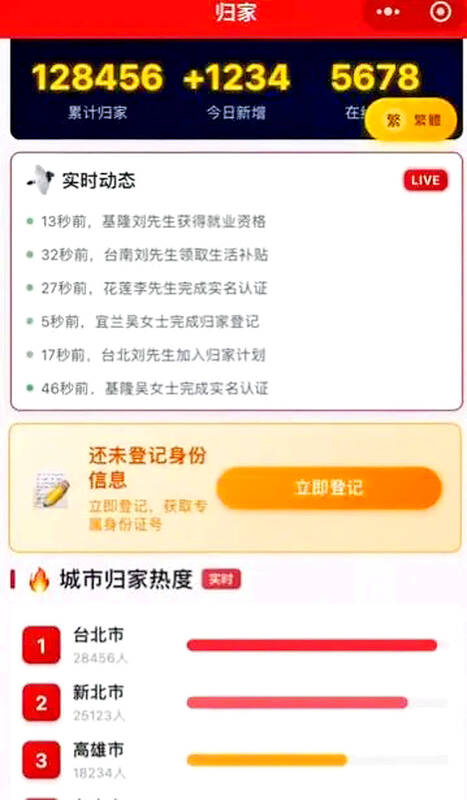
Photo: screenshot from whyyoutouzhele’s X account
The Ministry of Digital Affairs said it could not find the app when searching for it online, adding that it is not available on Apple’s iOS or Google’s Android systems in Taiwan or China, and researchers did not locate it on the WeChat or Tencent app stores.
The MAC confirmed that the app is not available on any platforms and said that if it is found, it would promptly be blocked, adding that it would not be protected as free speech, as its purpose is to eliminate the Republic of China.
If the ministry cannot find the app, then it does not exist, so it is utter nonsense that so many people have registered, an official familiar with the matter said.
“This is fake news designed to unsettle Taiwanese and weaken their resolve to defend themselves,” the official said.
“It is meant to create the false impression that many people are betraying Taiwan and that everyone should join,” they said.
The official called it a textbook example of foreign-origin disinformation meant to confuse the public and exaggerate that public opinion is trending towards reunification with China.

FUKUOKA SITUATION: Japanese media reported that the pathogen is expected to be identified by the summer, while the CDC downplayed the idea that it was hMPV A “mysterious cold-like illness” reported in Japan’s Fukuoka Prefecture does not seem to be a new disease, but Japanese authorities have been asked about the situation, the Centers for Disease Control (CDC) said yesterday. The Fukuoka Prefectural Medical Association on Wednesday told a news conference that a “mystery cold” that has become a hot topic on social media is “highly likely to be caused by some kind of viral infection,” Japan’s KBC News reported. “Many people are experiencing symptoms starting with a sore throat, followed by a runny nose, phlegm and a severe cough,” KBC News reported, citing association officials. Health authorities are

Nvidia Corp CEO Jensen Huang (黃仁勳) arrived in Taiwan yesterday ahead of upcoming AI and technology events, saying he plans to meet with clients and Taiwan Semiconductor Manufacturing Co Chairman C.C. Wei (魏哲家) during his visit. After landing at Taipei Songshan Airport, Huang posed for photos with fans and handed out Yakult drinks to reporters and supporters waiting at the scene, saying he has “a lot to do” during the trip. Asked about reports that Nvidia’s planned headquarters site in Taipei’s Beitou Shilin Technology Park could break ground on May 27, Huang said that if the company holds an event, he would

The Ministry of Finance this afternoon announced the winning numbers for the March-April uniform invoice lottery. The winning number for the NT$10 million (US$318,060) special prize is 19531471, and the winning number for the NT$2 million grand prize is 85941329. Three numbers were drawn for the NT$200,000 first prize: 07225810, 20231230 and 83518781. Those with receipts matching the last seven digits of any of the first-prize numbers will win the NT$40,000 second prize, while those matching the last six digits will win the NT$10,000 third prize. Those whose receipts match the last five digits of the first-prize numbers can claim the NT$4,000 fourth prize,
Former president Ma Ying-jeou (馬英九) yesterday expressed “shock and regret” over a statement issued by his wife without his consent, and rejected her assertion that his eldest sister, Ma Yi-nan (馬以南), would manage his medical care or act as his spokesperson amid an ongoing embezzlement probe into his foundation. Ma Ying-jeou in a statement said he was shocked by a statement by his wife, Chou Mei-ching (周美青), regarding his affairs. Ma Yi-nan “must not” be in charge of his healthcare and other personal affairs, nor can she be allowed to represent the Ma family, the former president said. He said he was also


 RSS
RSS