


The Central Emergency Operations Center (CEOC) yesterday announced that the flood red alert for the Mataian River (馬太鞍溪) barrier lake in Hualien County, which formed in July, had been lifted.
CEOC chief coordinator Chi Lien-cheng (季連成) told a news conference that the criteria for lifting the alert had been met, as the lake’s water level is stable, dredging operations in the river are ongoing, a temporary embankment had been strengthened, and evacuation plans had been drafted and drills conducted.
Recovery for the towns affected by the severe flooding following the overflow and collapse of the barrier lake on Sept. 23 could take three to five years, he said.

Photo: CNA
As for the new barrier lake that formed on the same creek on Tuesday, it overflowed at about 8:30pm on Tuesday, immersing the temporary bridge to Guangfu Township (光復) before 10pm, the CEOC said.
The bridge was built along Provincial Highway No. 9 and opened on Oct. 10 to restore access to Guangfu Township, after it was cut off when flood water destroyed Mataian River Bridge.
The 2m culvert remained intact, but silt and branches covered the road, the Highway Bureau’s Eastern Region Branch Office said.
A total of 97 residents from the downstream Atomo community in Dongfu Village (東富) were evacuated by 7pm on Tuesday, the Guangfu Township Office said.
Although the 97 evacuees were relocated to either a township shelter or stayed with relatives, five other residents chose to move to the upper floor of their homes, the office said.
As of about 10:45pm on Tuesday, the water had receded below the bridge, the center said, adding that downstream overflows were stable yesterday with no immediate risks of the barrier lake collapsing.
Two-way traffic was reopened on the bypass bridge yesterday afternoon with a speed limit of 30kph and trucks are not allowed on the bridge.
The Hualien County Government said that the new lake formed earlier on Tuesday and was expected to overflow within 24 hours.
It has a capacity of about 600,000 tonnes of water, far smaller than the main Mataian River barrier lake about 1km upstream that overflowed and collapsed last month, causing 19 fatalities.
Additional reporting by Wang Chin-yi
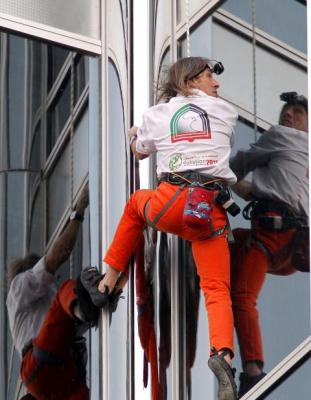
Alain Robert, known as the "French Spider-Man," praised Alex Honnold as exceptionally well-prepared after the US climber completed a free solo ascent of Taipei 101 yesterday. Robert said Honnold's ascent of the 508m-tall skyscraper in just more than one-and-a-half hours without using safety ropes or equipment was a remarkable achievement. "This is my life," he said in an interview conducted in French, adding that he liked the feeling of being "on the edge of danger." The 63-year-old Frenchman climbed Taipei 101 using ropes in December 2004, taking about four hours to reach the top. On a one-to-10 scale of difficulty, Robert said Taipei 101

Nipah virus infection is to be officially listed as a category 5 notifiable infectious disease in Taiwan in March, while clinical treatment guidelines are being formulated, the Centers for Disease Control (CDC) said yesterday. With Nipah infections being reported in other countries and considering its relatively high fatality rate, the centers on Jan. 16 announced that it would be listed as a notifiable infectious disease to bolster the nation’s systematic early warning system and increase public awareness, the CDC said. Bangladesh reported four fatal cases last year in separate districts, with three linked to raw date palm sap consumption, CDC Epidemic Intelligence
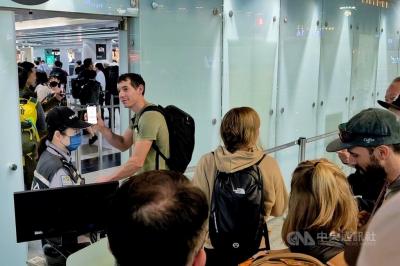
US climber Alex Honnold left Taiwan this morning a day after completing a free-solo ascent of Taipei 101, a feat that drew cheers from onlookers and gained widespread international attention. Honnold yesterday scaled the 101-story skyscraper without a rope or safety harness. The climb — the highest urban free-solo ascent ever attempted — took just more than 90 minutes and was streamed live on Netflix. It was covered by major international news outlets including CNN, the New York Times, the Guardian and the Wall Street Journal. As Honnold prepared to leave Taiwan today, he attracted a crowd when he and his wife, Sanni,

Taiwanese and US defense groups are collaborating to introduce deployable, semi-autonomous manufacturing systems for drones and components in a boost to the nation’s supply chain resilience. Taiwan’s G-Tech Optroelectronics Corp subsidiary GTOC and the US’ Aerkomm Inc on Friday announced an agreement with fellow US-based Firestorm Lab to adopt the latter’s xCell, a technology featuring 3D printers fitted in 6.1m container units. The systems enable aerial platforms and parts to be produced in high volumes from dispersed nodes capable of rapid redeployment, to minimize the risk of enemy strikes and to meet field requirements, they said. Firestorm chief technology officer Ian Muceus said


 RSS
RSS