


Taiwan People’s Party (TPP) Chairman Huang Kuo-chang (黃國昌) yesterday denied that his in-laws had funded a publicity company, which has been accused of surveilling political opponents.
Huang said that he has filed two lawsuits against Mirror Media and its reporters, saying that it had published false reports about him and Kai Ssu International, which has been accused of unlawfully following and photographing politicians and government officials.
Chinese-language media have reported that Kai Ssu’s financial backers include former Chinese Nationalist Party (KMT) legislator Chen Chien-ping (陳建平) and Huang An-chieh (黃安捷), the owner of a technology firm, as well as Heng Ho Construction Co, a firm owned by Huang Kuo-chang’s father-in-law, Kao Hsi-chih (高熙治).
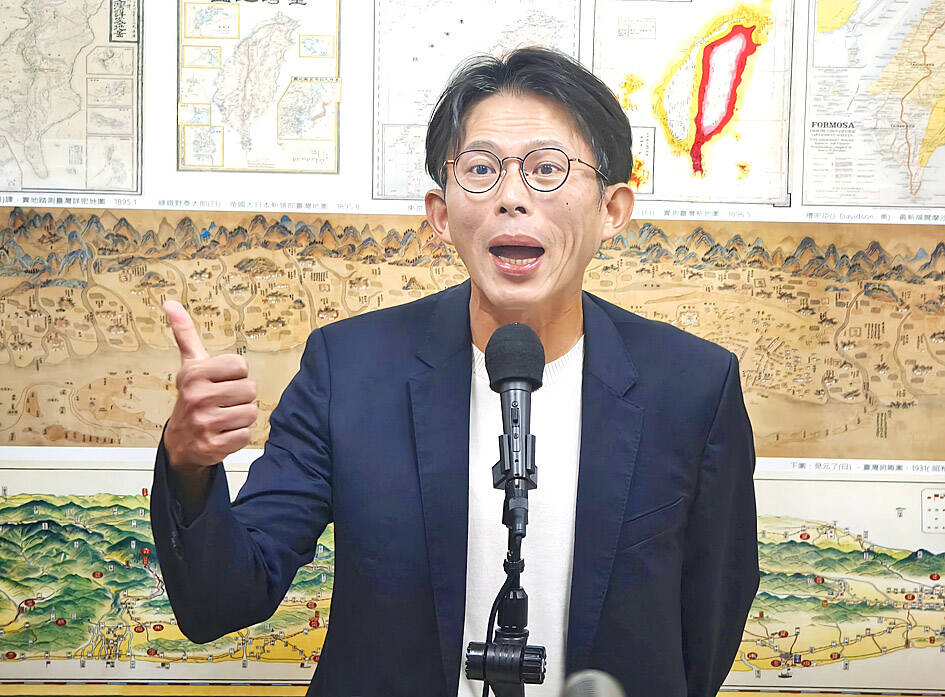
Photo: Wang Yi-song, Taipei Times
Huang Kuo-chang did not elaborate on the details of his lawsuits, saying only that Mirror Media was attempting to smear his reputation.
Chen and Accton Technology founder Huang An-chieh in 2021 each gave about NT$10 million (US$325,404) to Kai Ssu, Mirror Media reported.
Kuan Chih-yu (關智宇), the general manager of True Number Survey Research, a polling firm affiliated with the TPP, “invested” about NT$1 million in Kai Ssu, while another financial backer was Huang Kuo-chang’s sister-in-law Kao Hui (高翬), who is an executive at Heng Ho Construction, Mirror Media reported, citing people familiar with the matter.
Funding for two surveillance teams to follow targets around the clock would cost at least NT$80 million per year, it reported, citing experts and media insiders.
Democratic Progressive Party (DPP) Legislator Wang Yi-chuan (王義川), who was allegedly tracked and photographed by a surveillance team, earlier this month filed a judicial complaint against Huang Kuo-chang and asked prosecutors to determine whether such activity contravened the National Security Act (國家安全法) or the Personal Data Protection Act (個人資料保護法).
Since then, other politicians and media figures also sought investigations after more photos, allegedly taken by surveillance teams, surfaced of National Security Council personnel affiliated with the Presidential Office, police officials, top officials in the Control Yuan and the Examination Yuan, DPP lawmakers, ministers and other top government officials.
Meanwhile, people who purchased residential units built by Heng Ho Construction told reporters that they had financial disputes with the firm.
The buyers alleged that building codes had been contravened by the construction company, including over the use of inferior or flammable material, as well as structures blocking fire escapes, reports said.
The buyers refused to move in, prompting Heng Ho Construction to threaten to retain a NT$4 million deposit, leading to litigation, reports said.

A magnitude 6.1 earthquake struck off the coast of Yilan County at 8:39pm tonight, the Central Weather Administration (CWA) said, with no immediate reports of damage or injuries. The epicenter was 38.7km east-northeast of Yilan County Hall at a focal depth of 98.3km, the CWA’s Seismological Center said. The quake’s maximum intensity, which gauges the actual physical effect of a seismic event, was a level 4 on Taiwan’s 7-tier intensity scale, the center said. That intensity level was recorded in Yilan County’s Nanao Township (南澳), Hsinchu County’s Guansi Township (關西), Nantou County’s Hehuanshan (合歡山) and Hualien County’s Yanliao (鹽寮). An intensity of 3 was

Instead of focusing solely on the threat of a full-scale military invasion, the US and its allies must prepare for a potential Chinese “quarantine” of Taiwan enforced through customs inspections, Stanford University Hoover fellow Eyck Freymann said in a Foreign Affairs article published on Wednesday. China could use various “gray zone” tactics in “reconfiguring the regional and ultimately the global economic order without a war,” said Freymann, who is also a nonresident research fellow at the US Naval War College. China might seize control of Taiwan’s links to the outside world by requiring all flights and ships entering or leaving Taiwan
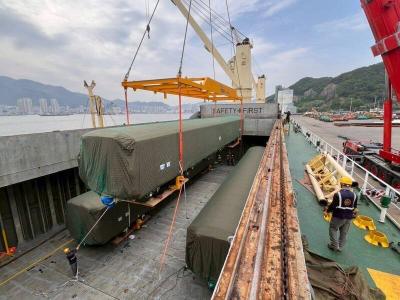
The first of 10 new high-capacity trains purchased from South Korea’s Hyundai Rotem arrived at the Port of Taipei yesterday to meet the demands of an expanding metro network, Taipei Rapid Transit Corp (TRTC) said yesterday. The train completed a three-day, 1,200km voyage from the Port of Masan in South Korea, the company said. Costing NT$590 million (US$18.79 million) each, the new six-carriage trains feature a redesigned interior based on "human-centric" transportation concepts, TRTC said. The design utilizes continuous longitudinal seating to widen the aisles and optimize passenger flow, while also upgrading passenger information displays and driving control systems for a more comfortable
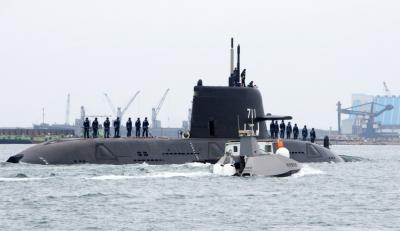
Taiwan's first indigenous defense submarine, the SS-711 Hai Kun (海鯤, or Narwhal), departed for its 13th sea trial at 7am today, marking its seventh submerged test, with delivery to the navy scheduled for July. The outing also marked its first sea deployment since President William Lai (賴清德) boarded the submarine for an inspection on March 19, drawing a crowd of military enthusiasts who gathered to show support. The submarine this morning departed port accompanied by CSBC Corp’s Endeavor Manta (奮進魔鬼魚號) uncrewed surface vessel and a navy M109 assault boat. Amid public interest in key milestones such as torpedo-launching operations and overnight submerged trials,


 RSS
RSS