


The Ministry of the Interior today said it would tighten fitness exemptions for military service by raising the body mass index (BMI) upper limit, reclassifying flat-footed people for alternative service and limiting exemptions to those with serious organ diseases.
The ministry reported to the Legislative Yuan’s Internal Administration Committee today on the compulsory military service and revised fitness standards.
The ministry said it is to revise conscription fitness standards after controversy over celebrities falsifying medical records to avoid compulsory service.

Photo: Taipei Times
The BMI upper threshold for exemption would be raised from 35 to 45, making it nearly impossible to avoid conscription by gaining weight, Department of Conscription Administration Director Shen Che-fang (沈哲芳) said.
Blood pressure would be a top priority, with exemptions only granted if measurements indicate heart or organ disease, Shen said, adding that future blood pressure checks would require hospitalization for proper evaluation.
Asked how the ministry would handle those found to have illegally avoided conscription, Shen said that those under 36 would be required to complete their service.
Officials are still discussing requiring those 37 or older to make up their service, as some legislators have suggested, he said.
Speaking to reporters after the meeting, Shen said that new fitness standards are largely finalized.
Anyone with a BMI from 15 to 45 would be required to serve, although the ministry still needs to consult further with medical associations, he said.
In addition, while people with a foot arch under 168 degrees were previously exempt from service, as they are not suitable for active duty, they would now be conscripted for alternative service, he said.
All 193 regulations regarding fitness standards are being reviewed, he added.
Under current fitness standards, men of conscription age are assigned to active duty, alternative service or are exempted based on their medical examination results.
Those with a BMI over 35 or under 15 may be exempted.
With the revised regulations raising the BMI threshold to over 45, for a height of 170cm, the previous weight exemption of more than 101.3kg would be increased to 130.05kg.


Kenting National Park service technician Yang Jien-fon (楊政峰) won a silver award in World Grand Prix Photography Awards Spring Season for his photograph of two male rat snakes intertwined in combat. Yang’s colleagues at Kenting National Park said he is a master of nature photography who has been held back by his job in civil service. The awards accept entries in all four seasons across six categories: architectural and urban photography, black-and-white and fine art photography, commercial and fashion photography, documentary and people photography, nature and experimental photography, and mobile photography. Awards are ranked according to scores and divided into platinum, gold and

More than half of the bamboo vipers captured in Tainan in the past few years were found in the city’s Sinhua District (新化), while other districts had smaller catches or none at all. Every year, Tainan captures about 6,000 snakes which have made their way into people’s homes. Of the six major venomous snakes in Taiwan, the cobra, the many-banded krait, the brown-spotted pit viper and the bamboo viper are the most frequently captured. The high concentration of bamboo vipers captured in Sinhua District is puzzling. Tainan Agriculture Bureau Forestry and Nature Conservation Division head Chu Chien-ming (朱健明) earlier this week said that the
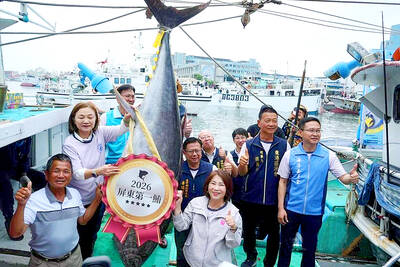
The first bluefin tuna of the season, brought to shore in Pingtung County and weighing 190kg, was yesterday auctioned for NT$10,600 (US$333.5) per kilogram, setting a record high for the local market. The auction was held at the fish market in Donggang Fishing Harbor, where the Siaoliouciou Island-registered fishing vessel Fu Yu Ching No. 2 delivered the “Pingtung First Tuna” it had caught for bidding. Bidding was intense, and the tuna was ultimately jointly purchased by a local restaurant and a local company for NT$10,600 per kilogram — NT$300 ,more than last year — for a total of NT$2.014 million. The 67-year-old skipper

BREACH OF CONTRACT: The bus operators would seek compensation and have demanded that the manufacturer replace the chips with ones that meet regulations Two bus operators found to be using buses with China-made chips are to demand that the original manufacturers replace the systems and provide compensation for breach of contract, the Veterans Affairs Council said yesterday. Democratic Progressive Party Legislator Michelle Lin (林楚茵) yesterday said that Da Nan Bus Co and Shin-Shin Bus Co Ltd have fielded a total of 82 buses that are using Chinese chips. The bus models were made by Tron-E, while the systems provider was CYE Electronics, Lin said. Lin alleged that the buses were using chips manufactured by Huawei subsidiary HiSilicon Co, which presents a national security risk if the


 RSS
RSS