


Taiwan would be a great member of a regional trade bloc that Australia is part of, given its track record as a “trusted economic partner,” a visiting Australian lawmaker said yesterday.
In contrast, China, which also seeks to join the Comprehensive and Progressive Agreement for Trans-Pacific Partnership (CPTPP), had quite a "difficult trading relationship" with Australia over the past years, said Richard Colbeck, a senator for Tasmania representing the Liberal Party.
"And to be frank, that should be considered as a part of our consideration of their membership" into the CPTPP, he said during an interview in Taipei.

Photo: CNA
Colbeck made the remarks when asked to comment on Taiwan's goal of joining the CPTPP, one of the biggest trade blocs in the world, representing around 15 percent of the global economy.
It currently has 12 members — Australia, Brunei, Canada, Chile, Japan, Malaysia, Mexico, New Zealand, Peru, Singapore, Vietnam and the UK.
Australia chairs the CPTPP next year.
China applied to join the CPTPP on Sept. 16, 2021, about a week before Taiwan applied to join on Sept. 22 that same year.
Beijing has opposed Taiwan's accession to the CPTPP.
This has led Taiwanese officials to worry that a successful bid by China could sink Taiwan’s hopes of joining the bloc.
Commenting on Taiwan and China's applications to join the CPTPP, Colbeck, who is visiting Taiwan together with three other Australian lawmakers, said he believes Taiwan "would be a great member of that trade partnership."
"It's a country that is a trusted economic partner. It's our seventh-largest. And it's a country that doesn't make unilateral decisions impacting trade that we already have, as we've experienced from some other jurisdictions of late," he said, referring to China.
He said that even though China is Australia's largest trading partner, both countries have had quite a "difficult trading relationship" over the past four to five years because China had made some "unilateral decisions with respect to the trade of Australian products."
The difficult trading experience with Beijing, which has "unjustifiably limited trade of some of our products into China," needs to be taken into account with respect to China's application to join the CPTPP, he said.
Such unilateral decisions by Beijing left a "bad taste in the mouth of Australians," Colbeck said.
Another member of the Australian delegation, Steven Georganas, said that the Australian Joint Standing Committee on Foreign Affairs, Defense and Trade has expressed its support toward Taiwan's application to join the CPTPP, while also advocating for a free-trade agreement between Taipei and Canberra as early as 2022.
Georganas said that allowing Taiwan to join the CPTPP does not change the current Taiwan Strait "status quo."
"So there's nothing to really fear from having a participant [to the CPTPP]. It only enhances the economy for everyone, not just for Australia and Taiwan, but for everyone," he said.
Colbeck and Georganas are joined by Darren Chester, a member of the Australian House of Representatives, and James McGrath, a senator for Queensland.
The delegation is visiting Taiwan from Saturday to tomorrow.
During their stay, the delegation is scheduled to meet with Vice President Hsiao Bi-khim (蕭美琴), Deputy Legislative Speaker Johnny Chiang (江啓臣), Minister of Foreign Affairs Lin Chia-lung (林佳龍), and hold discussions with government agencies with the aim of expanding bilateral exchanges on all fronts, the Ministry of Foreign Affairs said.

A magnitude 6.1 earthquake struck off the coast of Yilan County at 8:39pm tonight, the Central Weather Administration (CWA) said, with no immediate reports of damage or injuries. The epicenter was 38.7km east-northeast of Yilan County Hall at a focal depth of 98.3km, the CWA’s Seismological Center said. The quake’s maximum intensity, which gauges the actual physical effect of a seismic event, was a level 4 on Taiwan’s 7-tier intensity scale, the center said. That intensity level was recorded in Yilan County’s Nanao Township (南澳), Hsinchu County’s Guansi Township (關西), Nantou County’s Hehuanshan (合歡山) and Hualien County’s Yanliao (鹽寮). An intensity of 3 was

Instead of focusing solely on the threat of a full-scale military invasion, the US and its allies must prepare for a potential Chinese “quarantine” of Taiwan enforced through customs inspections, Stanford University Hoover fellow Eyck Freymann said in a Foreign Affairs article published on Wednesday. China could use various “gray zone” tactics in “reconfiguring the regional and ultimately the global economic order without a war,” said Freymann, who is also a nonresident research fellow at the US Naval War College. China might seize control of Taiwan’s links to the outside world by requiring all flights and ships entering or leaving Taiwan
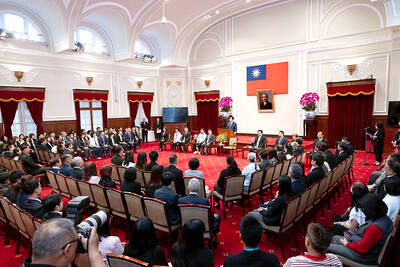
The next minimum wage hike is expected to exceed NT$30,000, President William Lai (賴清德) said yesterday during an award ceremony honoring “model workers,” including migrant workers, at the Presidential Office ahead of Workers’ Day today. Lai said he wished to thank the awardees on behalf of the nation and extend his most sincere respect for their hard work, on which Taiwan’s prosperity has been built. Lai specifically thanked 10 migrant workers selected for the award, saying that although they left their home countries to further their own goals, their efforts have benefited Taiwan as well. The nation’s industrial sector and small businesses lay
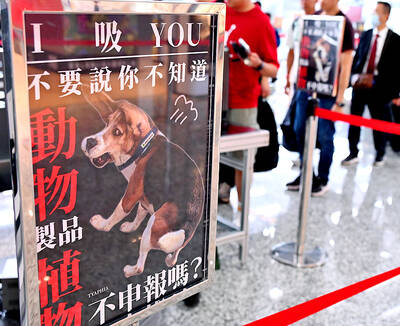
Quarantine awareness posters at Taiwan Taoyuan International Airport have gone viral for their use of wordplay. Issued by the airport branch of the Animal and Plant Health Inspection Agency, the posters feature sniffer dogs making a range of facial expressions, paired with advisory messages built around homophones. “We update the messages for holidays and campaign needs, periodically refreshing materials to attract people’s attention,” quarantine officials said. “The aim is to use the dogs’ appeal to draw focus to quarantine regulations.” A Japanese traveler visiting Taiwan has posted a photo on X of a poster showing a quarantine dog with a


 RSS
RSS