


The Legislative Yuan yesterday passed the Pingpu Indigenous People’s Identity Act (平埔原住民族群身分法), which stated the definition of what a Pingpu indigenous person is and the standards of eligibility, and put them under the jurisdiction of the Council of Indigenous Peoples.
The standard definition of the indigenous Pingpu people is that the term includes all indigenous peoples who speak an Austronesian language and are not defined as per the groups listed under Article 4 of the Indigenous People’s Act (原住民身份法), the bill says.
In the same article, it further states that the indigenous people whose languages, customs and culture are still extant and who still maintain their identity, and can cite subjective historical documents that can back up such identity, customs, languages and culture, can place an application with the Council of Indigenous Peoples.
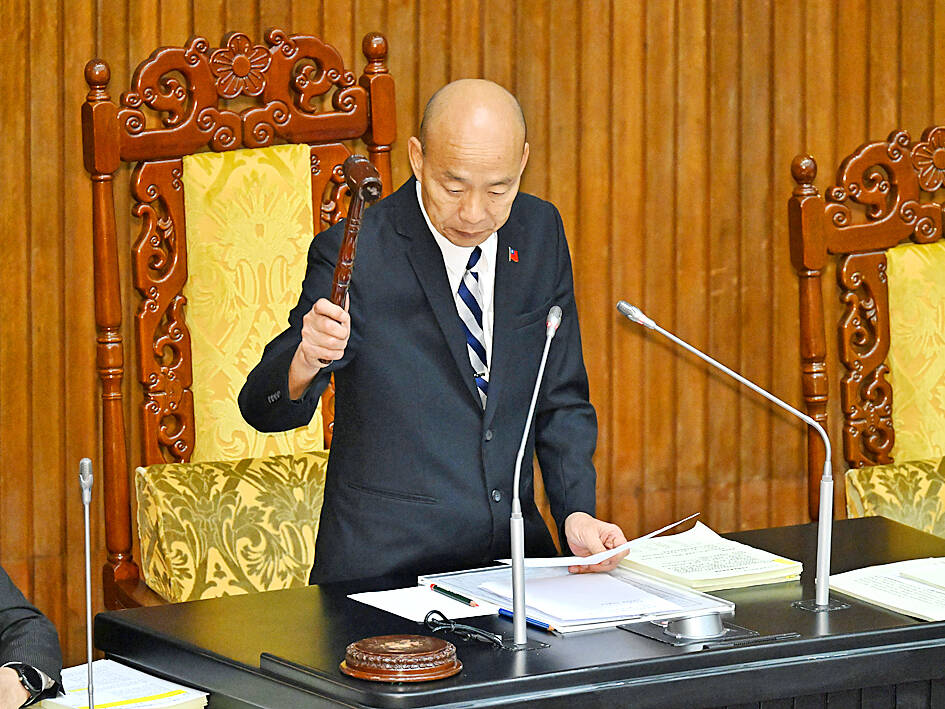
Photo: Chen Yi-kuan, Taipei Times
The review panel would include experts and academics and should comprise 11 to 23 people, and the number of panel members of any gender should not be fewer than one-third of the total number of committee members, the act says.
The mission, organization, operations, selection of panel members, their terms of service and the circumstances requiring committee members to recuse themselves should all be defined by the Council of Indigenous Peoples, it says.
Should an application be approved, the government is obligated to publish official notices outlining the criteria for recognition for that application for five years and, if necessary and after consulting with the people, extend the official notice period by another five years.
If, during this period, the people feel the need to issue, either collectively or individually, a documented application for additional certification processes, the Council of Indigenous Peoples should accept such petitions.
As of yesterday, nine Pingpu groups — the Siraya, the Taivoan, the Makatao, the Taukat, the Kaxabu, the Pazeh, the Papora, the Papulu and the Ketagalan — had already filed applications, the council said.
There are 620,000 lowland and highland indigenous people, and there are potentially 980,000 Pingpu indigenous people, according to council statistics.
The council said that preparations for relevant ancillary acts and cross-jurisdictional administrative processes have been completed and the government would attempt to expedite the ratification of applications and register people under their new ethnic identities.
The Siraya people filed an administrative lawsuit seeking rectification of their Siraya identity in 2010, and received a favorable ruling from the Constitutional Court in 2022.
The court ruled that the legal definition of “indigenous,” which excludes other classifications such as the Siraya, fails to uphold paragraphs 11 and 12 of Article 10 of the Additional Articles of the Constitution of the Republic of China (中華民國憲法增修條文).


UPGRADE: The Kang Ding-class frigate is replacing its Chaparall missiles with Tien Chien II and Hua Yang VLS, which would provide it with long-range, 360° air defense Taiwan plans to produce 1,200 to 1,376 Hai Chien II missiles (海劍二, Sea Sword II) — also known as TC-2N — to serve as the standard air defense system of the navy’s surface combatant fleet, a source said yesterday. Last week, the Hai Chien II, the naval version of the Tien Kung II missile (天劍二, Sky Sword II), completed a live-fire test in waters off the National Chungshan Institute of Science and Technology’s Jiupeng facility (九鵬) in Pingtung County’s Manjhou Township (滿州). The MIM72 Chaparral and other dated air defense missiles that currently arm Taiwanese ships have inadequate range to combat Chinese

REASONS FOR TRAVEL: An assistant professor said that proposed amendments to penalize drivers if they used drugs overseas would not deter people from traveling People who operate a motor vehicle under the influence of marijuana would have their driver’s license revoked, even if they used the substance while overseas, the Ministry of Transportation and Communications said yesterday, citing proposed amendments to the Road Traffic Management and Penalty Act (道路交通管理處罰條例). The amendments would also authorize the government to revoke the licenses of people determined to have used Category 1 or Category 2 narcotics, even if they were not operating a vehicle while under the influence of drugs, as well as ban them from taking the license test for three years, the ministry said. People aged 18 or

Johanne Liou (劉喬安), a Taiwanese woman who shot to unwanted fame during the Sunflower movement protests in 2014, returned to Taiwan last night after being deported from the US. She is to stand trial in Taiwan for charges involving embezzlement, fraud and drug crimes. The Criminal Investigation Bureau (CIB) said it took her into custody at Taiwan Taoyuan International Airport and would first question her before transferring her to the New Taipei District Prosecutors’ Office. She was arrested upon disembarking a flight from San Francisco that landed shortly before 7pm. Liou absconded to the US in 2019 after jumping bail
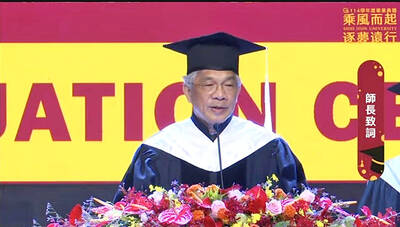
Shih Hsin University President Chen Ching-he (陳清河) yesterday issued a public apology for comments made in his commencement speech last week, stating that he has asked the school to suspend his duties and halt his wages for two months as a show of contrition. At the commencement ceremony on May 30, Chen said, “If you don’t manage your time well, or your own emotions, or your health, then I am telling every one of you — put a quick end to ‘you,’ because the world has no need for ‘you.’” The comments have sparked significant controversy online, and Chen through an open


 RSS
RSS