


South Korean economist Yoon Heo on Thursday advised against using “logical persuasion” in ongoing tariff negotiations with the administration of US President Donald Trump, saying that emotional appeals — particularly those invoking his “Make America Great Again” (MAGA) slogan — would be a more effective strategy.
Speaking at a seminar in Taipei hosted by the Chung-Hua Institution for Economic Research, Heo, a professor of international trade at Sogang University, shared insights from South Korea’s ongoing trade negotiations with the Trump administration.
Heo, a chief trade and economic security adviser for South Korea, said Seoul employed a tactic to rebrand and repackage its past, present and future investment plans in the US, emphasizing that the US was already the top destination for South Korean outbound investment in 2023.
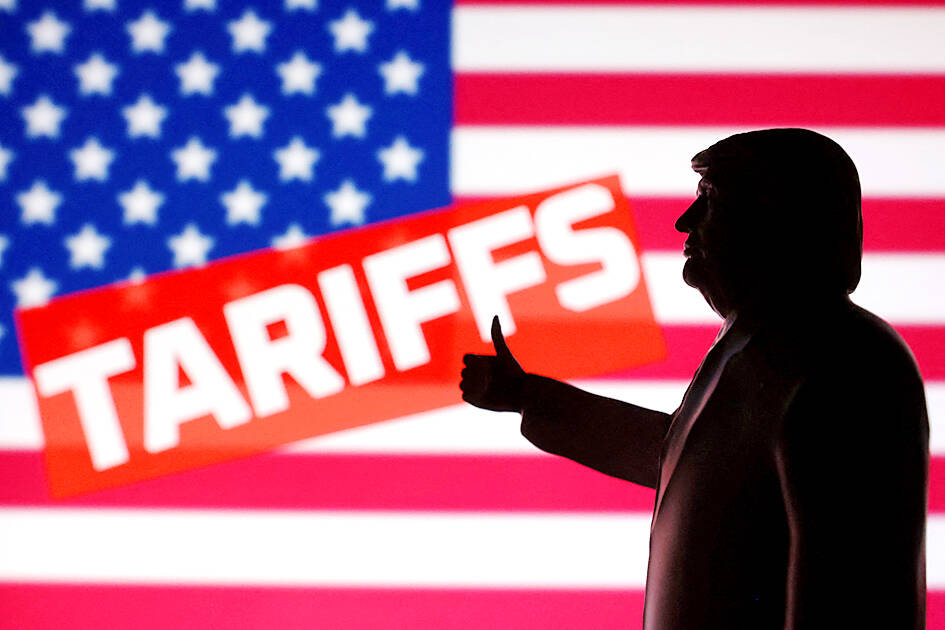
Photo: Reuters
During the negotiations, the South Korean delegation introduced a proposal called “Make American Shipbuilding Great Again,” aimed at revitalizing US shipbuilding, Heo said, adding that Trump reportedly responded very positively to the proposal.
The plan involved building shipyards, training shipbuilders and repairing US Navy vessels — measures that would help the US counter China’s rapidly expanding naval capabilities, Reuters reported.
Heo said that logical persuasion “would not have worked” with Trump.
Before a South Korean delegation met with the US president, US Secretary of Commerce Howard Lutnick reportedly warned them not to mention the US-Korea Free Trade Agreement, as South Korea’s large trade surplus would only anger Trump.
Heo suggested that Taiwan’s negotiators could adopt a similar approach.
“You say: ‘We want to contribute to your MAGA project. We want to contribute to rebuilding the United States, but we need you to help us persuade our domestic constituents,’” he said.
Former representative to the EU and Belgium Roy Lee (李淳) said: “We are negotiating with a friend, not an enemy — and that’s even more difficult.”
Lee said the US is not just any friend, but a “super big friend” that is probably Taiwan’s only security provider — a fact that Washington has repeatedly emphasized during the ongoing tariff talks.
He added that the US is also an essential partner in Taiwan’s supply chains, technology development and talent training.
Therefore, Taiwan has little choice but to agree to “most of Washington’s demands,” while seeking ways to make up for any perceived harm caused to the US, Lee said.
“The key is really how you communicate and create consensus within Taiwan,” he said.
Noting that South Korea put almost its entire domestic market on the table in its negotiations for a free-trade agreement with the US 15 years ago, Lee asked: “Is Taiwan ready to do that?”
“We want to have free trade, but we don’t want to open up... We can’t have it both ways,” he said.

FUKUOKA SITUATION: Japanese media reported that the pathogen is expected to be identified by the summer, while the CDC downplayed the idea that it was hMPV A “mysterious cold-like illness” reported in Japan’s Fukuoka Prefecture does not seem to be a new disease, but Japanese authorities have been asked about the situation, the Centers for Disease Control (CDC) said yesterday. The Fukuoka Prefectural Medical Association on Wednesday told a news conference that a “mystery cold” that has become a hot topic on social media is “highly likely to be caused by some kind of viral infection,” Japan’s KBC News reported. “Many people are experiencing symptoms starting with a sore throat, followed by a runny nose, phlegm and a severe cough,” KBC News reported, citing association officials. Health authorities are

Nvidia Corp CEO Jensen Huang (黃仁勳) arrived in Taiwan yesterday ahead of upcoming AI and technology events, saying he plans to meet with clients and Taiwan Semiconductor Manufacturing Co Chairman C.C. Wei (魏哲家) during his visit. After landing at Taipei Songshan Airport, Huang posed for photos with fans and handed out Yakult drinks to reporters and supporters waiting at the scene, saying he has “a lot to do” during the trip. Asked about reports that Nvidia’s planned headquarters site in Taipei’s Beitou Shilin Technology Park could break ground on May 27, Huang said that if the company holds an event, he would

The Ministry of Finance this afternoon announced the winning numbers for the March-April uniform invoice lottery. The winning number for the NT$10 million (US$318,060) special prize is 19531471, and the winning number for the NT$2 million grand prize is 85941329. Three numbers were drawn for the NT$200,000 first prize: 07225810, 20231230 and 83518781. Those with receipts matching the last seven digits of any of the first-prize numbers will win the NT$40,000 second prize, while those matching the last six digits will win the NT$10,000 third prize. Those whose receipts match the last five digits of the first-prize numbers can claim the NT$4,000 fourth prize,

SIX SUBSIDIES: The monthly allowance for older farmers is to increase to NT$10,000, and NT$5,000 is to be given to homemakers under the national pension system, Lai said The government is to implement major welfare policies for disadvantaged groups, including raising the monthly allowance for older farmers to NT$10,000 and providing homemakers with NT$5,000 per month, President William Lai (賴清德) said yesterday. Lai made the remarks during a visit to Wangling Temple in Chiayi County, saying that the planned increases were being introduced amid economic growth and an increase in tax revenue. Touting a policy, in which the government plans to provide a monthly allowance of NT$5,000 for every child under the age of 18 in a bid to address Taiwan’s low birthrate, Lai said that if received for the


 RSS
RSS