


Local authorities closed off the section of Provincial Highway No. 8 between the entrance to Taroko National Park and Tianxiang (天祥) in Hualien County at 1:30pm today and evacuated 800 people, citing concerns that a roadside barrier lake could overflow or collapse as early as 6pm.
The dam and lake are located near the 175.5km mark of the Central Cross-Island Highway, known as Provincial Highway No. 8, outside Jin Heng Tunnel (靳珩隧道), the Highway Bureau's Eastern Region Branch Office said.
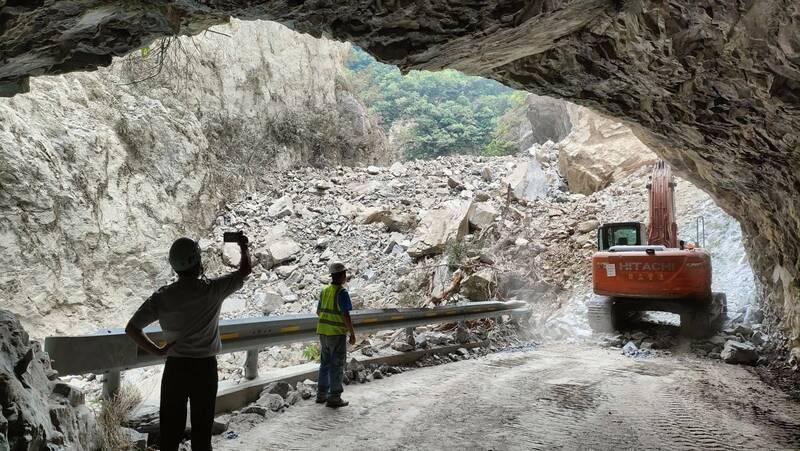
Photo courtesy of the Taroko National Park Administration
The location is about 950m away from Swallow Grotto Trail (燕子口步道), the office said.
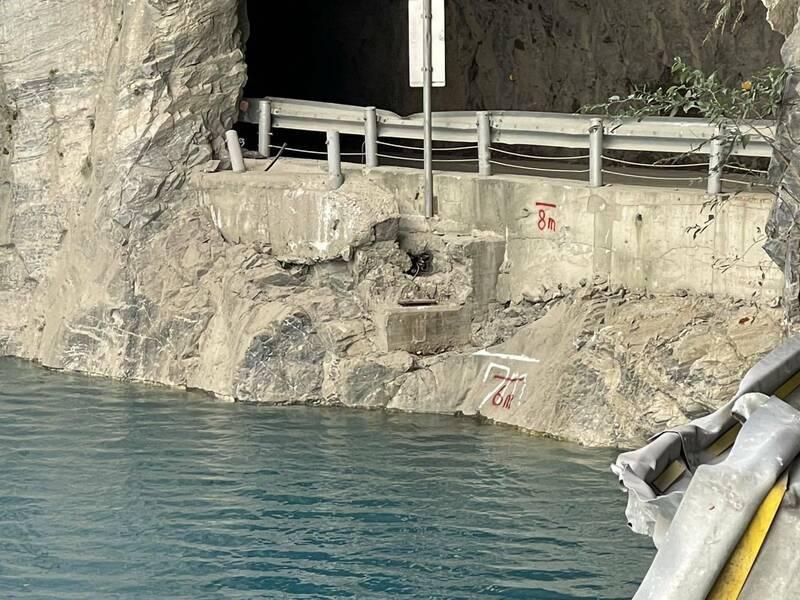
Photo courtesy of the Highway Bureau
Construction workers discovered the barrier lake at about noon today, and preliminary measurements showed that the top of the dam was higher than the road surface at the west entrance of the tunnel, the office said.
The water level in the lake has been rising at a rate of about 1m per hour and is currently about 10m below the road surface, it said.
It is estimated that if the water continues to rise, it could eventually overflow onto the road, prompting the road closure and evacuation, the office said.
The lake is about 100m long, 30m to 40m wide and about 25m deep, said Chen Pao-kuang (陳寶匡), who heads the Buluowan Station of the Taroko National Park Administration.
The water could overflow onto the road as early as 5pm, Chen said.
Huang Chun-tse (黃群策), director-general of the Forestry and Nature Conservation Agency's Hualien Office, said that the Highway Bureau sent an excavator to the site to remove the accumulated debris, but officials are concerned that the work may not keep pace with the rising water level.
The nearest village, Fushih (富世) in Sioulin Township (秀林), is not expected to be affected, while a downstream power plant has been told to shut its water intake, and residents have been warned to stay away from the riverbed, he added.

The Ministry of Finance this afternoon announced the winning numbers for the March-April uniform invoice lottery. The winning number for the NT$10 million (US$318,060) special prize is 19531471, and the winning number for the NT$2 million grand prize is 85941329. Three numbers were drawn for the NT$200,000 first prize: 07225810, 20231230 and 83518781. Those with receipts matching the last seven digits of any of the first-prize numbers will win the NT$40,000 second prize, while those matching the last six digits will win the NT$10,000 third prize. Those whose receipts match the last five digits of the first-prize numbers can claim the NT$4,000 fourth prize,

SIX SUBSIDIES: The monthly allowance for older farmers is to increase to NT$10,000, and NT$5,000 is to be given to homemakers under the national pension system, Lai said The government is to implement major welfare policies for disadvantaged groups, including raising the monthly allowance for older farmers to NT$10,000 and providing homemakers with NT$5,000 per month, President William Lai (賴清德) said yesterday. Lai made the remarks during a visit to Wangling Temple in Chiayi County, saying that the planned increases were being introduced amid economic growth and an increase in tax revenue. Touting a policy, in which the government plans to provide a monthly allowance of NT$5,000 for every child under the age of 18 in a bid to address Taiwan’s low birthrate, Lai said that if received for the
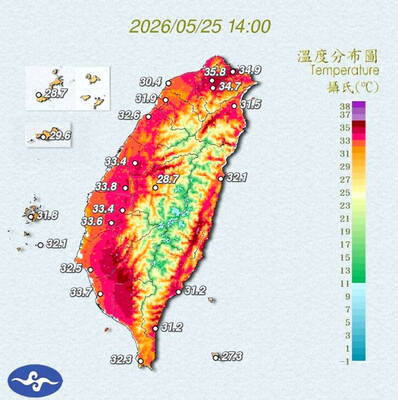
STAY COOL: The HPA recommended that people stay hydrated, use air-conditioning or fans while indoors, wear loose-fitting clothes and walk in the shade while outdoors Employers must implement measures such as installing cooling equipment, and providing drinking water and rest breaks for outdoor workers starting from Monday next week, the Taipei Department of Labor said on Sunday. Employers who fail to comply could face fines of NT$30,000 to NT$300,000 under the Occupational Safety and Health Act (職業安全衛生法), the department said. Businesses in Taipei employing fewer than 100 workers, as well as registered self-employed workers with labor insurance coverage, could receive on-site assessments and guidance from occupational safety consultants to help them apply for central government subsidies to implement or improve heat-protection measures, it said. Under the Ministry of
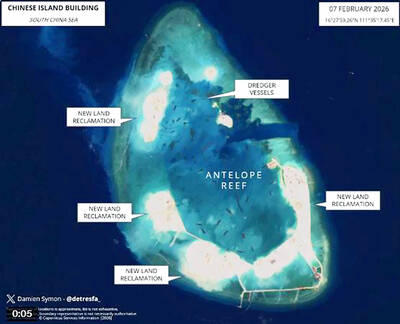
ISOLATION: The outposts would serve as support and backup bases, forcing US forces to either face China head-on or reroute, increasing travel time and operational costs China’s outposts in the South China Sea could be used to delay and constrain foreign forces during a conflict in the Taiwan Strait, giving Beijing a critical window to carry out amphibious landing and blockade operations, a report said. The Chinese Communist Party’s (CCP) forward operating bases on islands and reclaimed features in the South China Sea could delay foreign forces long enough for the Chinese People’s Liberation Army (PLA) to secure a key 48-to-72-hour window in the Taiwan Strait, a report commissioned by the Mainland Affairs Council found. The report, conducted by the Institute for National Defense and Security Research, examined


 RSS
RSS