


The Ministry of Environment (MOENV) yesterday unveiled the plaque for its new Department of Environmental Information Technology, with the goal of stepping up artificial intelligence (AI) applications in environmental governance.
The department was redesigned from the Department of Monitoring and Information — which had been operating for 38 years — to focus resources on developing data governance and AI applications, Minister of Environment Peng Chi-ming (彭啟明) said at the ceremony.
Also known as the “AI department,” its setup is expected to offer the ministry’s information technology personnel a more fulfilling career path, thereby bolstering talent retention, he said.
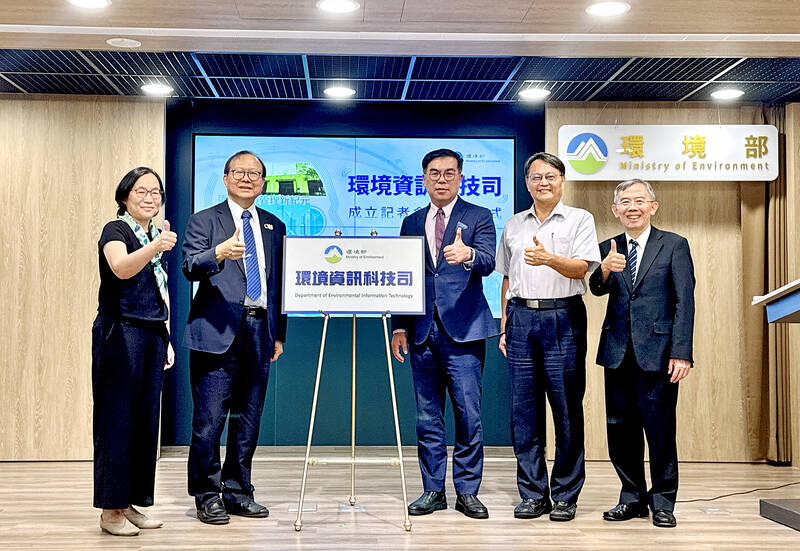
Photo: Huang Yi-ching, Taipei Times
The ministry has been using AI extensively to detect and investigate environmental crimes, including number-plate recognition, as well as to summarize environmental impact assessment (EIA) review meetings, Peng said.
With further development in the future, an AI-powered query system would also be employed to help the public understand lengthy EIA reports and allow developers to compare their EIA reports with qualified counterparts prior to submitting their reports to the EIA committee for review, he said.
That would help spot missing information in EIA documents and simplify communication processes, he added.
The ministry has digitally compiled about 15,000 environmental project achievement reports, which would be incorporated into the national environmental database, Department of Environmental Information Technology Director Chang Shun-chin (張順欽) said.
The department is to introduce more AI techniques to enhance the ministry’s public services, including a generative AI system that is expected to provide 24-hour service, he said.
In other news, the Taiwan Innotech Expo commenced yesterday and is to run through tomorrow at the World Trade Center in Taipei.
Launched in 2005, the expo this year has invited 10 global vendors based in the US, Japan, Germany and other countries to showcase their advanced techniques in smart technology and circular economy, said Lee Hung-hsi (李紅曦), director of agricultural science and technology at the Ministry of Agriculture.
The Sustainability Pavilion was co-organized by the agriculture ministry, the MOENV, the National Development Council, and the ministries of national defense, labor and digital affairs, to showcase 97 recently developed techniques, with the goal of promoting their commercialization, she said.
The pavilion features applications of AI in agricultural management and environmental protection..
For example, the Livestock Research Institute developed a manure-cleaning robot tailored to local barn layouts with replaceable brush modules, offering a more cost-effective solution to purchasing imported robots.
Aireco Co developed an AI-powered smart recycling system based on more than 5 million images of local recycled waste, which can process up to 30,000 tonnes of waste annually and could reduce manual labor by 70 percent.
The system can recognize more than 30 recyclable items ranging from plastics, iron and aluminum to paper and paper containers, as well as identify their product brands and whether they have residues at a precision rate of up to 90 percent.
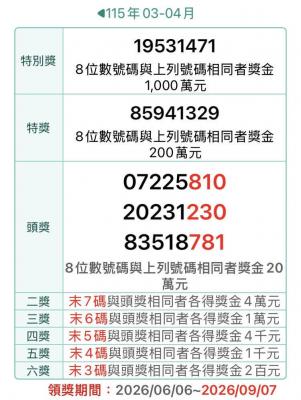
The Ministry of Finance this afternoon announced the winning numbers for the March-April uniform invoice lottery. The winning number for the NT$10 million (US$318,060) special prize is 19531471, and the winning number for the NT$2 million grand prize is 85941329. Three numbers were drawn for the NT$200,000 first prize: 07225810, 20231230 and 83518781. Those with receipts matching the last seven digits of any of the first-prize numbers will win the NT$40,000 second prize, while those matching the last six digits will win the NT$10,000 third prize. Those whose receipts match the last five digits of the first-prize numbers can claim the NT$4,000 fourth prize,

SIX SUBSIDIES: The monthly allowance for older farmers is to increase to NT$10,000, and NT$5,000 is to be given to homemakers under the national pension system, Lai said The government is to implement major welfare policies for disadvantaged groups, including raising the monthly allowance for older farmers to NT$10,000 and providing homemakers with NT$5,000 per month, President William Lai (賴清德) said yesterday. Lai made the remarks during a visit to Wangling Temple in Chiayi County, saying that the planned increases were being introduced amid economic growth and an increase in tax revenue. Touting a policy, in which the government plans to provide a monthly allowance of NT$5,000 for every child under the age of 18 in a bid to address Taiwan’s low birthrate, Lai said that if received for the
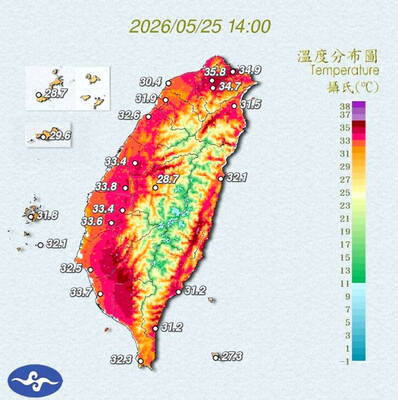
STAY COOL: The HPA recommended that people stay hydrated, use air-conditioning or fans while indoors, wear loose-fitting clothes and walk in the shade while outdoors Employers must implement measures such as installing cooling equipment, and providing drinking water and rest breaks for outdoor workers starting from Monday next week, the Taipei Department of Labor said on Sunday. Employers who fail to comply could face fines of NT$30,000 to NT$300,000 under the Occupational Safety and Health Act (職業安全衛生法), the department said. Businesses in Taipei employing fewer than 100 workers, as well as registered self-employed workers with labor insurance coverage, could receive on-site assessments and guidance from occupational safety consultants to help them apply for central government subsidies to implement or improve heat-protection measures, it said. Under the Ministry of
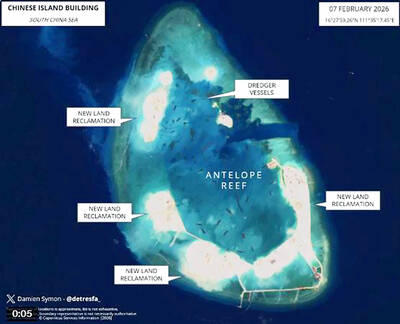
ISOLATION: The outposts would serve as support and backup bases, forcing US forces to either face China head-on or reroute, increasing travel time and operational costs China’s outposts in the South China Sea could be used to delay and constrain foreign forces during a conflict in the Taiwan Strait, giving Beijing a critical window to carry out amphibious landing and blockade operations, a report said. The Chinese Communist Party’s (CCP) forward operating bases on islands and reclaimed features in the South China Sea could delay foreign forces long enough for the Chinese People’s Liberation Army (PLA) to secure a key 48-to-72-hour window in the Taiwan Strait, a report commissioned by the Mainland Affairs Council found. The report, conducted by the Institute for National Defense and Security Research, examined


 RSS
RSS