


The US is bolstering deployment across the Asia-Pacific region, particularly in countries along the Pacific island chains, in response to China’s expanding “gray zone” activities in the region, Minister of Foreign Affairs Lin Chia-lung (林佳龍) said yesterday.
Lin made the comment in response to a Wall Street Journal report regarding the Pentagon’s military investment in Guam to protect Taiwan.
Added US presence in the region would also protect other nations in the first island chain, not only Taiwan, he said, adding that Taiwan would take measures and continue to work with like-minded countries to ensure regional peace and stability.
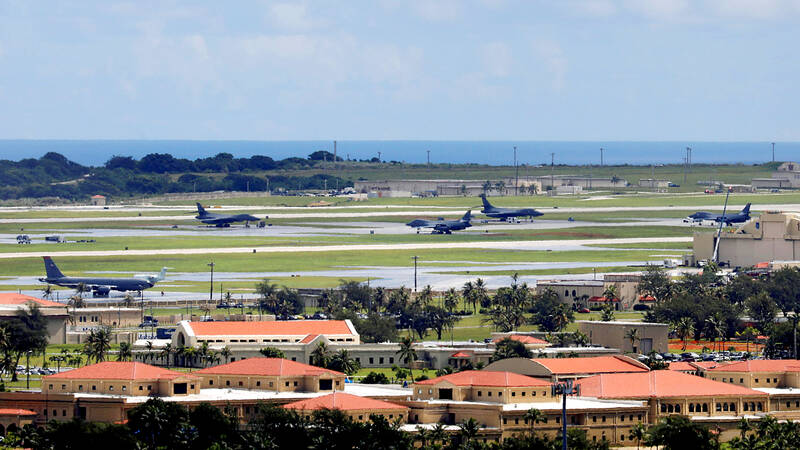
Photo: Reuters
The Wall Street Journal on Wednesday published an article titled “Fortifying America’s Pacific Front Line Is Getting Expensive and Difficult,” where it detailed the US’ multibillion dollar investment to “strengthen Guam’s role as an anchor of US military strategy,” the goal of which is “to deter China’s increasingly powerful military from using force to take over Taiwan.”
Developments on Guam include the new Camp Blaz marine base, a navy maintenance facility for submarines and upgrades to Anderson Air Force Base, from which the US could send long-range bombers into a Taiwan conflict, it said.
The US plans to increase troops on Guam by 10,000 by 2037, bringing the total number to about 34,000, the article said, with US$6.2 billion to be spent from 2019 to 2028 to establish “force-posture projects.”
As China’s missile capabilities have rapidly improved over the past few years, the US has reinforced its military capabilities on Guam, which is closer to Beijing than Hawaii, it said.
However, there is still debate about the strategic value and cost-effectiveness of that investment, it added.
The project is costly and logistically difficult, and might not bring the desired security advantages, as Guam is more than 2,400km from Taiwan and the South China Sea, it said, adding that the US must also contend with China’s “Guam killer,” an upgraded version of the DF-26 missile.
However, as a US territory, Guam allows US forces to forgo foreign approval, it said.
Moreover, China has set the second island chain territory as a key target, the report said, citing Chinese hackers infiltrating multiple networks on Guam and Chinese People’s Liberation Army military activity moving beyond the first island chain and into the second.
“Some people feel that Guam is critical, because of its location and that we need to make sure that we can operate from Guam effectively,” former US defense official Zack Cooper said. “Others believe that Guam is impossible to defend at an acceptable cost and that we should focus more on diversification.”
Marine Corps Commandant General Eric Smith in January said that with the US partially withdrawing forces from Okinawa, Japan, moving operations to Guam “puts us going the wrong way,” adding that the US still needs a deterrent force in the first island chain.
US Indo-Pacific Command Commander Admiral Samuel Paparo last month said that Guam anchors the US’ ability to defend, to project power, sustain alliances and partnerships, and deter aggression, while US Navy Rear Admiral Brett Mietus said: “Guam is just more developed than the other islands, so it makes sense to do the bulk of our investment here.”
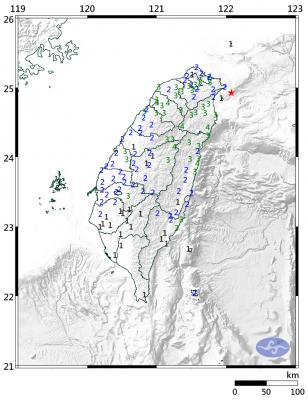
A magnitude 6.1 earthquake struck off the coast of Yilan County at 8:39pm tonight, the Central Weather Administration (CWA) said, with no immediate reports of damage or injuries. The epicenter was 38.7km east-northeast of Yilan County Hall at a focal depth of 98.3km, the CWA’s Seismological Center said. The quake’s maximum intensity, which gauges the actual physical effect of a seismic event, was a level 4 on Taiwan’s 7-tier intensity scale, the center said. That intensity level was recorded in Yilan County’s Nanao Township (南澳), Hsinchu County’s Guansi Township (關西), Nantou County’s Hehuanshan (合歡山) and Hualien County’s Yanliao (鹽寮). An intensity of 3 was
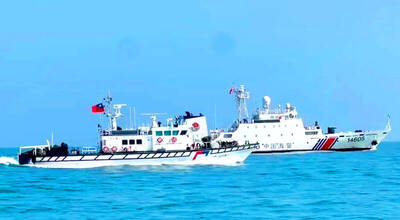
Instead of focusing solely on the threat of a full-scale military invasion, the US and its allies must prepare for a potential Chinese “quarantine” of Taiwan enforced through customs inspections, Stanford University Hoover fellow Eyck Freymann said in a Foreign Affairs article published on Wednesday. China could use various “gray zone” tactics in “reconfiguring the regional and ultimately the global economic order without a war,” said Freymann, who is also a nonresident research fellow at the US Naval War College. China might seize control of Taiwan’s links to the outside world by requiring all flights and ships entering or leaving Taiwan
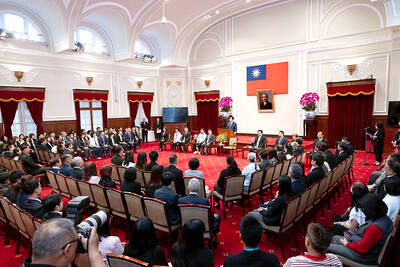
The next minimum wage hike is expected to exceed NT$30,000, President William Lai (賴清德) said yesterday during an award ceremony honoring “model workers,” including migrant workers, at the Presidential Office ahead of Workers’ Day today. Lai said he wished to thank the awardees on behalf of the nation and extend his most sincere respect for their hard work, on which Taiwan’s prosperity has been built. Lai specifically thanked 10 migrant workers selected for the award, saying that although they left their home countries to further their own goals, their efforts have benefited Taiwan as well. The nation’s industrial sector and small businesses lay
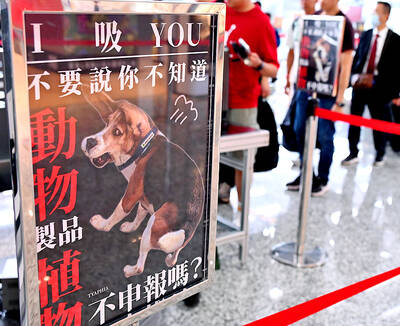
Quarantine awareness posters at Taiwan Taoyuan International Airport have gone viral for their use of wordplay. Issued by the airport branch of the Animal and Plant Health Inspection Agency, the posters feature sniffer dogs making a range of facial expressions, paired with advisory messages built around homophones. “We update the messages for holidays and campaign needs, periodically refreshing materials to attract people’s attention,” quarantine officials said. “The aim is to use the dogs’ appeal to draw focus to quarantine regulations.” A Japanese traveler visiting Taiwan has posted a photo on X of a poster showing a quarantine dog with a


 RSS
RSS