


The newly established shrimp and algae germplasm bank is comparable to a “Noah’s Ark for aquatic products” and expected to help reduce reliance on foreign supply of shrimp larvae, the Fisheries Research Institute said on Thursday last week.
The institute has already set up other germplasm banks for different aquatic life to promote the sustainable development of the nation’s aquaculture industry.
For example, the Penghu Marine Biology Research Center’s aquatic germplasm bank focuses on conserving aquatic genetic resources in the unique habitat of the marine environment of Penghu, the institute said.

Photo: CNA
The Freshwater Aquaculture Research Center’s aquatic germplasm bank focuses on genetic improvement, selection and breeding of tilapia — an important fish species export — and is the only germplasm bank dedicated to preserving freshwater genetic resources, it said.
The Eastern Marine Biological Research Center’s aquatic germplasm bank uses deep seawater unique to Taiwan’s east coast to cultivate low-temperature marine species with high economic value, such as grouper and clownfish, the institute said.
Compared with these germplasm banks, the shrimp and algae germplasm bank newly established at the Tungkang Aquaculture Research Center in Pingtung County’s Donggang Township (東港) focuses on biosecurity, and preserves up to eight shrimp species and 20 algae species, it said.
It is also dedicated to shrimp improvement and breeding, and is expected to produce shrimp larvae cultivated in specific pathogen-free environments, which would help meet the local agriculture industry’s demand for high-quality shrimp germplasms, the institute said, adding that would enhance the industry’s international competitiveness.
Tungkang Aquaculture Research Center director Wu Feng-cheng (吳豐成) said the shrimp and algae germplasm bank could prevent the domestic supply of various shrimp species from being cut off due to unstable imports.
The selection of germplasms would consider their tolerance to temperatures and salinity to minimize the influence of climate change, he said.
The cultivation has borne fruit and the first batch of whiteleg shrimp larvae would be released at about the beginning of next year for the industry to farm, he added.
Pingtung County Fisheries Youth Fellowship member Chan Yung-sheng (詹永聖) said that the local shrimp industry has long relied on larvae imports, which are priced 10-fold to 15-fold more than those cultivated locally.
However, with stricter biosecurity measures applied, imported shrimp larvae carry no viruses and grow faster, significantly reducing the risks related to the farming process, Chan said.
Therefore, the shrimp and algae germplasm bank is expected to help reduce costs and risks by improving local shrimp genetic resources, he said.
The institute said the first floor of the bank is designed to preserve germplasms of critical commercial shrimp species such as whiteleg shrimp, grass shrimp and giant river shrimp.
Microalgae species are preserved on the bank’s second floor, it said.
Such microalgae are indispensable, as they can be directly fed to shrimp larvae or to shrimp larvae’s feed organisms such as brine shrimps or rotifers, it said.
Additional reporting by CNA
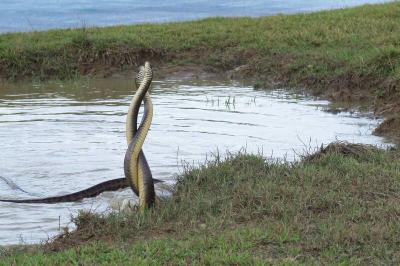
Kenting National Park service technician Yang Jien-fon (楊政峰) won a silver award in World Grand Prix Photography Awards Spring Season for his photograph of two male rat snakes intertwined in combat. Yang’s colleagues at Kenting National Park said he is a master of nature photography who has been held back by his job in civil service. The awards accept entries in all four seasons across six categories: architectural and urban photography, black-and-white and fine art photography, commercial and fashion photography, documentary and people photography, nature and experimental photography, and mobile photography. Awards are ranked according to scores and divided into platinum, gold and
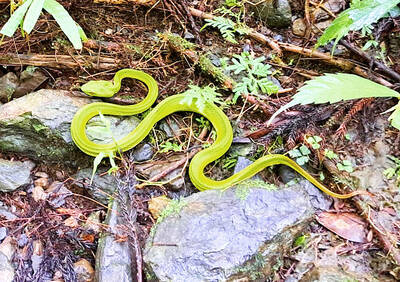
More than half of the bamboo vipers captured in Tainan in the past few years were found in the city’s Sinhua District (新化), while other districts had smaller catches or none at all. Every year, Tainan captures about 6,000 snakes which have made their way into people’s homes. Of the six major venomous snakes in Taiwan, the cobra, the many-banded krait, the brown-spotted pit viper and the bamboo viper are the most frequently captured. The high concentration of bamboo vipers captured in Sinhua District is puzzling. Tainan Agriculture Bureau Forestry and Nature Conservation Division head Chu Chien-ming (朱健明) earlier this week said that the
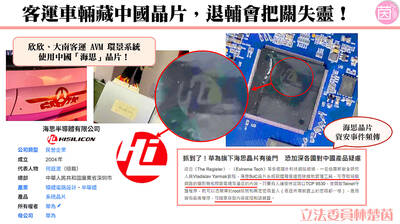
BREACH OF CONTRACT: The bus operators would seek compensation and have demanded that the manufacturer replace the chips with ones that meet regulations Two bus operators found to be using buses with China-made chips are to demand that the original manufacturers replace the systems and provide compensation for breach of contract, the Veterans Affairs Council said yesterday. Democratic Progressive Party Legislator Michelle Lin (林楚茵) yesterday said that Da Nan Bus Co and Shin-Shin Bus Co Ltd have fielded a total of 82 buses that are using Chinese chips. The bus models were made by Tron-E, while the systems provider was CYE Electronics, Lin said. Lin alleged that the buses were using chips manufactured by Huawei subsidiary HiSilicon Co, which presents a national security risk if the

The National Immigration Agency has banned two Chinese from returning to Taiwan, after they published social media content it described as disrespectful to national sovereignty. The agency imposed a two-month ban on a Chinese man surnamed Liang (梁) and a permanent ban on a woman surnamed Yang (楊), an influencer with 23 million followers, in October last year and last week respectively. Minister of the Interior Liu Shyh-fang (劉世芳) yesterday said on the sidelines of a legislative meeting that Chinese visitors to Taiwan are required to comply with the rules and regulations governing their entry permits. The government has handled the ban and


 RSS
RSS