


The political views of most of the Taiwanese students who took part in Beijing-sponsored journalism and media-related exchange activities remained mostly unchanged, a Mainland Affairs Council (MAC) study published on Sept. 24 showed.
China in the past few years has presented events for young reporters, content creators and influencers in a bid to sway the national identity and political views of Taiwanese, the abstract of the MAC-funded research said.
The study was conducted using data collected last year, it said.
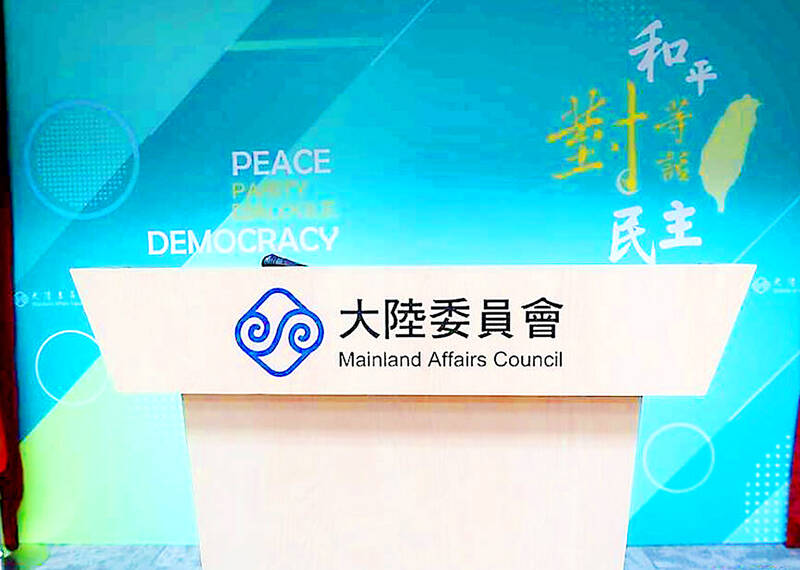
Photo: Chung Li-hua, Taipei Times
The events failed to change the Taiwanese national identity of the participants and might have backfired by giving young Taiwanese first-hand experience of Chinese political censorship and repressive practices, it said.
Most Taiwanese students attended exchange events hosted by the Chinese government for personal reasons, the study said.
A desire to learn, networking, career opportunities, interest in events promoted as part of the courses, low attendance fees and peer influence were the most commonly reported motivations for attending, it said.
Respondents who went to China for internships or student exchange programs usually did so as part of a plan to achieve specific objectives, while those who attended short-term events focused on exploring and finding new experiences, the study showed.
The responses showed that participants were mostly self-interested and focused on gaining tangible benefits from the activities, it said.
The most common types of activities hosted by China were short-term study programs, internships and competition or exhibition-type events apparently designed to cater to the academic and career needs of Taiwanese students, it said.
However, “Taiwanese” was the most common self-reported national identity among those who took part in China-sponsored events, the study showed.
Moreover, respondents said that personal experience was more important than the activities they attended in shaping their political views, it said.
Taiwanese attending exchange programs and activities in China reported gaining more knowledge about China, not all of which was positive, the study said.
Beijing’s political censorship, repression of Hong Kong’s democracy movement, heavy-handed responses to the COVID-19 pandemic and a massive unemployment rate among young people in China were among the insights young Taiwanese visitors to China gained, it said.
The factors have led to a decline in the attraction of Chinese government-sponsored exchange events among Taiwanese, it said.
Aspiring journalists, content creators and influencers who attended the events knew that Chinese minders were following them, that their content created at the events was subject to politically motivated censorship and that they had to censor themselves, it said.
The study’s authors recommended that the government educate Taiwanese students in media literacy and Internet safety to reduce the susceptibility of young people to Beijing-directed cognitive warfare, as well as mitigating the risk of leaking sensitive personal data.
The MAC should establish a social media-based community or Web site to provide safety tips for young people seeking work in China to protect them from being exploited by malicious groups, it said.


UPGRADE: The Kang Ding-class frigate is replacing its Chaparall missiles with Tien Chien II and Hua Yang VLS, which would provide it with long-range, 360° air defense Taiwan plans to produce 1,200 to 1,376 Hai Chien II missiles (海劍二, Sea Sword II) — also known as TC-2N — to serve as the standard air defense system of the navy’s surface combatant fleet, a source said yesterday. Last week, the Hai Chien II, the naval version of the Tien Kung II missile (天劍二, Sky Sword II), completed a live-fire test in waters off the National Chungshan Institute of Science and Technology’s Jiupeng facility (九鵬) in Pingtung County’s Manjhou Township (滿州). The MIM72 Chaparral and other dated air defense missiles that currently arm Taiwanese ships have inadequate range to combat Chinese

REASONS FOR TRAVEL: An assistant professor said that proposed amendments to penalize drivers if they used drugs overseas would not deter people from traveling People who operate a motor vehicle under the influence of marijuana would have their driver’s license revoked, even if they used the substance while overseas, the Ministry of Transportation and Communications said yesterday, citing proposed amendments to the Road Traffic Management and Penalty Act (道路交通管理處罰條例). The amendments would also authorize the government to revoke the licenses of people determined to have used Category 1 or Category 2 narcotics, even if they were not operating a vehicle while under the influence of drugs, as well as ban them from taking the license test for three years, the ministry said. People aged 18 or
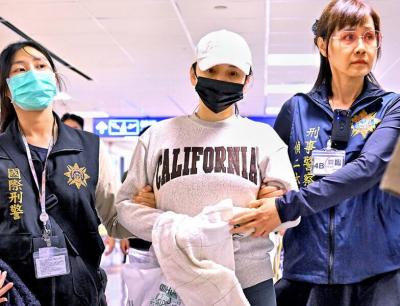
Johanne Liou (劉喬安), a Taiwanese woman who shot to unwanted fame during the Sunflower movement protests in 2014, returned to Taiwan last night after being deported from the US. She is to stand trial in Taiwan for charges involving embezzlement, fraud and drug crimes. The Criminal Investigation Bureau (CIB) said it took her into custody at Taiwan Taoyuan International Airport and would first question her before transferring her to the New Taipei District Prosecutors’ Office. She was arrested upon disembarking a flight from San Francisco that landed shortly before 7pm. Liou absconded to the US in 2019 after jumping bail
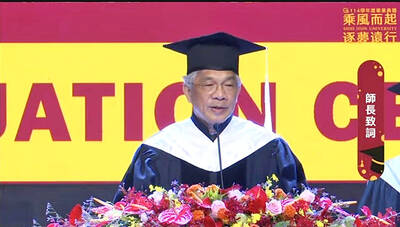
Shih Hsin University President Chen Ching-he (陳清河) yesterday issued a public apology for comments made in his commencement speech last week, stating that he has asked the school to suspend his duties and halt his wages for two months as a show of contrition. At the commencement ceremony on May 30, Chen said, “If you don’t manage your time well, or your own emotions, or your health, then I am telling every one of you — put a quick end to ‘you,’ because the world has no need for ‘you.’” The comments have sparked significant controversy online, and Chen through an open


 RSS
RSS