


Greenpeace yesterday urged the government to incorporate stricter regulation of fishery activities into marine protected area planning to help revive endangered coral reefs around Taiwan.
The nonprofit environmental group also called for listing Pingtung County’s Siaoliouciou Island (小琉球), South Penghu Marine National Park and Taitung County’s Sansiantai (三仙台) as marine sanctuaries based on the Marine Conservation Act (海洋保育法).
Efforts by the Fisheries Agency, the Tourism Administration and the Ocean Conservation Administration should be integrated in cooperation with local authorities to minimize disruptive activities for marine conservation, it said.
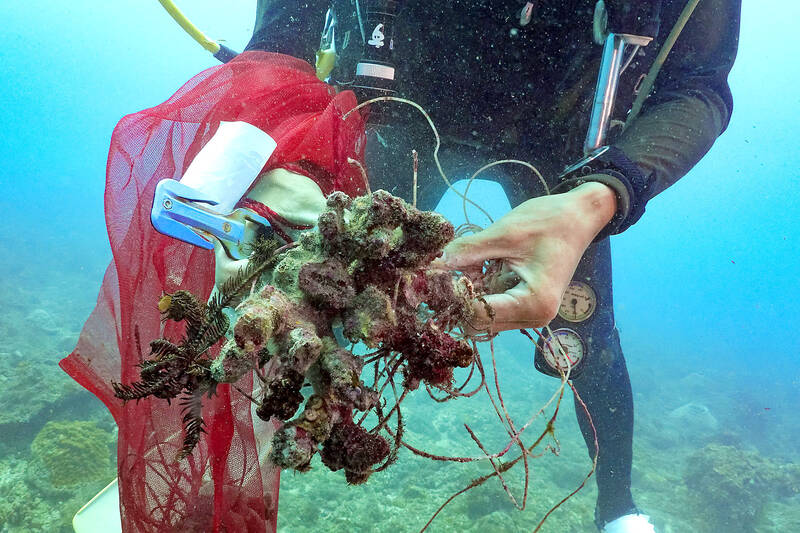
Photo courtesy of Greenpeace via CNA
Greenpeace East Asia Ocean Campaign spokesman Yves Chiu (邱聰榮) said the UN High Seas Treaty is to come into force after it was ratified by 60 countries last month.
That means the goal of protecting at least 30 percent of the ocean globally by 2030 has become imperative, he said.
Greenpeace conducted underwater investigations and monitoring across 20 dive sites within the marine national park, Liouciou Aquatic Propagation and Conservation Zone, and Sansiantai Recreation Area (三仙台風景特定區) from July to August, Chiu said.
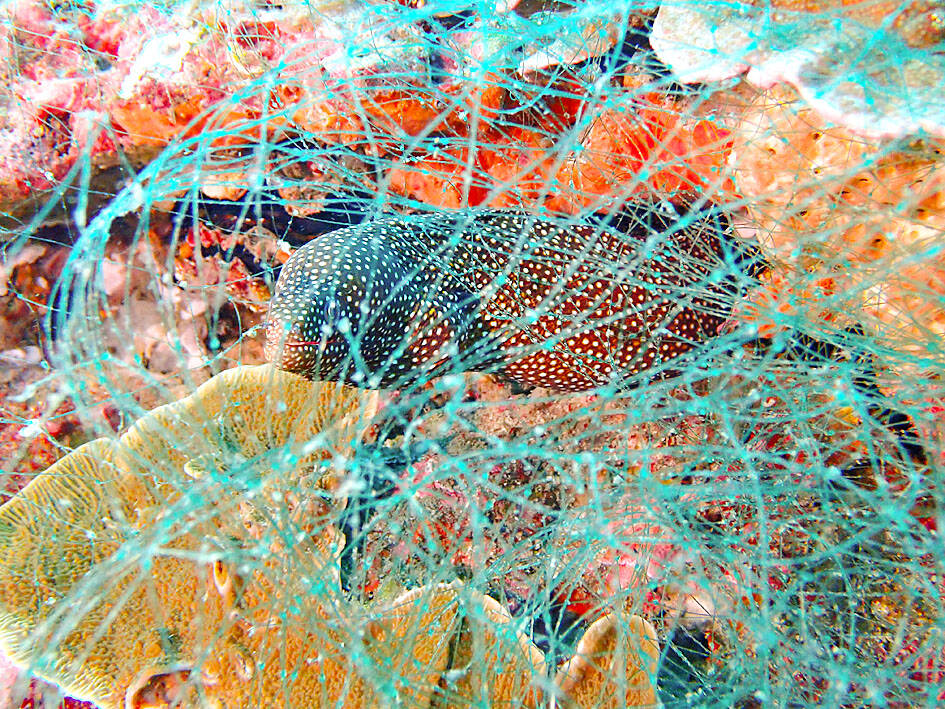
Photo courtesy of Greenpeace via CNA
The monitoring footage showed many coral reefs around Siaoliouciou Island and the marine national park covered with algae, resulting in coral bleaching, he said.
The investigations also found that coral reefs entangled with waste fishing gear were common in the three marine areas, Chiu said.
Greenpeace cross-analyzed data from automatic identification systems and data from underwater monitoring of coral reefs collected at the three areas to explore the link between fishery activities and coral reef ecosystems, he said.
The results showed that coral decline was correlated with fishery activities and exacerbated by increased fishing vessel traffic, Chiu said.
Siaoliouciou Island and the marine national park have been listed as marine protected areas, but they have much heavier fishing vessel traffic and more severe coral decline than Sansiantai, which has yet to be listed as a marine protected area, he said.
An understaffed patrol force also raised concern over insufficient enforcement, he added.
National Taitung University life science assistant professor Twan Wen-hung (段文宏), who is also managing supervisor at the Taiwan Coral Reef Society, said that overfishing is one of the most pervasive threats to coral reefs around the world.
For example, herbivorous fish, such as parrotfish, can help boost coral growth and recovery by inhibiting algae proliferation, he said, adding that overfishing would reduce the overall resilience of coral reef ecosystems.
Such fishing has therefore been banned in Hawaii and follow-up research showed that the conduct did help revive corals, he added.
To prevent established marine protected areas from degenerating into empty shells, the government should incorporate fishery management and education — including protective measures and fishing bans or restrictions for herbivorous fish — and engage in long-term monitoring and cooperation with local communities, Twan said.
Ocean Citizens Foundation executive director Wang Shiau-chan (王曉嬋) said the four islands situated in southern Penghu have been designated as a marine national park, which means the place should serve as a genetic reservoir and be held to the highest conservation standards, she said.
Stricter fishery control should be introduced to ensure surveillance and law enforcement, she said.

NATIONAL SECURITY: Authorities are working to confirm the identities of the military personnel involved and investigating possible illegal conduct and regulatory violations Authorities are probing possible national security implications after Kinmen police and immigration officers on Sunday found a Chinese woman allegedly posing as a tourist while engaging in prostitution involving more than 10 military personnel. The woman, surnamed Chen (陳), has since been deported, authorities said, adding that investigators are still working to confirm the identities of those implicated, as the records only listed code names and aliases. The case stemmed from a report received by the Kinmen District Prosecutors’ Office on Friday last week from the Jinhu Precinct of the Kinmen County Police Bureau. On Sunday, police, along with the National Immigration

GLOBALGIVING: ‘ Caving to external pressure is not acceptable for an organization that has cultivated justice reform and human rights for 30 years,’ one NGO said A slew of non-government organizations (NGOs) have withdrawn from the GlobalGiving fundraising platform after it announced it would use “Chinese Taipei” instead of “Taiwan” from next month. The Taiwan Good Rice Association wrote on Facebook on Friday that it was informed on April 28 via a teleconference call of the change, which was made because the platform wanted to operate in China. Taiwan Good Rice is to terminate all cooperative relationships with GlobalGiving in response to the platform’s “unilateral and non-negotiable” decision to remove references to Taiwan, the NGO said. “Taiwan is in the official name of Taiwan Good Rice Association and the

HEAVY WEATHER: Typhoon Jangmi is due to crash straight into the Ryukyus as airlines look to shift flights to larger aircraft or cancel flights to Okinawa entirely Taiwan’s international air carriers announced flight adjustments over the weekend as Typhoon Jangmi is forecast to hit the Ryukyu Islands today and tomorrow. The Central Weather Administration (CWA) upgraded Jangmi from a tropical storm to a typhoon at 8am yesterday, with the eye located 580km south of Naha city. It was moving north at 19kph. Today, China Airlines’ CI-120, CI-121, CI-122 and CI-123 flights between Taoyuan and Naha, Okinawa, have been canceled as well as CI-132 and CI-133 between Kaohsiung and Naha. EVA Air’s BR-112, BR-113, BR-186 and BR-185 flights between Taoyuan and Naha are also canceled. Low-cost carrier Tigerair Taiwan canceled IT-230,

REASONS FOR TRAVEL: An assistant professor said that proposed amendments to penalize drivers if they used drugs overseas would not deter people from traveling People who operate a motor vehicle under the influence of marijuana would have their driver’s license revoked, even if they used the substance while overseas, the Ministry of Transportation and Communications said yesterday, citing proposed amendments to the Road Traffic Management and Penalty Act (道路交通管理處罰條例). The amendments would also authorize the government to revoke the licenses of people determined to have used Category 1 or Category 2 narcotics, even if they were not operating a vehicle while under the influence of drugs, as well as ban them from taking the license test for three years, the ministry said. People aged 18 or


 RSS
RSS