


Taiwan's manufacturing sector contracted for the fourth consecutive month in August, despite modest improvements in overall conditions, the Taiwan Institute of Economic Research (TIER) said today.
The composite index rose to 9.24 points, up 0.88 from July, supported by stronger technology shipments and orders, a weaker New Taiwan dollar, and easing impacts from US tariffs.
However, traditional industries continued to face weak demand and intense overseas competition, prompting many firms to scale back output or adjust production schedules. As a result, most sectors remained in the blue-light category.
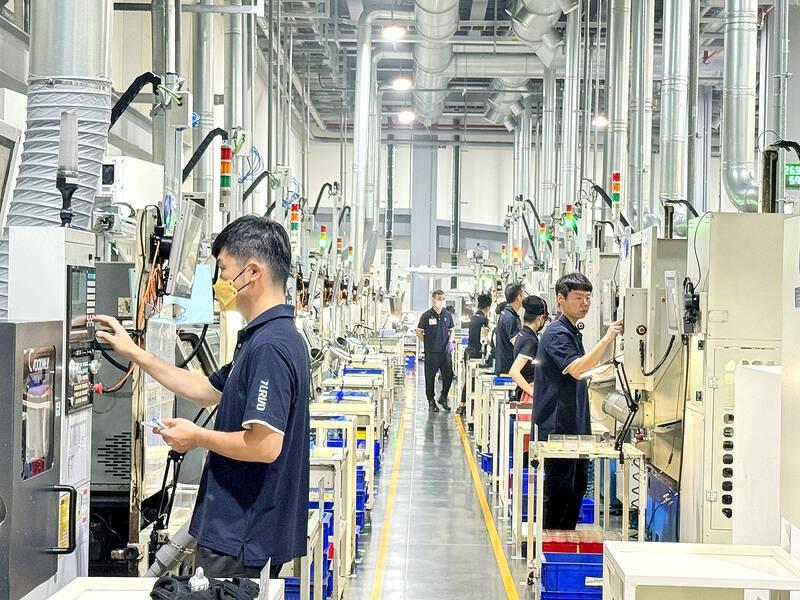
Photo: Amy Yang, Taipei Times
TIER uses a five-color system to gauge economic activity: red for overheating, yellow-red for fast growth, green for stable growth, yellow-blue for sluggish growth and blue for contraction.
By sector, semiconductors benefited from robust demand for artificial intelligence products and restocking of consumer electronics, lifting the industry's from yellow-blue in July to green in August.
In contrast, the machinery sector stayed in the blue zone, as weak US, European and Southeast Asian markets dragged down orders and exports, offsetting gains from semiconductor equipment demand.
More than 60 percent of industries remained in decline, underscoring an uneven recovery across the manufacturing sector.
Looking ahead, TIER said that Taiwan's outlook remains closely tied to developments in the US and China.
In the US, tariff uncertainty is easing, although duties on semiconductors remain unresolved, while the US Federal Reserve has signaled a cooling labor market and lingering inflationary pressure from tariffs.
In China, "anti-involution" measures and market support policies aimed at reducing cutthroat competition could help ease deflation risks, although their effectiveness in boosting consumer confidence and growth remains unclear.
TIER cautioned that global uncertainties continue to pose risks in the second half of this year, urging manufacturers to stay alert to potential challenges.

Considering that most countries issue more than five denominations of banknotes, the central bank has decided to redesign all five denominations, the bank said as it prepares for the first major overhaul of the banknotes in more than 24 years. Central bank Governor Yang Chin-lung (楊金龍) is expected to report to the Legislative Yuan today on the bank’s operations and the redesign’s progress. The bank in a report sent to the legislature ahead of today’s meeting said it had commissioned a survey on the public’s preferences. Survey results showed that NT$100 and NT$1,000 banknotes are the most commonly used, while NT$200 and NT$2,000

The Centers for Disease Control (CDC) yesterday reported the first case of a new COVID-19 subvariant — BA.3.2 — in a 10-year-old Singaporean girl who had a fever upon arrival in Taiwan and tested positive for the disease. The girl left Taiwan on March 20 and the case did not have a direct impact on the local community, it said. The WHO added the BA.3.2 strain to its list of Variants Under Monitoring in December last year, but this was the first imported case of the COVID-19 variant in Taiwan, CDC Deputy Director-General Lin Ming-cheng (林明誠) said. The girl arrived in Taiwan on

South Korea is planning to revise its controversial electronic arrival card, a step Taiwanese officials said prompted them to hold off on planned retaliatory measures, a South Korean media report said yesterday. A Yonhap News Agency report said that the South Korean Ministry of Foreign Affairs is planning to remove the “previous departure place” and “next destination” fields from its e-arrival card system. The plan, reached after interagency consultations, is under review and aims to simplify entry procedures and align the electronic form with the paper version, a South Korean ministry official said. The fields — which appeared only on the electronic form

The Ministry of Foreign Affairs (MOFA) is suspending retaliation measures against South Korea that were set to take effect tomorrow, after Seoul said it is updating its e-arrival system, MOFA said today. The measures were to be a new round of retaliation after Taiwan on March 1 changed South Korea's designation on government-issued alien resident certificates held by South Korean nationals to "South Korea” from the "Republic of Korea," the country’s official name. The move came after months of protests to Seoul over its listing of Taiwan as "China (Taiwan)" in dropdown menus on its new online immigration entry system. MOFA last week


 RSS
RSS