


The Taipei District Court yesterday sentenced four former Democratic Progressive Party (DPP) members for leaking sensitive information, including itineraries of the vice president’s diplomatic visits, to Chinese Central Military Commission intelligence officials.
Former councilor assistant Huang Chu-jung (黃取榮) was sentenced to 10 years in prison, while Ho Jen-chieh (何仁傑), a former assistant to then-minister of foreign affairs Joseph Wu (吳釗燮), received eight years and two months.
Chiu Shih-yuan (邱世元), a former deputy director of the DPP’s Taiwan Foundation for Democracy, received six years and two months, and former Presidential Office consultant Wu Shang-yu (吳尚雨) was handed a four-year sentence.
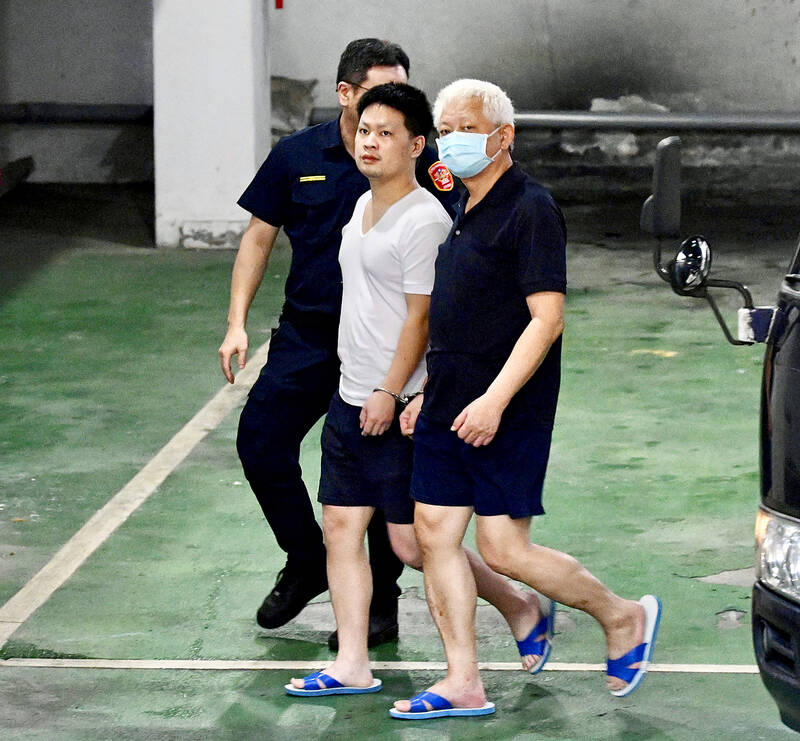
Photo: Lo Pei-de, Taipei Times
All four rulings can be appealed.
The court also fined Huang NT$1 million (US$32,854) and ordered the repayment of NT$4.97 million in criminal proceeds.
Chiu was fined NT$50,000, with NT$2.21 million in proceeds confiscated.
The Taipei District Prosecutors’ Office on June 10 indicted the four for leaking and relaying sensitive information under the Classified National Security Information Protection Act (國家機密保護法).
They were also charged earlier this year with contravening the National Security Act (國家安全法) by providing government secrets to China, and money laundering under the Money Laundering Control Act (洗錢防制法).
The High Prosecutors’ Office also indicted Huang under the National Security Act for his alleged role in establishing extensive espionage networks. That trial is ongoing.
Huang, a former assistant to New Taipei City Councilor Lee Yu-tien (李余典), from 2003 regularly traveled to China to sell tea and study at Jinan University, where he met two intelligence officers from the Chinese Central Military Commission, prosecution documents showed.
He was later recruited as a spy and provided with a work phone with a one-way data transmission app disguised as a game app, prosecutors said.
In 2017, he recruited Chiu, taking him on trips to Bangkok and Macau in 2023 and last year to meet Chinese intelligence officers, they said.
Chiu asked Wu Shang-yu for sensitive information related to then-vice president William Lai’s (賴清德) official visits to Paraguay and his campaign travel schedule, prosecutors said.
In 2022, Huang recruited Ho to provide records of conversations between Joseph Wu and foreign envoys or dignitaries, details of the US-Taiwan Initiative on 21st Century Trade pact and Taiwan’s emergency measures after the severing of diplomatic ties, they said.
Huang compiled the classified information provided by Chiu and Ho, and transmitted it via the app, they said.
Huang received more than NT$6.07 million in payments from the Chinese Communist Party, including NT$900,000 in cash seized in a search of his residence, while Chiu was paid more than NT$2.21 million, prosecutors said.
The two were paid tens of thousands of New Taiwan dollars quarterly, and received holiday bonuses worth tens of thousands of NT dollars, they said.
The payments were funneled through accounts of relatives and friends in China, then laundered back to Taiwan via unregistered remittances, prosecutors said.
Wu Shang-yu and Ho were found not to have obtained any illicit proceeds.
All four were expelled from the DPP in May.
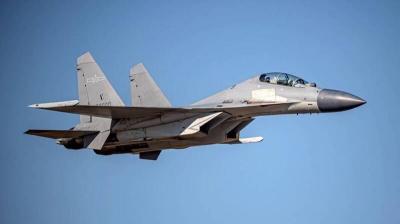
Eight Chinese naval vessels and 24 military aircraft were detected crossing the median line of the Taiwan Strait between 6am yesterday and 6am today, the Ministry of National Defense said this morning. The aircraft entered Taiwan’s northern, central, southwestern and eastern air defense identification zones, the ministry said. The armed forces responded with mission aircraft, naval vessels and shore-based missile systems to closely monitor the situation, it added. Eight naval vessels, one official ship and 36 aircraft sorties were spotted in total, the ministry said.
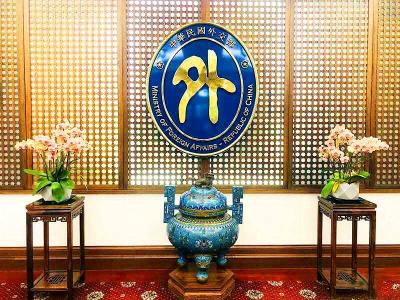
The Ministry of Foreign Affairs (MOFA) today said that if South Korea does not reply appropriately to its request to correct Taiwan’s name on its e-Arrival card system before March 31, it would take corresponding measures to alter how South Korea is labeled on the online Taiwan Arrival Card system. South Korea’s e-Arrival card system lists Taiwan as “China (Taiwan)” in the “point of departure” and “next destination” fields. The ministry said that it changed the nationality for South Koreans on Taiwan’s Alien Resident Certificates from “Korea” to “South Korea” on March 1, in a gesture of goodwill and based on the
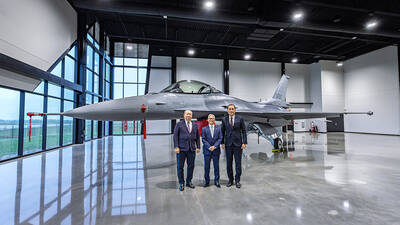
Taiwanese officials were shown the first of 66 F-16V fighter jets purchased by Taiwan from the United States, the Ministry of National Defense said yesterday, adding the aircraft has completed an initial flight test and is expected to be delivered later this year. A delegation led by Deputy Minister of National Defense Hsu Szu-chien (徐斯儉) visited Lockheed Martin’s F-16 C/D Block 70 (also known as F-16V) assembly line in South Carolina on March 16 to view the aircraft. The jet will undergo a final acceptance flight in the US before being delivered to Taiwan, the
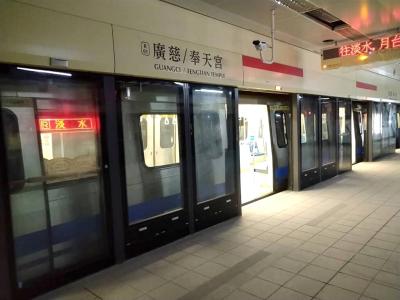
The New Taipei Metro's Sanyin Line and the eastern extension of the Taipei Metro's Tamsui-Xinyi Line (Red Line) are scheduled to begin operations in June, the National Development Council said today. The Red Line, which terminates at Xiangshan Station, would be connected by the 1.4km extension to a new eastern terminal, Guangci/Fengtian Temple Station, while the Sanyin Line would link New Taipei City's Tucheng and Yingge stations via Sanxia District (三峽). The council gave the updates at a council meeting reviewing progress on public construction projects for this year. Taiwan's annual public infrastructure budget would remain at NT$800 billion (US$25.08 billion), with NT$97.3


 RSS
RSS