


Poland has become the biggest buyer of drones from Taiwan as the eastern European country, on Russia’s doorstep, bolsters its defense capabilities and seeks to reduce reliance on Chinese parts.
Poland is now absorbing almost 60 percent of Taiwan’s drone exports, which expanded this year to about US$32 million through last month, from almost nothing in the previous years.
The next-largest importer of Taiwan’s drones is the US, to which Taiwan sold about US$7 million worth in the same period.
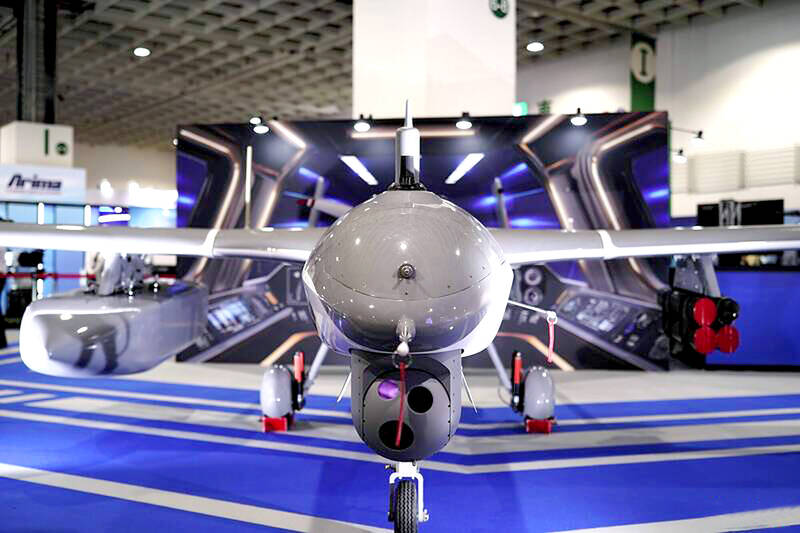
Photo: Chen Chih-cheng, Taipei Times
Taiwanese drone maker Ahamani said Polish demand was so great it was planning to open a factory there, and that other foreign companies, including a large South Korean drone company, had approached it about buying non-Chinese motors.
“In my view, Europe is a very important market in the drone industry, and Poland is a key gateway and base for us,” Ahamani CEO Kung Tzu-chi (龔子琪) said. “With drone companies around the world looking for non-Chinese supply chains, motors and batteries are in short supply.”
Drones have played a key role for Ukraine and its allies since the Russian invasion in 2022, and Russian drones in recent weeks have entered the airspace of several NATO members, including Poland.
As a result, Poland’s drone industry has expanded rapidly and is now looking at foreign markets.
Revenue at the country’s largest drone producer, WB Electronics, more than doubled to almost 3 billion zloty (US$823 million) last year, compared with 343 million zloty in 2021, before the war.
It has proposed a joint production agreement with Ahamani, Kung said.
WB, which relies heavily on army contracts, also sells equipment to Ukraine and has a production facility there.
“For Poland, closer cooperation with Taiwan is very good news,” said Justyna Siekierczak, board member at Polish Chamber of Unmanned Systems. “In the event of any destabilization in our country or growing hybrid threats, we in Poland must be prepared to increase our production capacity.”
The role of drones in Ukraine also prompted Taiwan to accelerate the development of its industry.
Despite a strong industrial base and world-class chipmaking capacity, the sector has struggled with limited orders and a shortage of key components, while larger companies have avoided entering the field because of business interests in China or a perceived lack of demand.
To counter these challenges, the Taiwanese government is supporting the industry with research-and-development subsidies and procurement programs. Rising demand from Western countries to bypass Chinese drone components has also created new opportunities. Documents show that Chinese companies have supplied military drones to the Russian war effort.
One of the Polish companies importing Taiwanese drone parts is Farada Group, a drone maker and service provider, which has designs on the US market.
“When planning our expansion into the US, which is a very natural market for us, we had to start thinking about replacing Chinese components in our drones with components from other, secure sources,” said Joanna Rutkowska, operations director at Farada.
The company partnered with Taiwanese drone component manufacturer Ahamani in 2023 and is mostly importing motors and batteries.
“Taiwan offers high-quality equivalents, with similar availability,” that meet US security standards, Rutkowska said.
The company hopes to sell drones to Taiwan’s military as it expands procurement.
Taiwan shipments also help Polish companies mitigate disruption after China scaled down sales to the US and Europe.
“The recent increase in imports of components from Taiwan to Poland is due to the fact that Poland is the only country that supplies most such components as an intermediary to Ukraine. Restrictions imposed by China have resulted in more of these components being imported from Taiwan,” said Igor Skawinski, chief executive officer at FlyFocus, which makes drones for the Polish military.
FlyFocus buys mostly European components to keep its supply chains short, but turns to Taiwan if components in Europe are too expensive.
The trade relationship has allowed Poland to increase production at a time of increased security risks, while offering Taiwan experience in a secure environment close to Ukraine, Siekierczak said.
“Our proximity to Ukraine is definitely an advantage. Ukraine is now a major customer for drone parts, which also allows us to gain valuable experience from Ukrainian drone manufacturers and customers,” Siekierczak said. “The proximity of Ukraine creates an opportunity to test drone equipment on the battlefield.”

FUKUOKA SITUATION: Japanese media reported that the pathogen is expected to be identified by the summer, while the CDC downplayed the idea that it was hMPV A “mysterious cold-like illness” reported in Japan’s Fukuoka Prefecture does not seem to be a new disease, but Japanese authorities have been asked about the situation, the Centers for Disease Control (CDC) said yesterday. The Fukuoka Prefectural Medical Association on Wednesday told a news conference that a “mystery cold” that has become a hot topic on social media is “highly likely to be caused by some kind of viral infection,” Japan’s KBC News reported. “Many people are experiencing symptoms starting with a sore throat, followed by a runny nose, phlegm and a severe cough,” KBC News reported, citing association officials. Health authorities are

Nvidia Corp CEO Jensen Huang (黃仁勳) arrived in Taiwan yesterday ahead of upcoming AI and technology events, saying he plans to meet with clients and Taiwan Semiconductor Manufacturing Co Chairman C.C. Wei (魏哲家) during his visit. After landing at Taipei Songshan Airport, Huang posed for photos with fans and handed out Yakult drinks to reporters and supporters waiting at the scene, saying he has “a lot to do” during the trip. Asked about reports that Nvidia’s planned headquarters site in Taipei’s Beitou Shilin Technology Park could break ground on May 27, Huang said that if the company holds an event, he would

Carrefour Taiwan is to begin using a new name from the start of July, but it cannot divulge the name until then, the chairman of the supermarket chain's parent company said today. President Chain Store Co chairman Lo Chih-hsien (羅智先) was asked by reporters after a shareholders' meeting to confirm whether the company has settled on a new name for the supermarket brand. In March, the government-registered name of two Carrefour Taiwan branches was quietly changed to "Le Chia Kang" (樂家康) in Chinese, raising speculation that has been selected as the name. Lo said that because of local regulations and contractual obligations, the

The Philippines would likely be involved in any conflict over Taiwan due to its proximity to the democracy claimed by China, President Ferdinand Marcos Jr said, reiterating a stance that risks angering Beijing. “In the Philippines, we do not have a choice because Taiwan is so close to the Philippines and we have almost 200,000 Filipino nationals living and working in Taiwan,” Marcos said in an interview with Japanese media in Manila on Monday. The Philippine leader’s comments come ahead of a state visit to Japan next week, where he is to meet with Japanese Prime Minister Sanae Takaichi to discuss security


 RSS
RSS