


The Taipei District Court today sentenced four former Democratic Progressive Party (DPP) members for espionage and leaking sensitive information — itineraries of the vice president’s visits to diplomatic nations — to intelligence officials from the Chinese Central Military Commission.
Former councilor assistant Huang Chu-jing (黃取榮) was sentenced to 10 years in prison, while Ho Jen-chieh (何仁傑), a former assistant to then-minister of foreign affairs Joseph Wu (吳釗燮), received eight years and two months.
Chiu Shih-yuan (邱世元), the former deputy director of the DPP’s Taiwan Foundation for Democracy, received six years and two months, and former Presidential Office consultant Wu Shang-yu (吳尚雨) was handed a four-year sentence.

Photo: Taipei Times file
All four rulings can be appealed.
The court also fined Huang NT$1 million (US$32,872) and confiscated or ordered the recovery of NT$4.97 million in criminal proceeds. Chiu was fined NT$50,000, with NT$2.21 million in proceeds confiscated.
The Taipei District Prosecutors’ Office on June 10 indicted the four for leaking and relaying sensitive information under the Classified National Security Information Protection Act (國家機密保護法).
They were also charged earlier this year with contravening the National Security Act (國家安全法) by providing government secrets to China, and money laundering under the Money Laundering Control Act (洗錢防制法).
Meanwhile, the Taiwan High Prosecutors’ Office indicted Huang under the National Security Act for his alleged role in establishing extensive espionage networks, though the trial is ongoing.
Huang, a former assistant to New Taipei City Councilor Lee Yu-tien (李余典) from 2003 regularly traveled to China to sell tea and study at Jinan University, where he met two intelligence officers from the Central Military Commission, prosecution documents showed.
He was later recruited as a spy and provided with a work phone with a one-way data transmission app disguised as a gaming app, prosecutors said.
In 2017, he recruited Chiu, taking him on trips to Bangkok and Macau in 2023 and last year to meet Chinese intelligence officers, they said.
Chiu then asked Wu Shang-yu for sensitive information related to then-vice president William Lai’s (賴清德) official visits to Paraguay and his campaign travel schedule, prosecutors said.
In 2022, Huang recruited Ho to provide records of conversations between Joseph Wu and foreign envoys or dignitaries, details of the US-Taiwan Initiative on 21st Century Trade pact and Taiwan’s emergency measures after the severing of diplomatic ties, they said.
Huang then compiled the classified information provided by Chiu and Ho and transmitted it via the encoded gaming app, they said.
Huang received more than NT$6.07 million in payments from the Chinese Communist Party, including NT$900,000 in cash seized in a search of his residence, while Chiu was paid more than NT$2.21 million, prosecutors found.
The two were paid tens of thousands of New Taiwan dollars quarterly, and received holiday bonuses worth tens of thousands of NT dollars, they found.
The payments were funneled through accounts of relatives and friends in China, then laundered back to Taiwan via underground remittances, prosecutors said.
Wu Shang-yu and Ho were found not to have obtained any illicit proceeds.
All four were expelled from the DPP in May.

Actor Darren Wang (王大陸) was sentenced to six months in prison, commutable to a fine, by the New Taipei District Court today for contravening the Personal Data Protection Act (個人資料保護法) in a case linked to an alleged draft-dodging scheme. Wang allegedly paid NT$3.6 million (US$114,380) to an illegal group to help him evade mandatory military service through falsified medical documents, prosecutors said. He transferred the funds to Chen Chih-ming (陳志明), the alleged mastermind of a draft-evasion ring, although he lost contact with him as he was already in detention on fraud charges, they said. Chen is accused of helping a

SECURITY: Starlink owner Elon Musk has taken pro-Beijing positions, and allowing pro-China companies to control Taiwan’s critical infrastructure is risky, a legislator said Starlink was reluctant to offer services in Taiwan because of the nation’s extremely high penetration rates in 4G and 5G services, the Ministry of Digital Affairs said yesterday. The ministry made the comments at a meeting of the legislature’s Transportation Committee, which reviewed amendments to Article 36 of the Telecommunications Management Act (電信管理法). Article 36 bans foreigners from holding more than 49 percent of shares in public telecommunications networks, while shares foreigners directly and indirectly hold are also capped at 60 percent of the total, unless specified otherwise by law. The amendments, sponsored by Chinese Nationalist Party (KMT) Legislator Ko
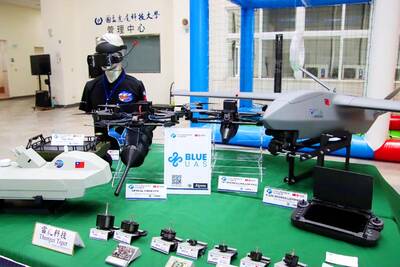
NON-RED SUPPLY: Boosting the nation’s drone industry is becoming increasingly urgent as China’s UAV dominance could become an issue in a crisis, an analyst said Taiwan’s drone exports to Europe grew 41.7-fold from 2024 to last year, with demand from Ukraine’s fight against Russian aggression the most likely driver of growth, a study showed. The Institute for Democracy, Society and Emerging Technology (DSET) in a statement on Wednesday said it found that many of Taiwan’s uncrewed aerial vehicle (UAV) sales were from Poland and the Czech Republic. These countries likely transferred the drones to Ukraine to aid it in its fight against the Russian invasion that started in 2022, it said. Despite the gains, Taiwan is not the dominant drone exporter to these markets, ranking second and fourth
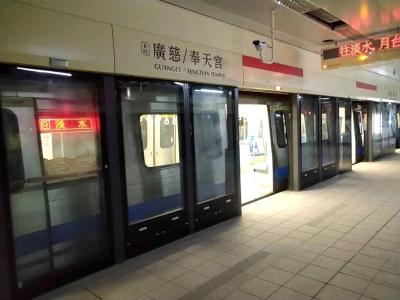
The eastern extension of the Taipei MRT Red Line could begin operations as early as late June, the Taipei Department of Rapid Transit Systems said yesterday. Taipei Rapid Transit Corp said it is considering offering one month of free rides on the new section to mark its opening. Construction progress on the 1.4km extension, which is to run from the current terminal Xiangshan Station to a new eastern terminal, Guangci/Fengtian Temple Station, was 90.6 percent complete by the end of last month, the department said in a report to the Taipei City Council's Transportation Committee. While construction began in October 2016 with an


 RSS
RSS