


The Coast Guard Administration (CGA) today said it seized 718kg of drugs worth NT$1.5 billion (US$49.6 million) from a Cambodian fishing boat in the waters southwest of Taiwan earlier this month and handed over the Chinese captain and crew members for prosecution.
Officers spotted the foreign fishing boat YAMA68 in waters 128 nautical miles (237km) southwest of Pingtung County's Maobitou (貓鼻頭) on Sept. 13, CGA Tainan Investigation Branch Deputy Director Hsu Che-li (許哲理) said.
The boat was flying the Taiwan flag, but suspiciously did not have its identification system activated, Hsu said.
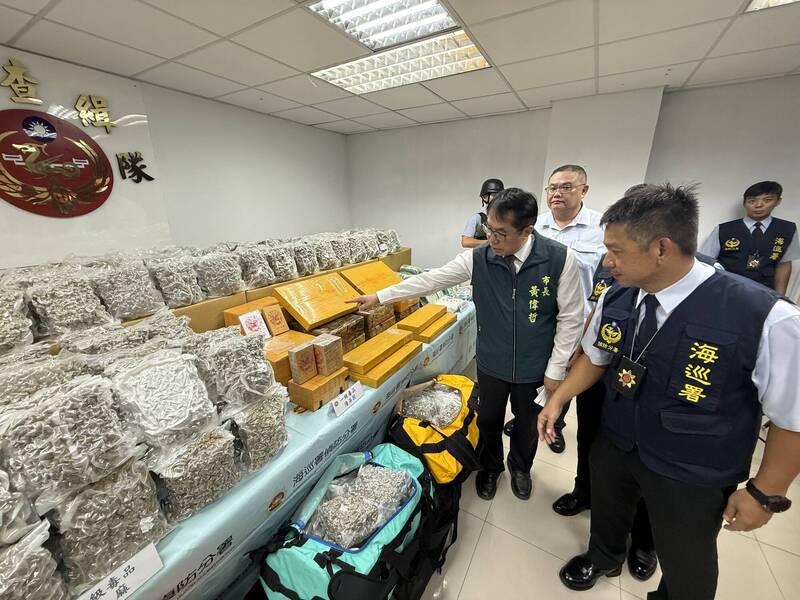
Photo: Wang Chun-chung, Taipei Times
Officers first ordered the boat to activate its identification system, but the boat fled and repeatedly evaded boarding, leading to a one-hour pursuit, he said, adding that they also noticed suspicious packages on deck.
Coast guard personnel eventually boarded the ship, took control of the captain and crew, and found 48 waterproof bags on board, all of which contained narcotics, Hsu said.
They found 10 bags of heroin weighing 209.3kg, 36 bags of marijuana weighing 472.39kg, one bag of methamphetamine weighing 18.2kg and one bag of nimetazepam weighing 18.3kg, he said.
After escorting the fishing boat back to port, the CGA reported the case to the Tainan District Prosecutors’ Office for further investigation, he added.
A preliminary investigation found that the fishing boat is from Cambodia, while the captain, surnamed Sun (孫), and three crew members are Chinese.
Each was allegedly paid 80,000 to 100,000 yuan (US$11,246 to US$14,058) to transport the drugs from Cambodia.
The boat is suspected to be a mother ship for drug trafficking, which would redistribute the drugs to other ships, officials said.
The sources and distribution routes are still under investigation.
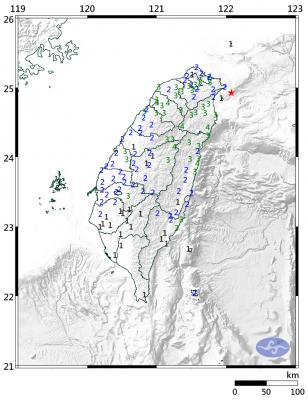
A magnitude 6.1 earthquake struck off the coast of Yilan County at 8:39pm tonight, the Central Weather Administration (CWA) said, with no immediate reports of damage or injuries. The epicenter was 38.7km east-northeast of Yilan County Hall at a focal depth of 98.3km, the CWA’s Seismological Center said. The quake’s maximum intensity, which gauges the actual physical effect of a seismic event, was a level 4 on Taiwan’s 7-tier intensity scale, the center said. That intensity level was recorded in Yilan County’s Nanao Township (南澳), Hsinchu County’s Guansi Township (關西), Nantou County’s Hehuanshan (合歡山) and Hualien County’s Yanliao (鹽寮). An intensity of 3 was
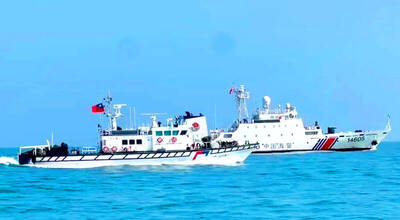
Instead of focusing solely on the threat of a full-scale military invasion, the US and its allies must prepare for a potential Chinese “quarantine” of Taiwan enforced through customs inspections, Stanford University Hoover fellow Eyck Freymann said in a Foreign Affairs article published on Wednesday. China could use various “gray zone” tactics in “reconfiguring the regional and ultimately the global economic order without a war,” said Freymann, who is also a nonresident research fellow at the US Naval War College. China might seize control of Taiwan’s links to the outside world by requiring all flights and ships entering or leaving Taiwan
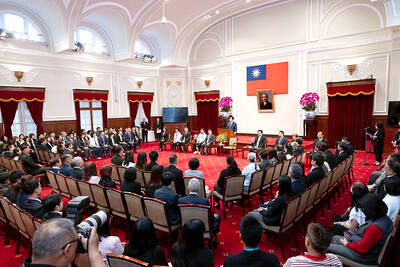
The next minimum wage hike is expected to exceed NT$30,000, President William Lai (賴清德) said yesterday during an award ceremony honoring “model workers,” including migrant workers, at the Presidential Office ahead of Workers’ Day today. Lai said he wished to thank the awardees on behalf of the nation and extend his most sincere respect for their hard work, on which Taiwan’s prosperity has been built. Lai specifically thanked 10 migrant workers selected for the award, saying that although they left their home countries to further their own goals, their efforts have benefited Taiwan as well. The nation’s industrial sector and small businesses lay
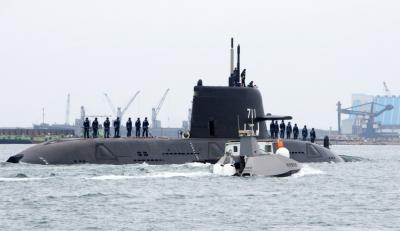
Taiwan's first indigenous defense submarine, the SS-711 Hai Kun (海鯤, or Narwhal), departed for its 13th sea trial at 7am today, marking its seventh submerged test, with delivery to the navy scheduled for July. The outing also marked its first sea deployment since President William Lai (賴清德) boarded the submarine for an inspection on March 19, drawing a crowd of military enthusiasts who gathered to show support. The submarine this morning departed port accompanied by CSBC Corp’s Endeavor Manta (奮進魔鬼魚號) uncrewed surface vessel and a navy M109 assault boat. Amid public interest in key milestones such as torpedo-launching operations and overnight submerged trials,


 RSS
RSS