


Taiwan’s Tiffany Queen (鄭宥筠) on Saturday drew wide attention at the Miss International Queen pageant in Thailand for her outfit inspired by elements of Taiwanese folk culture.
Although she did not place at the competition, considered the world’s largest transgender beauty contest, attendees described Queen’s outfit as “dazzling,” capturing the audience’s attention when she took the stage.
The costume, modeled after the general guards (將軍守) seen in Taiwan’s temple processions, featured a hand-painted mask, a tall headdress and a trident, all symbols of spiritual authority and the power to ward off evil.
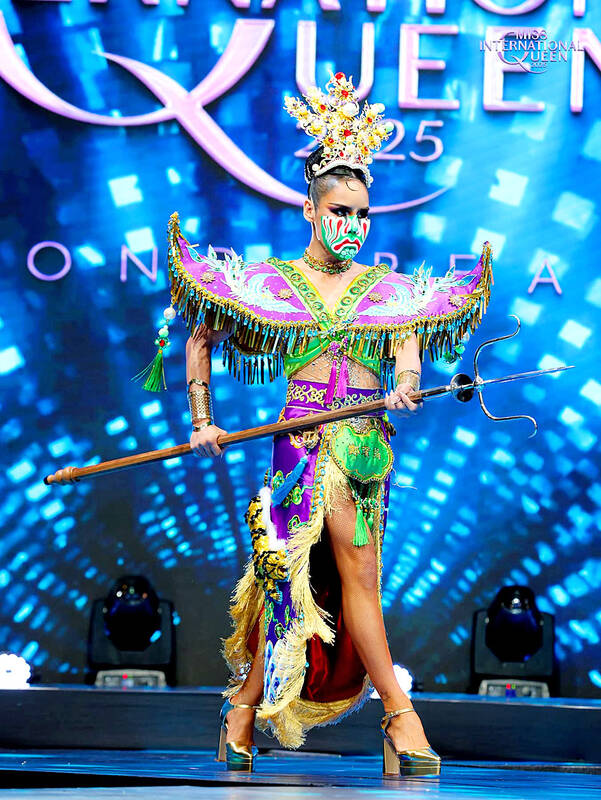
Photo courtesy of Tiffany Queen via CNA
The guards are regarded as protectors in Taiwanese folk belief, and often feature prominently at the head of temple parades, where they appear with fierce-looking faces and dramatic movements.
Queen said she and her team spent more than a month designing and crafting the outfit.
To capture the essence of the role, they visited several temples, consulted local masters and received support from temple communities, who lent equipment and shared guidance.
“The costume carries layers of cultural meaning rooted in Taiwan’s centuries-old religious practices,” she said.
Saturday was Queen’s first time attending the Miss International Queen contest, which included filming in Chiang Mai, cultural exchanges and sponsor visits.
She described the event as a “very meaningful experience.”
Queen, 30, said that attending the event had been her childhood dream.
Makeup artist Chen Wei-hsiang (陳韋翔) said that judges and fellow contestants were intrigued by the originality of Queen’s costume and praised it as a creative showcase of Taiwan’s heritage.
“I would say the Taiwanese team is incredibly popular, especially Tiffany, who gets along well with the international contestants, because she brings such positive energy,” Chen said.
The Miss International Queen pageant has been held for 19 consecutive years, attracting competitors from around the world and contributing to greater social acceptance of the transgender community.
Midori Monet of the US won first place this year, with runners-up Olivia Lauren of Cuba and Ha Tam Nhu of Vietnam.

FUKUOKA SITUATION: Japanese media reported that the pathogen is expected to be identified by the summer, while the CDC downplayed the idea that it was hMPV A “mysterious cold-like illness” reported in Japan’s Fukuoka Prefecture does not seem to be a new disease, but Japanese authorities have been asked about the situation, the Centers for Disease Control (CDC) said yesterday. The Fukuoka Prefectural Medical Association on Wednesday told a news conference that a “mystery cold” that has become a hot topic on social media is “highly likely to be caused by some kind of viral infection,” Japan’s KBC News reported. “Many people are experiencing symptoms starting with a sore throat, followed by a runny nose, phlegm and a severe cough,” KBC News reported, citing association officials. Health authorities are

Nvidia Corp CEO Jensen Huang (黃仁勳) arrived in Taiwan yesterday ahead of upcoming AI and technology events, saying he plans to meet with clients and Taiwan Semiconductor Manufacturing Co Chairman C.C. Wei (魏哲家) during his visit. After landing at Taipei Songshan Airport, Huang posed for photos with fans and handed out Yakult drinks to reporters and supporters waiting at the scene, saying he has “a lot to do” during the trip. Asked about reports that Nvidia’s planned headquarters site in Taipei’s Beitou Shilin Technology Park could break ground on May 27, Huang said that if the company holds an event, he would

The Ministry of Finance this afternoon announced the winning numbers for the March-April uniform invoice lottery. The winning number for the NT$10 million (US$318,060) special prize is 19531471, and the winning number for the NT$2 million grand prize is 85941329. Three numbers were drawn for the NT$200,000 first prize: 07225810, 20231230 and 83518781. Those with receipts matching the last seven digits of any of the first-prize numbers will win the NT$40,000 second prize, while those matching the last six digits will win the NT$10,000 third prize. Those whose receipts match the last five digits of the first-prize numbers can claim the NT$4,000 fourth prize,

Taiwan Travelogue (臺灣漫遊錄), which earlier this week became the first Taiwanese novel to win the International Booker Prize, is to be adapted into a television series through a Taiwan-Japan coproduction, producer Chang Chen-yu (張辰漁) said yesterday. Chang, a producer at World Softest Production Film Co, wrote on Facebook that the company had been searching for projects with international appeal that retain a strong Taiwanese identity after colleagues and Japanese partners strongly recommended the novel. After reading the book, Chang said he immediately decided to pursue the screen rights. “A great story has the power to transcend time and borders, and connect countless people,”


 RSS
RSS