


At 98 years old, “Broom Grandpa” Chang Shui (張水) can still be seen strolling the streets of Taitung County, a bundle of handmade brooms slung over his shoulder as he calls out to passersby in his signature sing-song tone.
For more than six decades, his strong hands have bound mountain grass and rattan into durable brooms — tools that sweep away not only dust, but also carry with them the warmth of human connection and a living piece of Taiwanese folk culture.
Once a familiar figure across Taiwan, Chang, affectionately known as “Old Chang the Broom Seller,” now mostly remains in the eastern county.
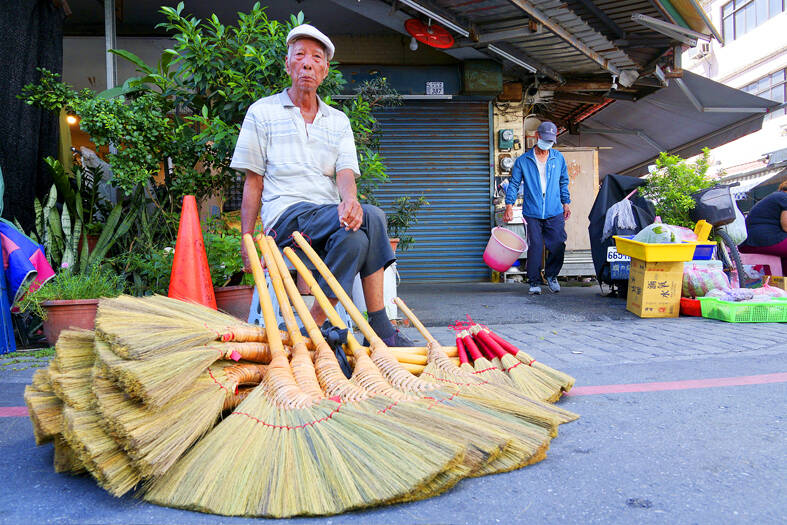
Photo: Liu Jen-wei, Taipei Times
Locals eagerly track his movements on social media, rushing to buy his brooms before they sell out. Despite often declaring that each time would be his last, Chang always returns to the streets to sell his wares.
His signature brooms, tied with tiger grass and rattan strips, require exceptional wrist strength to bind tightly.
“If the knot isn’t firm, the broom loosens after a few sweeps, and no one will want it,” Chang said with pride. “Mine can last five years. People trust me. Some even buy more than a hundred.”
Chang’s creations serve more than household needs.
During Taitung’s famed Bombing of Master Handan (炸寒單) festival, his brooms are swept between “heaven and earth” during firecracker barrages, earning the name tiandi sao (天地掃, heaven-and-earth brooms in Chinese).
Believers say the brooms, once blessed in the fiery ritual, carry protective powers against evil. Smaller versions, known as “lucky brooms,” adorn homes, temples and even indigenous households as talismans of blessing and protection.
For longtime residents, spotting Chang on the streets is a cherished ritual.
“His back is as straight as the brooms he sells,” said Cheng Kuo-cheng (鄭國正), a local historian from Chenggong Township (成功). “Meeting him is more than a transaction. It is about sharing blessings, memories and human warmth.”
Shoppers say they never mind when he insists, “This is the last batch,” only to reappear again.
“I always buy five or six at a time,” said Ms Lee, a longtime customer. “He’s been talking about retiring for years, but I’m glad to be ‘fooled.’ It means he’s still healthy, and we still get his wonderful brooms.”

UPGRADE: The Kang Ding-class frigate is replacing its Chaparall missiles with Tien Chien II and Hua Yang VLS, which would provide it with long-range, 360° air defense Taiwan plans to produce 1,200 to 1,376 Hai Chien II missiles (海劍二, Sea Sword II) — also known as TC-2N — to serve as the standard air defense system of the navy’s surface combatant fleet, a source said yesterday. Last week, the Hai Chien II, the naval version of the Tien Kung II missile (天劍二, Sky Sword II), completed a live-fire test in waters off the National Chungshan Institute of Science and Technology’s Jiupeng facility (九鵬) in Pingtung County’s Manjhou Township (滿州). The MIM72 Chaparral and other dated air defense missiles that currently arm Taiwanese ships have inadequate range to combat Chinese

REASONS FOR TRAVEL: An assistant professor said that proposed amendments to penalize drivers if they used drugs overseas would not deter people from traveling People who operate a motor vehicle under the influence of marijuana would have their driver’s license revoked, even if they used the substance while overseas, the Ministry of Transportation and Communications said yesterday, citing proposed amendments to the Road Traffic Management and Penalty Act (道路交通管理處罰條例). The amendments would also authorize the government to revoke the licenses of people determined to have used Category 1 or Category 2 narcotics, even if they were not operating a vehicle while under the influence of drugs, as well as ban them from taking the license test for three years, the ministry said. People aged 18 or

GLOBALGIVING: ‘ Caving to external pressure is not acceptable for an organization that has cultivated justice reform and human rights for 30 years,’ one NGO said A slew of non-government organizations (NGOs) have withdrawn from the GlobalGiving fundraising platform after it announced it would use “Chinese Taipei” instead of “Taiwan” from next month. The Taiwan Good Rice Association wrote on Facebook on Friday that it was informed on April 28 via a teleconference call of the change, which was made because the platform wanted to operate in China. Taiwan Good Rice is to terminate all cooperative relationships with GlobalGiving in response to the platform’s “unilateral and non-negotiable” decision to remove references to Taiwan, the NGO said. “Taiwan is in the official name of Taiwan Good Rice Association and the

HEAVY WEATHER: Typhoon Jangmi is due to crash straight into the Ryukyus as airlines look to shift flights to larger aircraft or cancel flights to Okinawa entirely Taiwan’s international air carriers announced flight adjustments over the weekend as Typhoon Jangmi is forecast to hit the Ryukyu Islands today and tomorrow. The Central Weather Administration (CWA) upgraded Jangmi from a tropical storm to a typhoon at 8am yesterday, with the eye located 580km south of Naha city. It was moving north at 19kph. Today, China Airlines’ CI-120, CI-121, CI-122 and CI-123 flights between Taoyuan and Naha, Okinawa, have been canceled as well as CI-132 and CI-133 between Kaohsiung and Naha. EVA Air’s BR-112, BR-113, BR-186 and BR-185 flights between Taoyuan and Naha are also canceled. Low-cost carrier Tigerair Taiwan canceled IT-230,


 RSS
RSS