


The Mainland Affairs Council (MAC) yesterday pledged to cooperate should the Legislative Yuan launch an investigation into former deputy legislative speaker Hung Hsiu-chu’s (洪秀柱) attendance at China’s military parade on Wednesday celebrating the 80th anniversary of the end of World War II.
China’s state-run China Central Television (CCTV) identified Hung as the representative of the Chinese Nationalist Party (KMT), as she was also a former KMT chairwoman.
Hung was deputy legislative speaker and a prominent Taiwanese political figure, MAC Deputy Minister Shen You-chung (沈有忠) told a news conference after a Cabinet meeting.
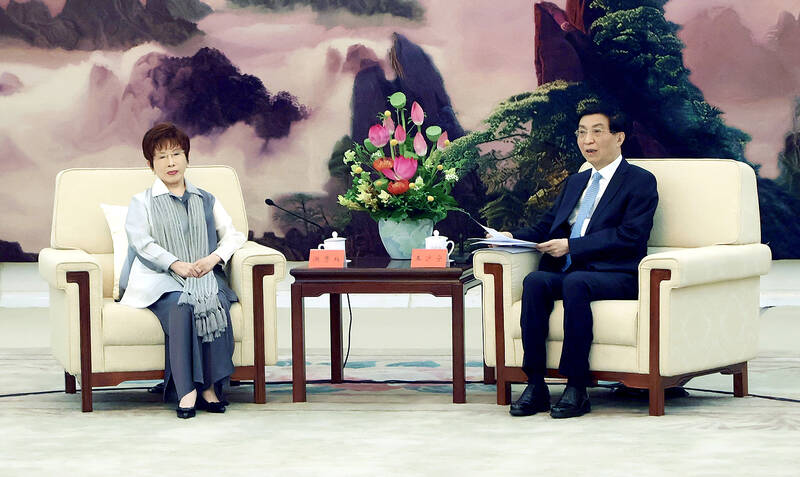
Photo: CNA
The Act Governing Relations Between the People of the Taiwan Area and the Mainland Area (臺灣地區與大陸地區人民關係條例) stipulates that the Legislative Yuan would have to launch an investigation to determine whether Hung contravened the act, Shen said.
“We will fully cooperate if the Legislative Yuan launches an investigation,” he said.
The act has some gray areas, such as what constitutes “cooperative activities” with China and “harming national interests,” Shen said.
As such, the act authorizes the agency where the stakeholder used to work to investigate and verify.
Hung could face a fine of NT$100,000 to NT$500,000 for contravening the act, Shen said, adding that the council would propose amendments to the act if the public believes that those gray areas should be addressed and penalties are not strict enough.
Article 9-3 states that no person who previously assumed the office of deputy minister as a political appointee or major general or a higher-ranking post in national defense, foreign affairs, mainland affairs or any government agencies related to national security, or who served as the chief officer of intelligence agencies, shall participate in any ceremony or activity held by a political party, military, administrative or political agencies (institutions) or organizations in China, which in turns harm national dignity.
Conduct that is deemed harmful to national dignity includes saluting the Chinese flag or emblems, singing the Chinese national anthem or other similar behavior that symbolizes Beijing’s political authority, the article says.
So far, it does not seem that Hung should be regulated based on Article 9-3 of the act, MAC Deputy Minister and spokesman Liang Wen-chieh (梁文傑) told the council’s weekly news conference.
“She used to be the deputy legislative speaker, which oversaw the operation of the legislature’s Foreign and National Defense Committee and could consequently come into close contact with confidential security information. We will study the legislative purpose of the article first,” Liang said.
However, Hung went to China as a former KMT chairwoman, for which the party should be held accountable, Liang said.
Aside from the Chinese military parade on Wednesday, Hung met with the Chinese People’s Political Consultative Conference Chairman Wang Huning (王滬寧) yesterday afternoon.
In response, Liang quoted from a council statement issued in 2015 that said: “It is regrettable that certain Taiwanese attended the military parade in China without defending the government’s contribution in withstanding Japan’s invasion and upholding national dignity.”
This official statement was approved by then-MAC minister Andrew Hsia (夏立言), who is now the KMT’s deputy chairman.
“This was our position 10 years ago. It remains our position now,” Liang said.
He also said that fewer Taiwanese entertainers in Taiwan shared celebratory messages about the military parade this time.
This shows that the council’s warnings not to amplify Chinese “united front” propaganda worked to deter such behavior, he said.
The CCTV gave Taiwanese entertainers six text templates to choose from and share on social media.
None of them crossed the line, Liang said, adding that the council would conduct further research into the matter.
The bottom line is that they must not denigrate Taiwan’s sovereignty and must not advocate taking over Taiwan by force, he said.

A magnitude 6.1 earthquake struck off the coast of Yilan County at 8:39pm tonight, the Central Weather Administration (CWA) said, with no immediate reports of damage or injuries. The epicenter was 38.7km east-northeast of Yilan County Hall at a focal depth of 98.3km, the CWA’s Seismological Center said. The quake’s maximum intensity, which gauges the actual physical effect of a seismic event, was a level 4 on Taiwan’s 7-tier intensity scale, the center said. That intensity level was recorded in Yilan County’s Nanao Township (南澳), Hsinchu County’s Guansi Township (關西), Nantou County’s Hehuanshan (合歡山) and Hualien County’s Yanliao (鹽寮). An intensity of 3 was

Instead of focusing solely on the threat of a full-scale military invasion, the US and its allies must prepare for a potential Chinese “quarantine” of Taiwan enforced through customs inspections, Stanford University Hoover fellow Eyck Freymann said in a Foreign Affairs article published on Wednesday. China could use various “gray zone” tactics in “reconfiguring the regional and ultimately the global economic order without a war,” said Freymann, who is also a nonresident research fellow at the US Naval War College. China might seize control of Taiwan’s links to the outside world by requiring all flights and ships entering or leaving Taiwan
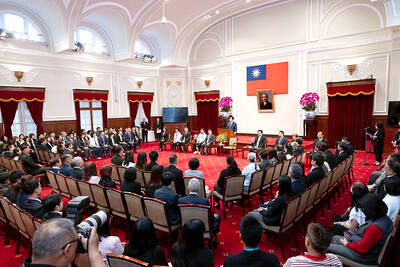
The next minimum wage hike is expected to exceed NT$30,000, President William Lai (賴清德) said yesterday during an award ceremony honoring “model workers,” including migrant workers, at the Presidential Office ahead of Workers’ Day today. Lai said he wished to thank the awardees on behalf of the nation and extend his most sincere respect for their hard work, on which Taiwan’s prosperity has been built. Lai specifically thanked 10 migrant workers selected for the award, saying that although they left their home countries to further their own goals, their efforts have benefited Taiwan as well. The nation’s industrial sector and small businesses lay
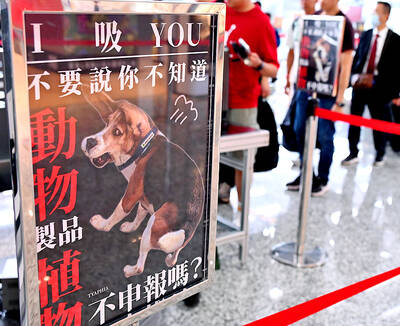
Quarantine awareness posters at Taiwan Taoyuan International Airport have gone viral for their use of wordplay. Issued by the airport branch of the Animal and Plant Health Inspection Agency, the posters feature sniffer dogs making a range of facial expressions, paired with advisory messages built around homophones. “We update the messages for holidays and campaign needs, periodically refreshing materials to attract people’s attention,” quarantine officials said. “The aim is to use the dogs’ appeal to draw focus to quarantine regulations.” A Japanese traveler visiting Taiwan has posted a photo on X of a poster showing a quarantine dog with a


 RSS
RSS