


Taiwanese and French universities have jointly developed an online learning platform offering courses on Taiwan’s culture and indigenous languages, including Hoklo (commonly known as Taiwanese) and Hakka.
Scheduled to launch next month, the platform would feature 17 Taiwan Studies courses, said the Paris-based Institut national des langues et civilisations orientales (Inalco), a French public university specializing in the study of languages and civilizations, particularly from non-Western regions.
“Through language learning, students in France and around the world can connect with Taiwan. Our program encourages foreigners to get to know Taiwan, whether they are based in France, Taiwan or elsewhere. At the same time, all of these courses are open to Taiwanese citizens, including those living overseas,” said Taiwanese academic Liu Chan-yueh (劉展岳), who heads the Taiwan Studies Program at Inalco.

Photo: Taipei Times
Among the language courses offered on the platform are Hoklo — which Liu said is distinct and should not be confused with Minnan (閩南語) or Hokkien (福建話) — as well as Hakka and several of Taiwan’s indigenous languages, including Paiwan, Rukai, Atayal, Bunun, Amis, Truku, Puyuma, Saisiyat and Hla’alua. Taiwanese Mandarin, taught with traditional characters, would also be included.
Most of the language courses would offer curricula for beginners and advanced learners, and all would be free of charge, with instruction provided by professional language teachers in Taiwan, Liu said.
“Although the courses are free, students must show honest motivation to learn Taiwan’s languages, complete the full curriculum and respect the teachers, who devote considerable time and effort to preparation and instruction,” said Liu, who this year received the Ministry of Education’s (MOE) Outstanding Award in Promoting Taiwan Native Languages.
Schools and organizations in Taiwan involved in the collaboration include National Taiwan Normal University, National Kaohsiung Normal University, National Chengchi University, National Central University, National Pingtung University and the Taiwan Austronesian Language Association.
Separately, the ministry on Monday issued a call for entries for the Taiwanese and Hakka Literature Awards, now in their 10th year. Writers are invited to submit works in Hoklo and Hakka, with this year’s top prize increased to NT$100,000.
“We hope to promote Taiwanese and Hakka literature by encouraging writers to produce more original works in the spirit of the native literature movement,” Department of Lifelong Education official Tsai Chung-wu (蔡忠武) said.
The deadline for submissions is Oct. 31.
For more information, visit the ministry’s Web site at depart.moe.edu.tw/ED2400/Default.aspx, or the Taiwanese languages portal, language.moe.gov.tw, which provides official guidelines on the use of Taiwanese and Hakka words and phrases.
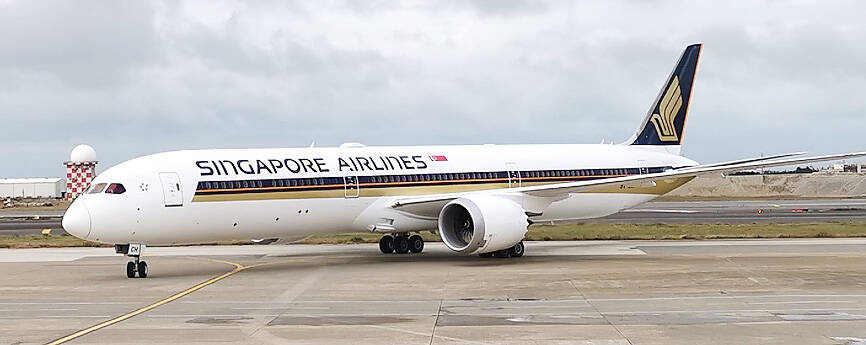
INCREASED CAPACITY: The flights on Mondays, Wednesdays, Fridays and Sundays would leave Singapore in the morning and Taipei in the afternoon Singapore Airlines is adding four supplementary flights to Taipei per week until May to meet increased tourist and business travel demand, the carrier said on Friday. The addition would raise the number of weekly flights it operates to Taipei to 18, Singapore Airlines Taiwan general manager Timothy Ouyang (歐陽漢源) said. The airline has recorded a steady rise in tourist and business travel to and from Taipei, and aims to provide more flexible travel arrangements for passengers, said Ouyang, who assumed the post in July last year. From now until Saturday next week, four additional flights would depart from Singapore on Monday, Wednesday, Friday

Taiwan’s three major international carriers are increasing booking fees, with EVA Airways having already increased the charge to US$28 per flight segment from US$25, while China Airlines (CAL) and Starlux Airlines are set to follow suit. Booking fees are charged by airlines through a global distribution system (GDS) and passed on to passengers. Carriers that apply the fees include CAL, EVA, Starlux and Tigerair Taiwan. A GDS is a computerized network operated by a company that connects airlines with travel agents and ticketing platforms, allowing reservations to be made and processed in real time. Major players include Amadeus, Sabre and Travelport. EVA Air began
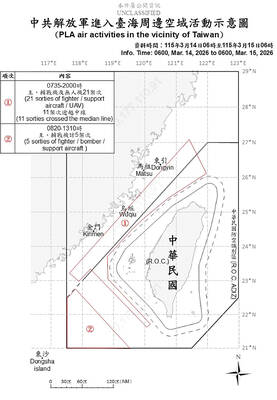
The Ministry of National Defense yesterday reported the return of large-scale Chinese air force activities after their unexplained absence for more than two weeks, which had prompted speculation regarding Beijing’s motives. China usually sends fighter jets, drones and other military aircraft around the nation on a daily basis. Interruptions to such routine are generally caused by bad weather. The Ministry of National Defense said it had detected 26 Chinese military aircraft in the Taiwan Strait over the previous 24 hours. It last reported that many aircraft on Feb. 25, when it spotted 30 aircraft, saying Beijing was carrying out another “joint combat

WATCH FOR HITCHHIKERS: The CDC warned those returning home from Japan to be alert for any contagious diseases that might have come back with them People who have returned from Japan following the World Baseball Classic (WBC) games during the weekend are recommended to watch for symptoms of infectious gastroenteritis, flu and measles for two weeks, the Centers for Disease Control (CDC) said. Flu viruses remain the most common respiratory pathogen in Taiwan in the past four weeks and the influenza B virus accounted for 55.7 percent of the tested cases, exceeding the percentage of influenza A (H3N2) infections and becoming the local dominant strain, CDC Epidemic Intelligence Center Deputy Director Lee Chia-lin (李佳琳) said at a news conference on Tuesday. There were 82,187 hospital visits for


 RSS
RSS