


The Chiang Kai-shek Memorial Hall held a concert yesterday featuring popular songs banned during Taiwan’s authoritarian period, jogging memories for older listeners and offering rare glimpses for young audience members into music from the country’s martial law era.
Featuring a performance by veteran singer-songwriter "Pig Head Skin" (朱頭皮), whose real name is Chu Yueh- hsin (朱約信), and commentary from Eric Scheihagen, a researcher of Taiwanese popular music, the event was part of the memorial hall’s series to push forward transitional justice.
Delving deep into the vault of Taiwanese popular music, the pair discussed the double entendres and purported hidden messages in the songs that caused them to be censored by the authorities.
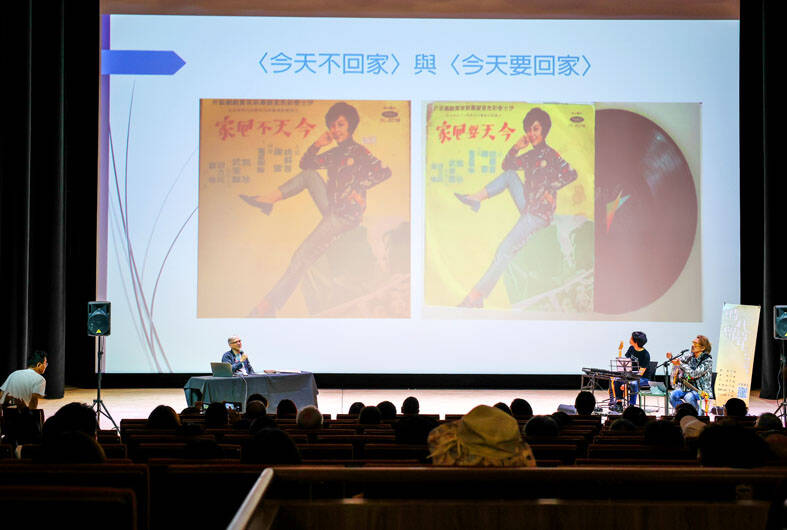
Photo: CNA
Some of these songs had to have parts of their lyrics changed before they could be published in Taiwan, but were given the green light overseas, resulting in two different versions.
One such song was "Chih Hu Che Yeh" (之乎者也) by singer-songwriter Lo Ta-yu (羅大佑), a sneering criticism of the censorship system and the public’s acquiescence to rampant music piracy at the time of its release in 1982.
While the original version of the now-classic piece released outside Taiwan included a verse that was a blunt attack on censorship and piracy, the Taiwanese version contained only an abstract depiction of the maladies it set out to tackle.
Other well-known pieces featured during the show included Chen Hsiao-yun’s (陳小雲) "Dancing Lady" (舞女) and Yun Yi-yi’s (云一依) "Yon Don’t Love Me, but I Love You," allegedly banned as it was thought to be an analogy of Taiwan after the United States cut diplomatic ties with it in 1979.
According to Scheihagen, "Dancing Lady" was purportedly freedom-of-speech pioneer Deng Nan-jung’s (鄭南榕) favorite song, as he believed the song was an analogy of Taiwan, which, like women who danced for a living, had long been exploited by foreign colonizers.
Scheihagen added that the songs are not only precious for their intrinsic artistic value, but also because they offer people glimpses into Taiwan’s society at the time they were released.
"Some songs were banned even though their lyrics appeared completely harmless," he said.
"We should cherish the freedom we enjoy today, not having to worry about being punished or arrested just for singing a song," he said.

A magnitude 6.1 earthquake struck off the coast of Yilan County at 8:39pm tonight, the Central Weather Administration (CWA) said, with no immediate reports of damage or injuries. The epicenter was 38.7km east-northeast of Yilan County Hall at a focal depth of 98.3km, the CWA’s Seismological Center said. The quake’s maximum intensity, which gauges the actual physical effect of a seismic event, was a level 4 on Taiwan’s 7-tier intensity scale, the center said. That intensity level was recorded in Yilan County’s Nanao Township (南澳), Hsinchu County’s Guansi Township (關西), Nantou County’s Hehuanshan (合歡山) and Hualien County’s Yanliao (鹽寮). An intensity of 3 was

Instead of focusing solely on the threat of a full-scale military invasion, the US and its allies must prepare for a potential Chinese “quarantine” of Taiwan enforced through customs inspections, Stanford University Hoover fellow Eyck Freymann said in a Foreign Affairs article published on Wednesday. China could use various “gray zone” tactics in “reconfiguring the regional and ultimately the global economic order without a war,” said Freymann, who is also a nonresident research fellow at the US Naval War College. China might seize control of Taiwan’s links to the outside world by requiring all flights and ships entering or leaving Taiwan
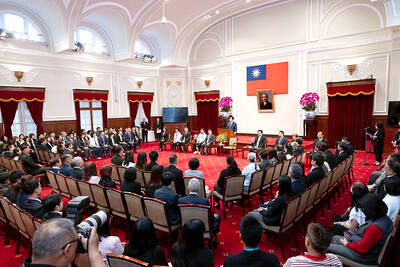
The next minimum wage hike is expected to exceed NT$30,000, President William Lai (賴清德) said yesterday during an award ceremony honoring “model workers,” including migrant workers, at the Presidential Office ahead of Workers’ Day today. Lai said he wished to thank the awardees on behalf of the nation and extend his most sincere respect for their hard work, on which Taiwan’s prosperity has been built. Lai specifically thanked 10 migrant workers selected for the award, saying that although they left their home countries to further their own goals, their efforts have benefited Taiwan as well. The nation’s industrial sector and small businesses lay
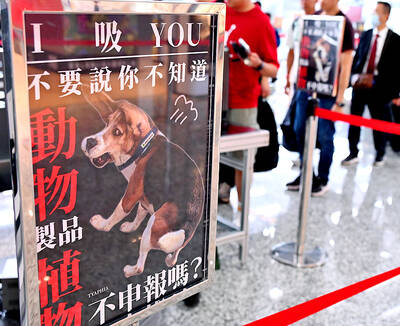
Quarantine awareness posters at Taiwan Taoyuan International Airport have gone viral for their use of wordplay. Issued by the airport branch of the Animal and Plant Health Inspection Agency, the posters feature sniffer dogs making a range of facial expressions, paired with advisory messages built around homophones. “We update the messages for holidays and campaign needs, periodically refreshing materials to attract people’s attention,” quarantine officials said. “The aim is to use the dogs’ appeal to draw focus to quarantine regulations.” A Japanese traveler visiting Taiwan has posted a photo on X of a poster showing a quarantine dog with a


 RSS
RSS