


Two Taiwanese YouTubers were fined NT$10,000 for releasing a sky lantern on railway tracks at Shifen Station (十分) in New Taipei City, triggering online debate and prompting officials to promise better oversight.
The duo, known as “Tsai Tai-tai and Tsai Sheng-sheng” (菜苔苔與菜生生), said in an apology video on YouTube on Saturday that they were directed onto the tracks by vendors.
They said that many other visitors were also releasing lanterns on the tracks at that time at the popular tourist spot in New Taipei City’s Pingsi District (平溪), but police officers later told them their actions contravened the Railway Act (鐵路法).
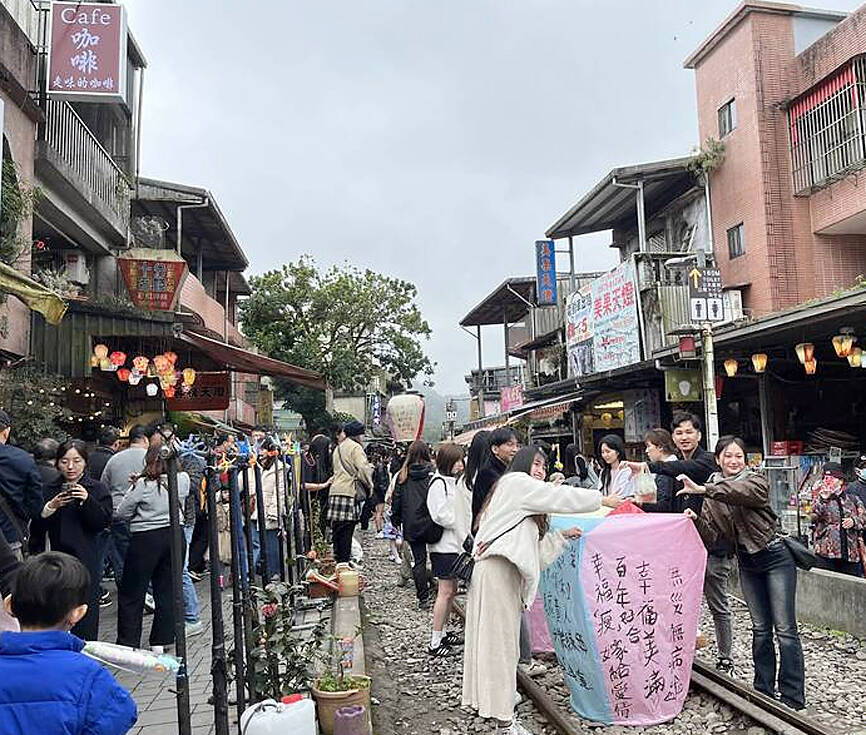
Photo: Huang Tzu-yang, Taipei Times
The Tourism Administration said the practice of releasing lanterns on railway tracks raises legal concerns and pledged to step up efforts to warn tourists against releasing lanterns on the tracks.
Under Article 57 of the act, pedestrians and vehicles “shall not intrude into/onto railway routes, bridges, as well as places inside tunnels and stations not designated for public use.”
The Railway Bureau said it is considering amendments to the act to meet tourism demand while ensuring safety, and would continue to review cases referred by the Railway Police before imposing penalties.
Releasing sky lanterns is a traditional practice in which a paper lantern, often inscribed with wishes or prayers and containing a fuel source that produces a small flame, is released to float into the sky.
The New Taipei City Government said lanterns can only be released in specific areas under the New Taipei City Sky Lantern Release Management Regulations (新北市天燈施放管理辦法), including between the Shifen Visitor Center in Pingsi and Shigong Bridge (師功橋) and within 200m of the Keelung River (基隆河).
The city added that releases are banned between 10pm and 6am, with contraveners facing fines of up to NT$3,000 under the Fire Services Act (消防法).
A new “New Taipei City sky lantern sustainable development ordinance” (新北市天燈永續發展自治條例) — currently awaiting approval from the Executive Yuan — would require vendors to buy certification stamps and pay a sustainable development fee, city officials said.

Considering that most countries issue more than five denominations of banknotes, the central bank has decided to redesign all five denominations, the bank said as it prepares for the first major overhaul of the banknotes in more than 24 years. Central bank Governor Yang Chin-lung (楊金龍) is expected to report to the Legislative Yuan today on the bank’s operations and the redesign’s progress. The bank in a report sent to the legislature ahead of today’s meeting said it had commissioned a survey on the public’s preferences. Survey results showed that NT$100 and NT$1,000 banknotes are the most commonly used, while NT$200 and NT$2,000

The Centers for Disease Control (CDC) yesterday reported the first case of a new COVID-19 subvariant — BA.3.2 — in a 10-year-old Singaporean girl who had a fever upon arrival in Taiwan and tested positive for the disease. The girl left Taiwan on March 20 and the case did not have a direct impact on the local community, it said. The WHO added the BA.3.2 strain to its list of Variants Under Monitoring in December last year, but this was the first imported case of the COVID-19 variant in Taiwan, CDC Deputy Director-General Lin Ming-cheng (林明誠) said. The girl arrived in Taiwan on

South Korea is planning to revise its controversial electronic arrival card, a step Taiwanese officials said prompted them to hold off on planned retaliatory measures, a South Korean media report said yesterday. A Yonhap News Agency report said that the South Korean Ministry of Foreign Affairs is planning to remove the “previous departure place” and “next destination” fields from its e-arrival card system. The plan, reached after interagency consultations, is under review and aims to simplify entry procedures and align the electronic form with the paper version, a South Korean ministry official said. The fields — which appeared only on the electronic form

The Ministry of Foreign Affairs (MOFA) is suspending retaliation measures against South Korea that were set to take effect tomorrow, after Seoul said it is updating its e-arrival system, MOFA said today. The measures were to be a new round of retaliation after Taiwan on March 1 changed South Korea's designation on government-issued alien resident certificates held by South Korean nationals to "South Korea” from the "Republic of Korea," the country’s official name. The move came after months of protests to Seoul over its listing of Taiwan as "China (Taiwan)" in dropdown menus on its new online immigration entry system. MOFA last week


 RSS
RSS