


Environmental groups on Tuesday called for sustainable marine management strategies to facilitate the development of fisheries while conserving marine resources.
The Fisheries Research Institute and environmental groups held the Taiwan-Japan Satoumi Forum, inviting Japanese academics to share Japan’s “satoumi” experience, which refers to the Japanese concept of humans coexisting harmoniously with the ocean.
Developed based on the concept of “satoyama” — the management of forests through agricultural communities — satoumi focuses on marine management strategies that align with the sustainable development of marine resources and biodiversity in coastal areas, institute researcher Chen Chun-lung (陳均龍) said.
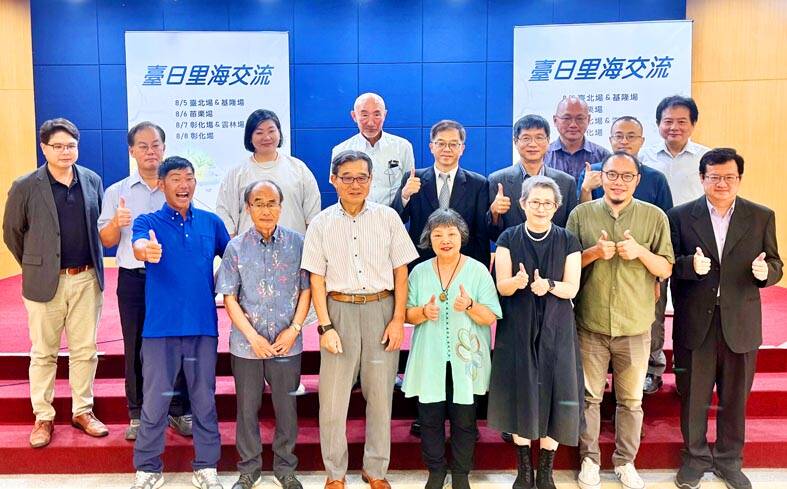
Photo: Huang Yi-ching, Taipei Times
Wild at Heart Legal Defense Association research fellow Kuo Chia-wen (郭佳雯) said that marine resource depletion is worsening, especially on Taiwan’s west coast, which is intensively developed.
The shrinking white dolphin population in the region is an indicator, Kuo said.
Matsu’s Fish Conservation Union founder Chen Bing-heng (陳秉亨) said that Taiwan should integrate resources to rehabilitate marine resources in line with the concept of satoumi, as the construction of offshore wind farms in the past few years has affected the marine ecosystem.
Fukuoka City Fisheries Cooperative vice president Takayuki Handa said that wind turbines used for offshore wind power generation should not be built in areas where fishers have set up fixed nets or mobile fishing gear.
Although solar panels are installed on farmland in Japan to generate the electricity required to cultivate crops, Tokyo refrained from promoting fishery and electricity symbiosis in fisheries, given that most aquafarms in Japan are situated at sea rather than on land, he said.
Handa said that he would bring his experience at the forum back to Japan to share with other members of the cooperative, adding that he hopes to initiate the collaboration between Taiwan and Japan in building a satoumi economy.
Also on Tuesday, environmental groups protested the inclusion of critical habitats of white dolphins in the Taichung Port Specific Zone Plan, calling on the Taichung City Government to demarcate the habitats as a marine resource zone instead.
Kuo said that about 90 percent of Taiwanese white dolphins move through the waters around the Port of Taichung, but data showed that their population has decreased to fewer than 50, meaning that extinction might be imminent.
Wild at Heart Legal Defense Association researcher Hong Shuo-cheng (洪碩辰) said that the fifth liquefied natural gas receiving terminal to be constructed by Taiwan Power Co and the second receiving terminal to be expanded by CPC Corp, Taiwan are within critical habitats of white dolphins.
The habitats should be excluded from the port’s specific zone and redefined as a Category 1 marine resource zone in accordance with the Spatial Planning Act (國土計畫法), he said.
Additional reporting by CNA

FUKUOKA SITUATION: Japanese media reported that the pathogen is expected to be identified by the summer, while the CDC downplayed the idea that it was hMPV A “mysterious cold-like illness” reported in Japan’s Fukuoka Prefecture does not seem to be a new disease, but Japanese authorities have been asked about the situation, the Centers for Disease Control (CDC) said yesterday. The Fukuoka Prefectural Medical Association on Wednesday told a news conference that a “mystery cold” that has become a hot topic on social media is “highly likely to be caused by some kind of viral infection,” Japan’s KBC News reported. “Many people are experiencing symptoms starting with a sore throat, followed by a runny nose, phlegm and a severe cough,” KBC News reported, citing association officials. Health authorities are

Nvidia Corp CEO Jensen Huang (黃仁勳) arrived in Taiwan yesterday ahead of upcoming AI and technology events, saying he plans to meet with clients and Taiwan Semiconductor Manufacturing Co Chairman C.C. Wei (魏哲家) during his visit. After landing at Taipei Songshan Airport, Huang posed for photos with fans and handed out Yakult drinks to reporters and supporters waiting at the scene, saying he has “a lot to do” during the trip. Asked about reports that Nvidia’s planned headquarters site in Taipei’s Beitou Shilin Technology Park could break ground on May 27, Huang said that if the company holds an event, he would

The Ministry of Finance this afternoon announced the winning numbers for the March-April uniform invoice lottery. The winning number for the NT$10 million (US$318,060) special prize is 19531471, and the winning number for the NT$2 million grand prize is 85941329. Three numbers were drawn for the NT$200,000 first prize: 07225810, 20231230 and 83518781. Those with receipts matching the last seven digits of any of the first-prize numbers will win the NT$40,000 second prize, while those matching the last six digits will win the NT$10,000 third prize. Those whose receipts match the last five digits of the first-prize numbers can claim the NT$4,000 fourth prize,

SIX SUBSIDIES: The monthly allowance for older farmers is to increase to NT$10,000, and NT$5,000 is to be given to homemakers under the national pension system, Lai said The government is to implement major welfare policies for disadvantaged groups, including raising the monthly allowance for older farmers to NT$10,000 and providing homemakers with NT$5,000 per month, President William Lai (賴清德) said yesterday. Lai made the remarks during a visit to Wangling Temple in Chiayi County, saying that the planned increases were being introduced amid economic growth and an increase in tax revenue. Touting a policy, in which the government plans to provide a monthly allowance of NT$5,000 for every child under the age of 18 in a bid to address Taiwan’s low birthrate, Lai said that if received for the


 RSS
RSS