


Prepackaged drinks without added sugar are to be exempted from commodity taxes, following amendments passed yesterday by the Legislative Yuan.
The change to the Commodity Tax Act (貨物稅條例) was a bipartisan effort to improve public health by making bottled beverages without added sugar a more appealing choice for consumers.
About one in every three children in Taiwan is overweight, while half of adults experience weight problems.
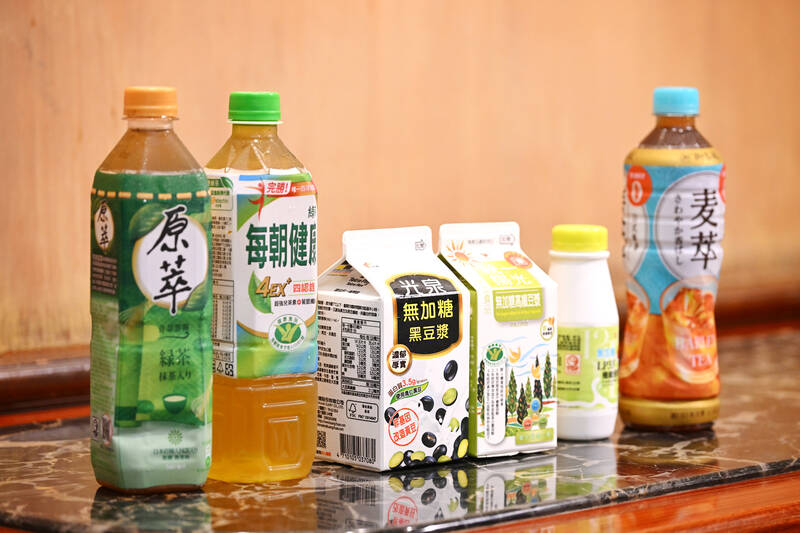
Photo: Chen Yi-kuan, Taipei Times
Article 8 of the act already exempts “pure natural fruit juice, fruit syrup, concentrated fruit syrup, concentrated fruit juice and pure natural vegetable juice” that is in compliance with national standards from commodity taxes.
The change also removes the 13 percent commodity tax on color televisions, video recorders, record players and audio recorders.
The reasoning behind the removal of the appliances from the list is that they have become essential consumer goods for many, calling the fairness and legitimacy of levying taxes on them into question.
They are also being replaced by new products, leading to a decrease in tax revenue.
The legislature also passed two resolutions related to the new amendments.
The first is that the Ministry of Finance is to prepare a one-year assessment report on tax exemptions for household appliances.
The second is that the ministry is to provide data on commodity and business taxes for imported and domestically produced beverages according to their price as part of efforts to ensure that consumers see the benefits of the new exemptions.
The ministry would also work with consumer protection agencies and other institutions to monitor whether companies have passed on the benefits to consumers.
Chang Chih-jen (張智仁), honorary chairman of the Taipei-based Chinese Taipei Society for the Study of Obesity, said that the Legislative Yuan should expand the tax exemption to other drinks without added sugar in a bid to improve public health.
Excessive sugar intake is linked to high blood pressure, high blood sugar levels, cardiovascular issues and chronic diseases, Chang told reporters.
Sugary drinks are a potential contributing factor to obesity in Taiwan, he said.
Eliminating taxes on sugar-free drinks is an implicit tax on drinks with added sugar, as it makes the public aware that the government is taking their health seriously and is promoting awareness of sugar’s harmful effects, he said.
Only prepackaged sugar-free drinks are exempt, while hand-shaken ones are not, he said.
The next step should be to expand the exemption to hand-shaken drinks so there is a consistent “sugar-free, tax-free” system, Chang said, adding that higher taxes should be levied on shaken drinks with added sugar.
Taipei Medical University School of Nutrition and Health Sciences head Hsia Shih-min (夏詩閔) told reporters that excessive sugar intake is linked to several chronic diseases.
Encouraging consumers to choose sugar-free drinks is good for public health, Hsia said, adding that he supports the new amendments.
Encouraging people to reduce their sugar intake requires continued advocacy from civic groups, as well as communication and coordination between the government and business, changes in people’s purchasing choices and enhanced nutrition education, he said.
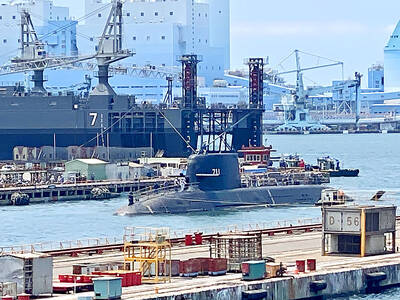
AGING: While Japan has 22 submarines, Taiwan only operates four, two of which were commissioned by the US in 1945 and 1946, and transferred to Taiwan in 1973 Taiwan would need at least 12 submarines to reach modern fleet capabilities, CSBC Corp, Taiwan chairman Chen Cheng-hung (陳政宏) said in an interview broadcast on Friday, citing a US assessment. CSBC is testing the nation’s first indigenous defense submarine, the Hai Kun (海鯤, Narwhal), which is scheduled to be delivered to the navy next month or in July. The Hai Kun has completed torpedo-firing tests and is scheduled to undergo overnight sea trials, Chen said on an SET TV military affairs program. Taiwan would require at least 12 submarines to establish a modern submarine force after assessing the nation’s operational environment and defense

Yangmingshan National Park authorities yesterday urged visitors to respect public spaces and obey the law after a couple was caught on a camera livestream having sex at the park’s Qingtiangang (擎天崗) earlier in the day. The Shilin Police Precinct in Taipei said it has identified a suspect and his vehicle registration number, and would summon him for questioning. The case would be handled in accordance with public indecency charges, it added. The couple entered the park at about 11pm on Thursday and began fooling around by 1am yesterday, the police said, adding that the two were unaware of the park’s all-day live
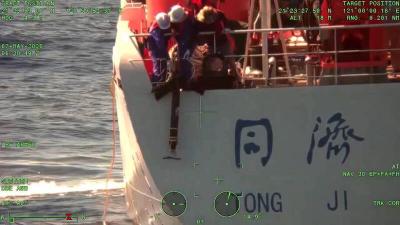
The coast guard today said that it had disrupted "illegal" operations by a Chinese research ship in waters close to the nation and driven it away, part of what Taipei sees a provocative pattern of China's stepped up maritime activities. The coast guard said that it on Thursday last week detected the Chinese ship Tongji (同濟號), which was commissioned only last year, 29 nautical miles (54km) southeast of the southern tip of Taiwan, although just outside restricted waters. The ship was observed lowering ropes into the water, suspected to be the deployment of scientific instruments for "illegal" survey operations, and the coast

A former soldier and an active-duty army officer were yesterday indicted for allegedly selling classified military training materials to a Chinese intelligence operative for a total of NT$79,440. The Taipei District Prosecutors’ Office indicted Chen Tai-yin (陳泰尹) and Lee Chun-ta (李俊達) for contravening the National Security Act (國家安全法) and the Anti-Corruption Act (貪污治罪條例). Chen left the military in September 2013 after serving alongside then-staff sergeant Lee, now an army lieutenant, at the 21st Artillery Command of the army’s Sixth Corps from 2011 to 2013, according to the indictment. Chen met a Chinese intelligence operative identified as “Wang” (王) through a friend in November


 RSS
RSS