


The US Senate Committee on Appropriations yesterday preliminarily passed a bill that would authorize US President Donald Trump to use US$1 billion to support Taiwan’s military defenses.
The US$852-billion bill would primarily expand the US Navy’s shipbuilding and missile production.
Democratic Senator Chris Coons told reporters that the committee agreed to authorize Trump to use “Presidential Drawdown Authority” (PDA) to transfer military equipment from existing stockpiles to Taiwan.

Photo: Reuters
In September last year, former US president Joe Biden used the PDA for the second time to provide Taiwan with US$567 million in military aid, the largest amount of PDA aid ever given to Taiwan.
Cato Institute military analyst Eric Gomez, who has long advocated Taiwan develop asymmetric combat capabilities, said in an article in Foreign Policy magazine last year that the PDA may be a temporary solution to the delay in US arms sales to Taiwan.
Gomez said that Taiwan acquires most of its US weapons through the “Foreign Military Sales” (FMS) program, which typically requires major weapons systems to be built from scratch.
All FMS deals exceeding a certain threshold, about US$14 million for Taiwan, must be reported to the US Congress, he said.
FMS is a relatively slow bureaucratic process with some delays expected between notifying the US Congress and delivery of weapons, Gomez said.
Taiwan typically waits longer than other countries for the same weapons, he added.
As the PDA allows the president to deliver weapons from current stockpiles, there is no need to wait for manufacturing, he said.
If utilized properly, the PDA can help Taiwan adopt asymmetric defenses and advance its self-defense capabilities, Gomez said.
The bill also supported increasing aid to Ukraine by US$800 million.
In addition, the bill allocates US$225 million for the Baltic Security Initiative and an additional US$119 million to strengthen collective security of US European Command, investments that are “all related to Ukraine in some way,” Coons said.
The bill also includes US$20 million to support the second pillar of the AUKUS research plan, a trilateral security partnership between the US, UK and Australia, he said.
This includes cooperation on the military applications of new technologies such as artificial intelligence and quantum computing, he added.
The bill must be passed by the US Senate and House of Representatives and signed by Trump before becoming law.
A bill passed by the US House of Representative on July 18 allocated US$500 million to provide Taiwan with defense materials and services and military training and education.

The military has spotted two Chinese warships operating in waters near Penghu County in the Taiwan Strait and sent its own naval and air forces to monitor the vessels, the Ministry of National Defense (MND) said. Beijing sends warships and warplanes into the waters and skies around Taiwan on an almost daily basis, drawing condemnation from Taipei. While the ministry offers daily updates on the locations of Chinese military aircraft, it only rarely gives details of where Chinese warships are operating, generally only when it detects aircraft carriers, as happened last week. A Chinese destroyer and a frigate entered waters to the southwest
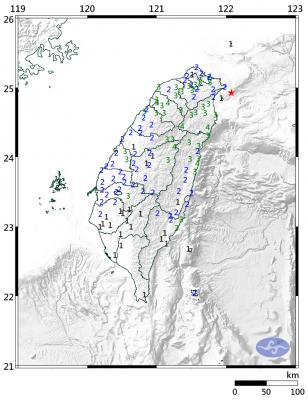
A magnitude 6.1 earthquake struck off the coast of Yilan County at 8:39pm tonight, the Central Weather Administration (CWA) said, with no immediate reports of damage or injuries. The epicenter was 38.7km east-northeast of Yilan County Hall at a focal depth of 98.3km, the CWA’s Seismological Center said. The quake’s maximum intensity, which gauges the actual physical effect of a seismic event, was a level 4 on Taiwan’s 7-tier intensity scale, the center said. That intensity level was recorded in Yilan County’s Nanao Township (南澳), Hsinchu County’s Guansi Township (關西), Nantou County’s Hehuanshan (合歡山) and Hualien County’s Yanliao (鹽寮). An intensity of 3 was
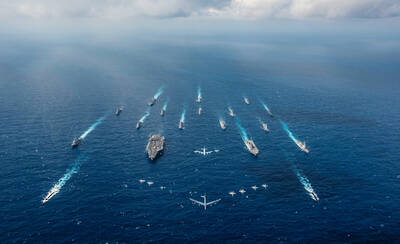
Japanese Prime Minister Sanae Takaichi’s comment last year on Tokyo’s potential reaction to a Taiwan-China conflict has forced Beijing to rewrite its invasion plans, a retired Japanese general said. Takaichi told the Diet on Nov. 7 last year that a Chinese naval blockade or military attack on Taiwan could constitute a “survival-threatening situation” for Japan, potentially allowing Tokyo to exercise its right to collective self-defense. Former Japan Ground Self-Defense Force general Kiyofumi Ogawa said in a recent speech that the remark has been interpreted as meaning Japan could intervene in the early stages of a Taiwan Strait conflict, undermining China’s previous assumptions
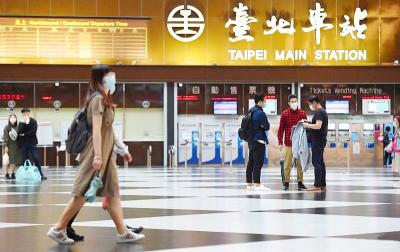
Taiwan Railways Corp (TRC) today announced that Shin Kong Mitsukoshi has been selected as the preferred bidder to operate the Taipei Railway Station shopping mall, replacing the current operator, Breeze Development Co Ltd. Among eight qualified firms that delivered presentations and were evaluated by a review committee, Shin Kong Mitsukoshi was ranked first, while Breeze was named the runner-up, the rail company said in a statement. Contract negotiations are to proceed in accordance with regulations, it said, adding that if negotiations with the top bidder fail, it could invite the second-ranked applicant to enter talks. Breeze in a statement today expressed doubts over


 RSS
RSS