


The government yesterday activated the Central Emergency Operations Center (CEOC) after the Central Weather Administration (CWA) issued a tsunami alert following a magnitude 8.8 earthquake off the east coast of Russia’s Kamchatka Peninsula.
This was the first time that the government activated an emergency response to potential damage that could be caused by a tsunami. In the past, the CEOC generally began to operate when the nation was affected by typhoons or earthquakes.
Prior to yesterday, the CWA had also issued tsunami alerts after a magnitude 9 earthquake in Japan on March 11, 2011, and a magnitude 7.1 earthquake off the coast of Hualien on April 3 last year.
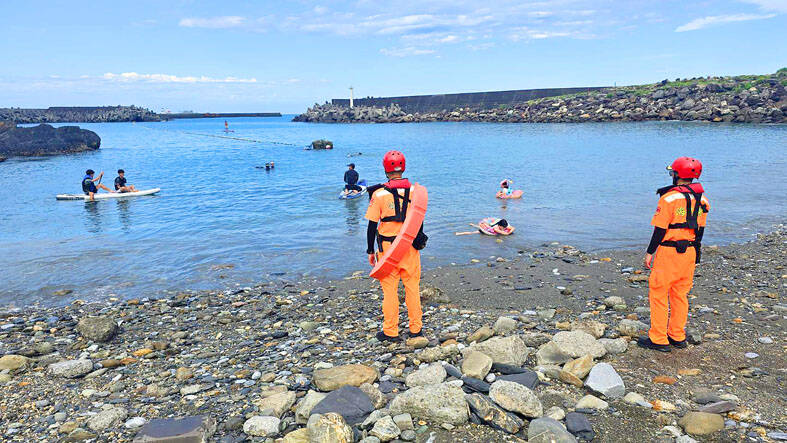
Photo: CNA
Yesterday’s alert applied to all coastlines around the nation.
Waves on the southeast and southwest coasts could reach 0.3m to 1m, while those elsewhere along the coastline were forecast to be less than 0.3m, according to the alert.
The tsunami alert came as southwest Taiwan — particularly Tainan, and Yunlin and Chiayi counties — was struggling to recover from the heavy infrastructure damage caused by torrential rain brought by the southwest monsoon.
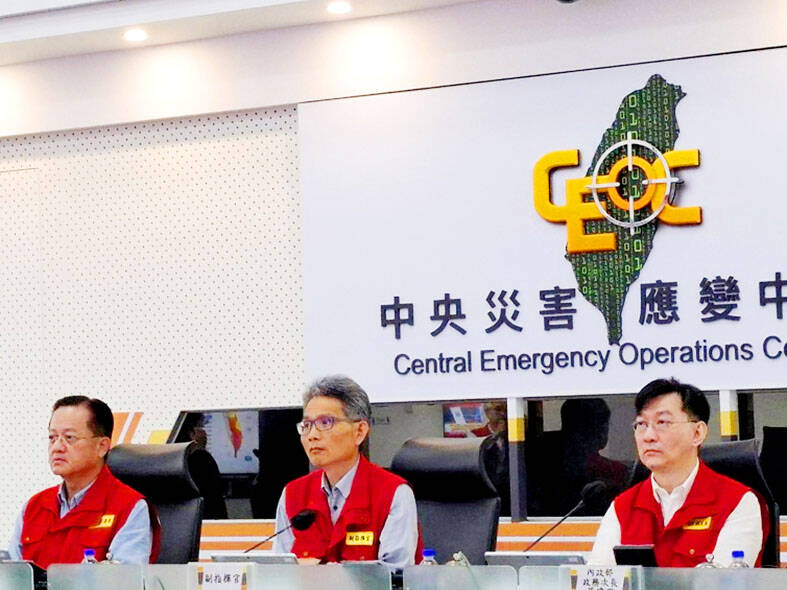
Photo courtesy of the Water Resources Agency.
A simulation conducted by the National Science and Technology Center for Disaster Reduction showed that the areas that could be hit by tsunami included Tainan, Kaohsiung and New Taipei City, as well as Chiayi, Pingtung, Taitung, Yilan and Hualien counties.
Disaster relief officials said during a CEOC briefing that the Ministry of National Defense and the National Air Service Corps have helicopters on standby for rescue missions, while the Coast Guard Administration would patrol fishing ports and other coastal facilities, urging people to move away from the coastline.
Meanwhile, the Fisheries Agency was in charge of reminding fishers working in waters near Taiwan and in the north Pacific to be on alert, the center said.
As of press time, the CWA had yet to lift the tsunami alert. However, its observation data as of 1:45pm showed that the highest wave reached 9cm, which was detected off the coast of Yilan County’s Suao Township (蘇澳).
Waves reached only 1cm to 2cm in Kaohsiung, and Taitung and Pingtung counties, CWA data showed.
Whale-watching boats in Hualien continued to operate despite the tsunami warning, with travelers on board saying that they barely felt any difference.
EVA Air, Starlux Airlines and Tigerair Taiwan announced the cancellation of flights to Sendai Airport in northeast Japan after the airport closed its runways following the earthquake.
The earthquake occurred due to the northwestward subduction of the Pacific tectonic plate beneath the Okhotsk microplate, the CWA said, adding that it was a typical subduction zone earthquake.
Seismic history data showed that, since 1900, 133 magnitude 7 and larger quakes have been recorded in the area around the epicenter, with 12 of them being larger than magnitude 8, the CWA said.
The largest was a magnitude 9 earthquake in 1952, which triggered a tsunami and generated 12m-high waves, it added.
The speed at which tsunami waves travel is related to the depth of the seafloor, CWA Seismological Center Director Wu Chien-fu (吳健富) said.
The deeper the seafloor, the faster tsunami waves travel, he said.
Tsunami waves generated by a 5,000m deep earthquake could travel 800kph, while those triggered by a 500m deep quake could travel at 250kph, he said.
Tsunami waves build up in height when moving from deeper to shallower parts of the seafloor, Wu added
Cliffs along the nation’s east coast hinder the buildup of tsunami waves, while the undersea terrain off the southwest coast could facilitate such wave amplification, he said.
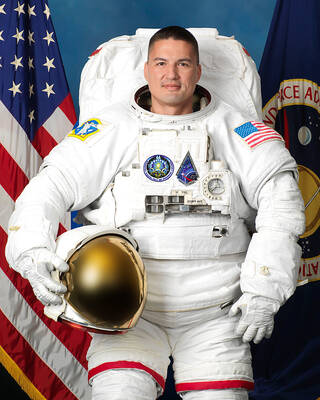
SPACE VETERAN: Kjell N. Lindgren, who helps lead NASA’s human spaceflight missions, has been on two expeditions on the ISS and has spent 311 days in space Taiwan-born US astronaut Kjell N. Lindgren is to visit Taiwan to promote technological partnerships through one of the programs organized by the US for its 250th national anniversary. Lindgren would be in Taiwan from Tuesday to Saturday next week as part of the US Bureau of Educational and Cultural Affairs’ US Speaker Program, organized to celebrate the 250th anniversary of the signing of the Declaration of Independence, the American Institute in Taiwan (AIT) said in a statement yesterday. Lindgren plans to engage with key leaders across the nation “to advance cutting-edge technological partnerships and inspire the next generation of scientists and engineers,”

UNREASONABLE SURVEILLANCE: A camera targeted on an road by a neighbor captured a man’s habitual unsignaled turn into home, netting him dozens of tickets The Taichung High Administrative Court has canceled all 45 tickets given to a man for failing to use a turn signal while driving, as it considered long-term surveillance of his privacy more problematic than the traffic violations. The man, surnamed Tseng (曾), lives in Changhua County and was reported 45 times within a month for failing to signal while driving when he turned into the alley where his residence is. The reports were filed by his neighbor, who set up security cameras that constantly monitored not only the alley but also the door and yard of Tseng’s house. The surveillance occurred from July
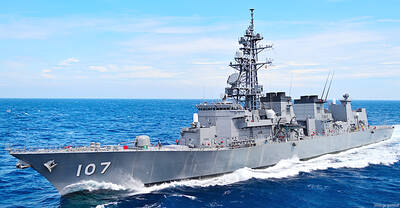
A Japan Self-Defense Forces vessel entered the Taiwan Strait yesterday, Japanese media reported. After passing through the Taiwan Strait, the Ikazuchi was to proceed to the South China Sea to take part in a joint military exercise with the US and the Philippines, the reports said. Japan Self-Defense Force vessels were first reported to have passed through the strait in September, 2024, with two further transits taking place in February and June last year, the Asahi Shimbun reported. Yesterday’s transit also marked the first time since Japanese Prime Minister Sanae Takaichi took office that a Japanese warship has been sent through the Taiwan
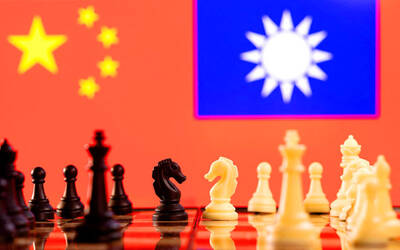
‘SAME OLD TRICK’: Even if Beijing resumes individual travel to Taiwan, it would only benefit Chinese tourism companies, the Economic Democracy Union convener said China’s 10 new “incentives” are “sugar-coated poison,” an official said yesterday, adding that Taiwanese businesses see them clearly for what they are, but that Beijing would inevitably find some local collaborators to try to drums up support. The official, speaking on condition of anonymity, made the remark ahead of a news conference the General Chamber of Commerce is to hold today. The event, titled “Industry Perspectives on China’s Recent Pro-Taiwan Policies,” is expected to include representatives from industry associations — such as those in travel, hotels, food and agriculture — to request the government cooperate with China’s new measures, people familiar with


 RSS
RSS