


A two-month weight-loss program has helped people lose 5kg on average and reduce waistlines by 5cm, Taiwan University Hospital told a news conference in Taipei on Friday.
The program, which has 17 specialists, has treated 117 people so far, hospital dietitians told the news conference.
The average participant reduced their body mass index to 29.1 from 30.9, lost 2.61 percent of body fat, and their blood pressure, lipids and sugar levels indicated a return to health, the dietitians said.
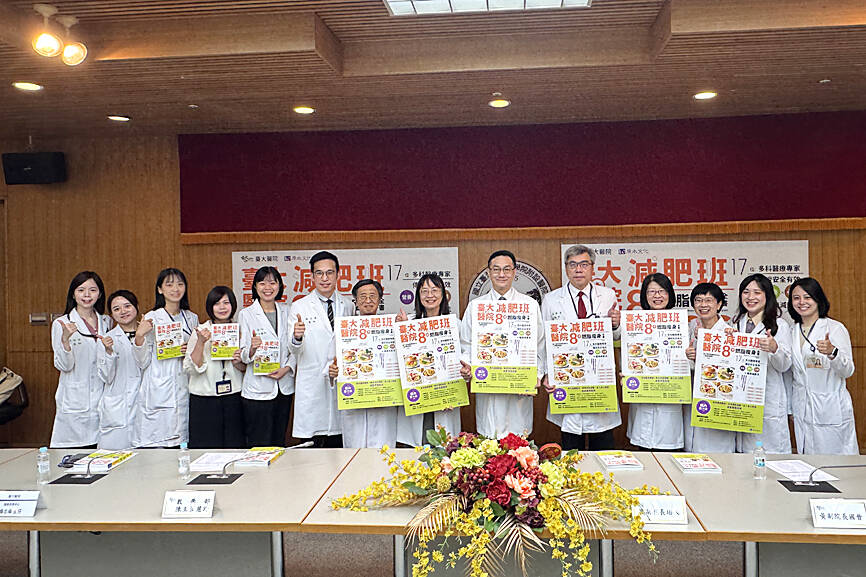
Photo: Chiu Chih-jou, Taipei Times
People who want to lose weight should rely on scientifically proven and sustainable strategies, not the latest fad, such as GLP-1, hospital deputy superintendent Lo Pei-jen (婁培人) said.
The program’s core mission is to help people lose weight and keep it down long-term, Lo said.
Obesity is tied to eight out of Taiwan’s 10 leading causes of death, said Chen Pei-hung (陳珮蓉), the director of the hospital’s dietetics department.
The program revolves around imposing a calorie deficit via diet, exercise and psychological support, conditioning the body to maintain leanness, Chen said.
People do not need to be famished to lose weight, said Chen Hui-chun (陳慧君), deputy director of the dietetics department.
Routine exercise and a diet of high-quality proteins, unrefined carbs, “good” fats, and a “rainbow” of fruits and vegetables are enough to achieve and maintain leanness, she said.
People should eat and hydrate before exercising to increase the efficiency of fat burning, she said.
Participants in the program range from people wanting to be prettier to people weighing more than 100kg, said Hsiao Ching-ju (蕭靜如), an instructor in the hospital’s health resource center.
The program uses a menu of 28 healthy meals to avoid tedium and unpalatability associated with dieting, Hsiao said.
The optimal rate to lose weight is 0.5kg to 1kg per week, she added.
The hospital’s team of exercise and physical therapy specialists selected 12 exercises that people in the program can choose from and do at home, health resource center director Yang Chih-wei (楊志偉) said.
The routines include arm strength training, elastic band exercises and yoga stretches that are introduced gradually to habituate participants to physical activity and change their metabolism, Yang said.
Losing weight is not a matter of willpower, but incrementally introducing tangible and sustained changes to everyday routine, said Lai Jin-shin (賴金鑫), director of the hospital’s physical medicine and rehabilitation department.
Keeping a healthy weight is a life-long process and not one that can be rushed through, Lai added.

The Ministry of Finance this afternoon announced the winning numbers for the March-April uniform invoice lottery. The winning number for the NT$10 million (US$318,060) special prize is 19531471, and the winning number for the NT$2 million grand prize is 85941329. Three numbers were drawn for the NT$200,000 first prize: 07225810, 20231230 and 83518781. Those with receipts matching the last seven digits of any of the first-prize numbers will win the NT$40,000 second prize, while those matching the last six digits will win the NT$10,000 third prize. Those whose receipts match the last five digits of the first-prize numbers can claim the NT$4,000 fourth prize,

SIX SUBSIDIES: The monthly allowance for older farmers is to increase to NT$10,000, and NT$5,000 is to be given to homemakers under the national pension system, Lai said The government is to implement major welfare policies for disadvantaged groups, including raising the monthly allowance for older farmers to NT$10,000 and providing homemakers with NT$5,000 per month, President William Lai (賴清德) said yesterday. Lai made the remarks during a visit to Wangling Temple in Chiayi County, saying that the planned increases were being introduced amid economic growth and an increase in tax revenue. Touting a policy, in which the government plans to provide a monthly allowance of NT$5,000 for every child under the age of 18 in a bid to address Taiwan’s low birthrate, Lai said that if received for the
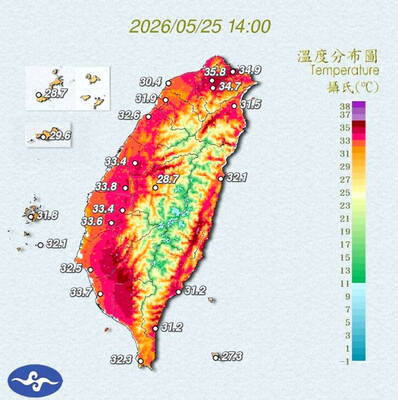
STAY COOL: The HPA recommended that people stay hydrated, use air-conditioning or fans while indoors, wear loose-fitting clothes and walk in the shade while outdoors Employers must implement measures such as installing cooling equipment, and providing drinking water and rest breaks for outdoor workers starting from Monday next week, the Taipei Department of Labor said on Sunday. Employers who fail to comply could face fines of NT$30,000 to NT$300,000 under the Occupational Safety and Health Act (職業安全衛生法), the department said. Businesses in Taipei employing fewer than 100 workers, as well as registered self-employed workers with labor insurance coverage, could receive on-site assessments and guidance from occupational safety consultants to help them apply for central government subsidies to implement or improve heat-protection measures, it said. Under the Ministry of
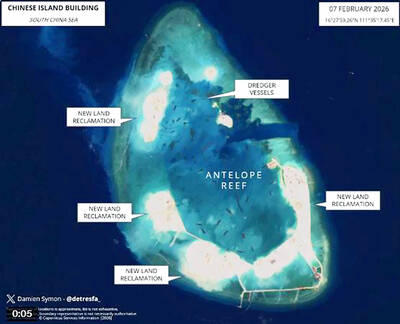
ISOLATION: The outposts would serve as support and backup bases, forcing US forces to either face China head-on or reroute, increasing travel time and operational costs China’s outposts in the South China Sea could be used to delay and constrain foreign forces during a conflict in the Taiwan Strait, giving Beijing a critical window to carry out amphibious landing and blockade operations, a report said. The Chinese Communist Party’s (CCP) forward operating bases on islands and reclaimed features in the South China Sea could delay foreign forces long enough for the Chinese People’s Liberation Army (PLA) to secure a key 48-to-72-hour window in the Taiwan Strait, a report commissioned by the Mainland Affairs Council found. The report, conducted by the Institute for National Defense and Security Research, examined


 RSS
RSS