


The Ministry of National Defense (MND) has outlined the latest findings from the Han Kuang annual military exercise in a report submitted to lawmakers on Friday.
The 41st iteration of the exercise, held from July 9 to Saturday last week, was the longest in its history and featured war games without predetermined outcomes, reflecting a shift toward more realistic training scenarios.
The ministry’s report was delivered to the Legislative Yuan in advance of a Foreign Affairs and National Defense Committee meeting scheduled for tomorrow, which is to be attended by Minister of National Defense Wellington Koo (顧立雄).
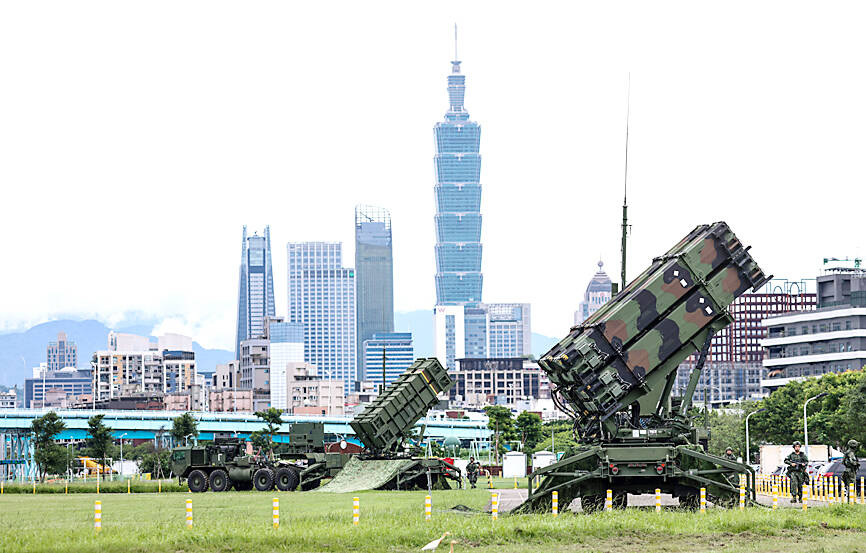
Photo: Cheng I-hwa, AFP
Should China attempt an invasion, the Chinese People’s Liberation Army (PLA) is expected to deploy amphibious and air assault units to capture strategically vital locations, including New Taipei City’s Bali District (八里), the Port of Taipei and Taipei International Airport (Songshan airport), the report said.
Similar sites in southern and central Taiwan are also potential targets, it said.
Taiwan’s forces should improve integration of firepower across diverse systems, including rocket and tube artillery, air defense, anti-tank guided missiles and drones, it said.
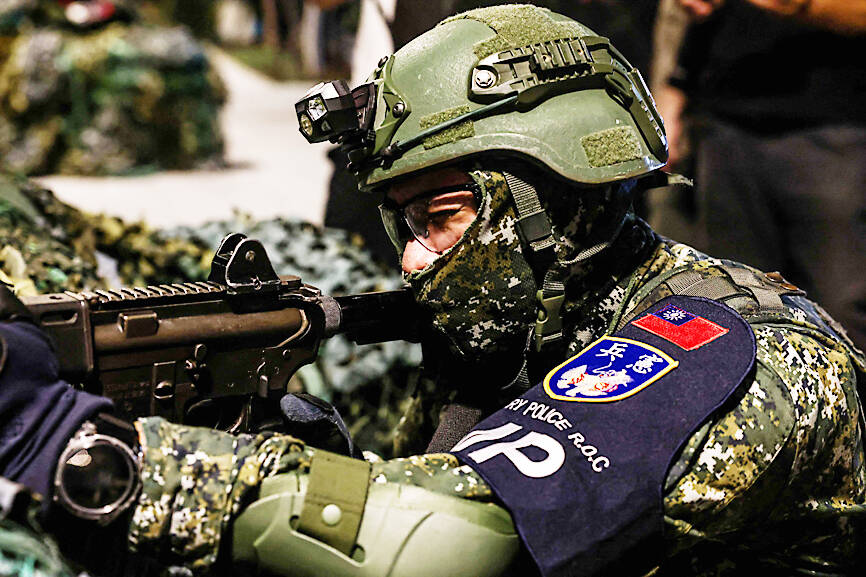
Photo: Cheng I-hwa, AFP
The military’s objective is to delay enemy advancements by inflicting heavy casualties and extending the time required to break into Taiwanese territory, the ministry said.
Considering the extended time required for calling up reservists, the ministry plans to deploy regular units for defense preparations, starting this year, it said.
The exercise confirmed that the military should continue assessing its use of civilian logistical capabilities and methods, focusing on enhancing mobility, modular pallet use and the dispersion of stockpiles, it added.
The national defense logistics management system should bolster its ability to create a unified operational picture to better support combat units, the ministry said.
The ministry would coordinate with other ministries and agencies to strengthen defensive measures at key airports, harbors and beaches, it said.
The armed forces are expediting the acquisition of Hesco bastions, which can be rapidly and flexibly deployed to form military barriers, it added.
The exercise involved simulating the laying of mines in the waters off beaches and harbors that the PLA would likely target, with the aim of inflicting losses on their landing forces and preventing supply ships from accessing these locations, it said.
Civilian logistical resources were employed to deploy wave breakers and abandoned motor vehicles as makeshift anti-landing obstacles, the report said.
Units across all branches of the military practiced signal discipline, de-identification and operating from dispersed positions to enhance force preservation in a real conflict, it said.
This year’s Han Kuang exercise also simulated the military’s raising of alert levels in response to intelligence, shifting the mission from countering “gray zone” skirmishes, cyber warfare and disinformation to preparing for a full-scale conflict, it said.
The aim was to ensure a swift and efficient transition to fighting a full-scale conflict, it added.
The military has begun integrating ground combat units from the army, navy and air force garrisoned in Taipei to strengthen the defense of the nation’s capital, the ministry said.
Counter-airborne and air mobile operations at Songshan airport and defense bridges were key elements of the exercise in the Taipei metropolitan area, it said, adding that for the first time, the Taipei Mass Rapid Transit was used to transport troops.

UPGRADE: The Kang Ding-class frigate is replacing its Chaparall missiles with Tien Chien II and Hua Yang VLS, which would provide it with long-range, 360° air defense Taiwan plans to produce 1,200 to 1,376 Hai Chien II missiles (海劍二, Sea Sword II) — also known as TC-2N — to serve as the standard air defense system of the navy’s surface combatant fleet, a source said yesterday. Last week, the Hai Chien II, the naval version of the Tien Kung II missile (天劍二, Sky Sword II), completed a live-fire test in waters off the National Chungshan Institute of Science and Technology’s Jiupeng facility (九鵬) in Pingtung County’s Manjhou Township (滿州). The MIM72 Chaparral and other dated air defense missiles that currently arm Taiwanese ships have inadequate range to combat Chinese

REASONS FOR TRAVEL: An assistant professor said that proposed amendments to penalize drivers if they used drugs overseas would not deter people from traveling People who operate a motor vehicle under the influence of marijuana would have their driver’s license revoked, even if they used the substance while overseas, the Ministry of Transportation and Communications said yesterday, citing proposed amendments to the Road Traffic Management and Penalty Act (道路交通管理處罰條例). The amendments would also authorize the government to revoke the licenses of people determined to have used Category 1 or Category 2 narcotics, even if they were not operating a vehicle while under the influence of drugs, as well as ban them from taking the license test for three years, the ministry said. People aged 18 or

HEAVY WEATHER: Typhoon Jangmi is due to crash straight into the Ryukyus as airlines look to shift flights to larger aircraft or cancel flights to Okinawa entirely Taiwan’s international air carriers announced flight adjustments over the weekend as Typhoon Jangmi is forecast to hit the Ryukyu Islands today and tomorrow. The Central Weather Administration (CWA) upgraded Jangmi from a tropical storm to a typhoon at 8am yesterday, with the eye located 580km south of Naha city. It was moving north at 19kph. Today, China Airlines’ CI-120, CI-121, CI-122 and CI-123 flights between Taoyuan and Naha, Okinawa, have been canceled as well as CI-132 and CI-133 between Kaohsiung and Naha. EVA Air’s BR-112, BR-113, BR-186 and BR-185 flights between Taoyuan and Naha are also canceled. Low-cost carrier Tigerair Taiwan canceled IT-230,
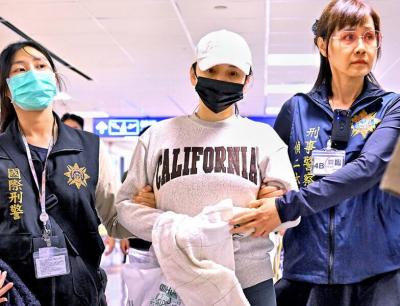
Johanne Liou (劉喬安), a Taiwanese woman who shot to unwanted fame during the Sunflower movement protests in 2014, returned to Taiwan last night after being deported from the US. She is to stand trial in Taiwan for charges involving embezzlement, fraud and drug crimes. The Criminal Investigation Bureau (CIB) said it took her into custody at Taiwan Taoyuan International Airport and would first question her before transferring her to the New Taipei District Prosecutors’ Office. She was arrested upon disembarking a flight from San Francisco that landed shortly before 7pm. Liou absconded to the US in 2019 after jumping bail


 RSS
RSS