


The opposition Chinese Nationalist Party (KMT) and Taiwan People’s Party (TPP) yesterday voted to further extend the current legislative session to Aug. 31, lengthening the previously extended session by another month.
Using their combined majority, the two opposition parties outvoted the Democratic Progressive Party (DPP) 59-49, saying many urgent proposed bills should not be postponed to the next session.
The legislature meets in two regular sessions each year: one from February to the end of May, and the other from September to the end of December.

Photo: Chen Yi-kuan, Taipei Times
Yesterday’s vote, proposed by the TPP on June 13, followed an earlier extension proposed by the KMT on April 18, which the two parties on May 20 jointly supported to extend the session to July 31.
SPECIAL BUDGET
KMT Legislator Chen Yu-jen (陳玉珍) said that following the Legislative Yuan’s passage of a NT$545 billion (US$18.53 billion) special relief bill last week, which includes a NT$10,000 universal cash handout, the Cabinet should draw up a special budget and submit it to the Legislative Yuan for review.
TPP Legislator Liu Shu-pin (劉書彬) said the US is expected to announce tariffs on Taiwan soon, and the legislature should remain in session to respond promptly to any resulting impact.
However, DPP caucus chief executive Rosalia Wu (吳思瑤) called the extension “groundless” and accused the opposition parties of using the prolonged session as their “legislative umbrella.”
Wu was referring to the constitutional and legal protections that shield lawmakers from arrest or detention without the legislature’s consent while it is in session, unless they are caught in the act of committing a crime.
‘CHINESE TERRORISM’
Meanwhile, DPP lawmakers yesterday criticized the opposition for repeatedly blocking a vote on a proposal condemning Beijing for “transnational acts of terrorism,” following confirmation from Czech officials that Chinese agents surveilled Vice President Hsiao Bi-khim (蕭美琴) and planned a collision with her car during her visit to Prague last year.
The DPP on July 4 put forth a vote for the legislature to officially condemn China and demand that Beijing issue a formal apology to Taiwan and the world, as well as promise that it would cease all harassment, threats or acts of violence toward Taiwanese officials and people in the international community.
Yesterday was the third time the opposition declined to include the proposal on the agenda.
The proposal also demanded that national security reforms be expedited to bolster national security in light of continued Chinese infiltration and threats.
It also called on the government to work with like-minded countries to jointly maintain peace across the Taiwan Strait and uphold regional security.

A magnitude 6.1 earthquake struck off the coast of Yilan County at 8:39pm tonight, the Central Weather Administration (CWA) said, with no immediate reports of damage or injuries. The epicenter was 38.7km east-northeast of Yilan County Hall at a focal depth of 98.3km, the CWA’s Seismological Center said. The quake’s maximum intensity, which gauges the actual physical effect of a seismic event, was a level 4 on Taiwan’s 7-tier intensity scale, the center said. That intensity level was recorded in Yilan County’s Nanao Township (南澳), Hsinchu County’s Guansi Township (關西), Nantou County’s Hehuanshan (合歡山) and Hualien County’s Yanliao (鹽寮). An intensity of 3 was
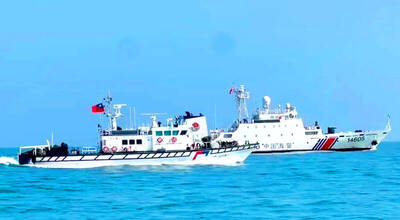
Instead of focusing solely on the threat of a full-scale military invasion, the US and its allies must prepare for a potential Chinese “quarantine” of Taiwan enforced through customs inspections, Stanford University Hoover fellow Eyck Freymann said in a Foreign Affairs article published on Wednesday. China could use various “gray zone” tactics in “reconfiguring the regional and ultimately the global economic order without a war,” said Freymann, who is also a nonresident research fellow at the US Naval War College. China might seize control of Taiwan’s links to the outside world by requiring all flights and ships entering or leaving Taiwan
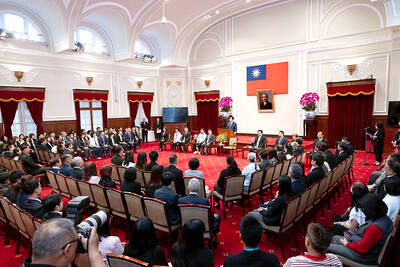
The next minimum wage hike is expected to exceed NT$30,000, President William Lai (賴清德) said yesterday during an award ceremony honoring “model workers,” including migrant workers, at the Presidential Office ahead of Workers’ Day today. Lai said he wished to thank the awardees on behalf of the nation and extend his most sincere respect for their hard work, on which Taiwan’s prosperity has been built. Lai specifically thanked 10 migrant workers selected for the award, saying that although they left their home countries to further their own goals, their efforts have benefited Taiwan as well. The nation’s industrial sector and small businesses lay
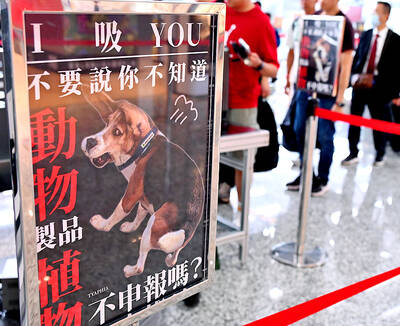
Quarantine awareness posters at Taiwan Taoyuan International Airport have gone viral for their use of wordplay. Issued by the airport branch of the Animal and Plant Health Inspection Agency, the posters feature sniffer dogs making a range of facial expressions, paired with advisory messages built around homophones. “We update the messages for holidays and campaign needs, periodically refreshing materials to attract people’s attention,” quarantine officials said. “The aim is to use the dogs’ appeal to draw focus to quarantine regulations.” A Japanese traveler visiting Taiwan has posted a photo on X of a poster showing a quarantine dog with a


 RSS
RSS