


The public should watch out for manipulation of information about voting in recalls on July 26, the Taiwan Information Environment Research Center said in a report published on Thursday, adding that those who encounter such material should attempt to discern who was being targeted and what message was being conveyed.
When viewing material related to the recall votes, the public should determine whether it aligns with the worldview of the Chinese Communist Party (CCP) by saying that the recall campaigns were unjust or that the votes must not be allowed to succeed, the report said.
People should be on the lookout for phrases such as “polls,” “foreign experts” and “foreign media reports,” and assess whether they are being used manipulatively, it said.
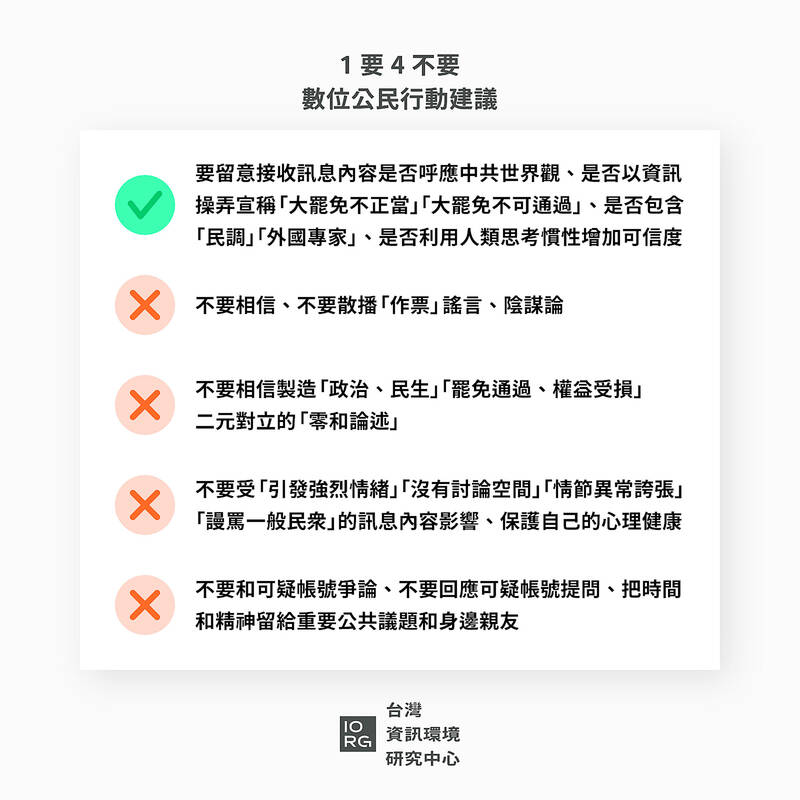
Photo: screen grab from the Information Operations Research Group Web site
Claims based on polls should be investigated, it said.
The transparency, design philosophy and the framing of questions in polls should be analyzed before ascribing great value to the results of a poll, the report said.
Comments and news clips from foreign academics, experts, and political figures are often used to lend credibility to reports, but their remarks can be over-extrapolated or misinterpreted, it said.
The nationality of the people being quoted can be used to project the illusion that they are speaking on behalf of their country, it said, adding that quotes should always be verified.
The public should not believe any reports or rumors that the Central Election Commission, polling staff or political parties are involved in vote-rigging, as that not only erodes public trust in the authenticity of a vote and the democratic system, but also risks contravening the law, it said.
Binary or “zero sum” rhetoric should be rejected, such as claims that successful recalls would affect everyday life and regional stability, the IORG said.
There would never be a definite causal effect between the outcome of a vote and everyday life or regional stability, while the “zero sum” mentality does not align with real life, it said.
The CCP and its supporters often use cost of living issues and fear of war to belittle Taiwan’s government and the nation’s sovereignty, it said, adding that they accuse the government of focusing on the recalls while ignoring public welfare.
The claim that recalls would lead to war in the Taiwan Strait is also prevalent among such misinformation, the researchers said.
The Threads social media site is a major source of comments that aim to fan emotions and foment arguments, they said, adding that the accounts responsible for such material are likely to be controlled by malicious actors.
The public should research the veracity of content posted online and refrain from responding to accounts that exhibit signs they are stirring, which would save time and protect personal information, they added.

Considering that most countries issue more than five denominations of banknotes, the central bank has decided to redesign all five denominations, the bank said as it prepares for the first major overhaul of the banknotes in more than 24 years. Central bank Governor Yang Chin-lung (楊金龍) is expected to report to the Legislative Yuan today on the bank’s operations and the redesign’s progress. The bank in a report sent to the legislature ahead of today’s meeting said it had commissioned a survey on the public’s preferences. Survey results showed that NT$100 and NT$1,000 banknotes are the most commonly used, while NT$200 and NT$2,000

The Centers for Disease Control (CDC) yesterday reported the first case of a new COVID-19 subvariant — BA.3.2 — in a 10-year-old Singaporean girl who had a fever upon arrival in Taiwan and tested positive for the disease. The girl left Taiwan on March 20 and the case did not have a direct impact on the local community, it said. The WHO added the BA.3.2 strain to its list of Variants Under Monitoring in December last year, but this was the first imported case of the COVID-19 variant in Taiwan, CDC Deputy Director-General Lin Ming-cheng (林明誠) said. The girl arrived in Taiwan on

South Korea is planning to revise its controversial electronic arrival card, a step Taiwanese officials said prompted them to hold off on planned retaliatory measures, a South Korean media report said yesterday. A Yonhap News Agency report said that the South Korean Ministry of Foreign Affairs is planning to remove the “previous departure place” and “next destination” fields from its e-arrival card system. The plan, reached after interagency consultations, is under review and aims to simplify entry procedures and align the electronic form with the paper version, a South Korean ministry official said. The fields — which appeared only on the electronic form

The Ministry of Foreign Affairs (MOFA) is suspending retaliation measures against South Korea that were set to take effect tomorrow, after Seoul said it is updating its e-arrival system, MOFA said today. The measures were to be a new round of retaliation after Taiwan on March 1 changed South Korea's designation on government-issued alien resident certificates held by South Korean nationals to "South Korea” from the "Republic of Korea," the country’s official name. The move came after months of protests to Seoul over its listing of Taiwan as "China (Taiwan)" in dropdown menus on its new online immigration entry system. MOFA last week


 RSS
RSS