


Taiwanese students, businesspeople and those residing overseas should participate in the recall votes, YouTube streamer Pa Chiung (八炯) told a rally in Taipei yesterday.
Pa Chiung said he had just returned from the US and Canada, where he urged overseas Taiwanese to fly back to vote on July 26 or Aug. 23.
Two weeks earlier, he had read that the Chinese Communist Party intended to facilitate travel for Taiwanese businesspeople to vote in the recalls.

Photo: CNA
The number of businesspeople who have been incentivized to vote has undoubtedly increased, Pa Chiung said, adding that he launched his North America tour in hopes of persuading Taiwanese there to vote.
His events in the two nations typically drew individual audiences of 100 to 200 people, with one attended by 400, he said.
Most of the people he spoke to wanted Chinese Nationalist Party (KMT) Legislator Hsu Chiao-hsin (徐巧芯) recalled, while KMT Legislator Lo Ting-wei (羅廷瑋) was second, he said.

Photo: CNA
Pa Chiung said he was confident that if those people returned to Taiwan and voted, the recalls against Hsu and Lo would succeed.
Yeh Chun-lien (葉春蓮), a retired teacher from Hualien County, told the rally in Taipei that the recall of all 31 KMT lawmakers facing a vote, with a special focus on KMT caucus whip Fu Kun-chi (傅?萁), was the goal.
A sweep of the recall votes would prevent Taiwanese politics from sliding into complete chaos, Yeh added.
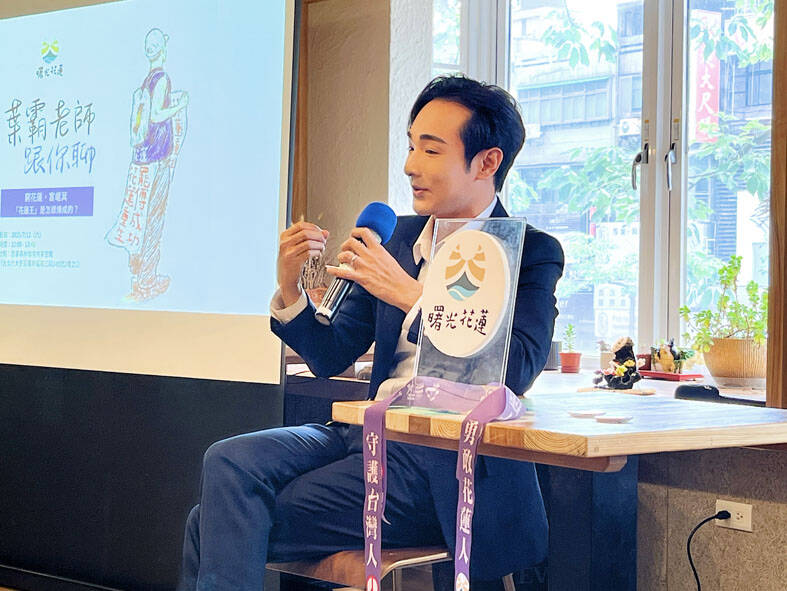
YouTuber Pa Chiung speaks at a recall campaign event in Taipei yesterday.
At a separate rally backing a “No” vote in the attempt to recall KMT Legislator Wang Hung-wei (王鴻薇), KMT deputy chairman Sean Lien (連勝文) said that President William Lai (賴清德) is seeking total control through the elimination of opposition.
“Taiwan should not condone Lai’s efforts to be a despot,” Lien said.
At a separate “No” rally, Taipei Mayor Chiang Wan-an (蔣萬安) spoke alongside five KMT legislators facing votes.
“Opposing the recalls is supporting Taiwanese democracy,” Chiang said.
In Taichung, recall campaigners participating in a journey throughout Taiwan hosted an event at Shuian Temple (水安宮) in Nantun District (南屯), while the KMT held a rally at which Legislative Speaker Han Kuo-yu (韓國瑜), Taichung Mayor Lu Shiow-yen (盧秀燕) and Taiwan People’s Party (TPP) Chairman Huang Kuo-chang (黃國昌) spoke.
Separately, the Central Election Commission (CEC) said that all promotional material, regardless of whether it supports or opposes recalls, must bear information identifying the person or political party who created it.
People who produce and distribute recall campaign material and are not one of the elected officials facing a vote or the head of a recall campaign must include their address on the material, the CEC said, citing the Civil Servants Election and Recall Act (公職人員選舉罷免法).
Those who contravene the rules face a fine of NT$100,000 to NT$1 million (US$3,424 to US$34,241), it said.
Additional reporting by Huang Hsu-lei and CNA

NATIONAL SECURITY: Authorities are working to confirm the identities of the military personnel involved and investigating possible illegal conduct and regulatory violations Authorities are probing possible national security implications after Kinmen police and immigration officers on Sunday found a Chinese woman allegedly posing as a tourist while engaging in prostitution involving more than 10 military personnel. The woman, surnamed Chen (陳), has since been deported, authorities said, adding that investigators are still working to confirm the identities of those implicated, as the records only listed code names and aliases. The case stemmed from a report received by the Kinmen District Prosecutors’ Office on Friday last week from the Jinhu Precinct of the Kinmen County Police Bureau. On Sunday, police, along with the National Immigration

GLOBALGIVING: ‘ Caving to external pressure is not acceptable for an organization that has cultivated justice reform and human rights for 30 years,’ one NGO said A slew of non-government organizations (NGOs) have withdrawn from the GlobalGiving fundraising platform after it announced it would use “Chinese Taipei” instead of “Taiwan” from next month. The Taiwan Good Rice Association wrote on Facebook on Friday that it was informed on April 28 via a teleconference call of the change, which was made because the platform wanted to operate in China. Taiwan Good Rice is to terminate all cooperative relationships with GlobalGiving in response to the platform’s “unilateral and non-negotiable” decision to remove references to Taiwan, the NGO said. “Taiwan is in the official name of Taiwan Good Rice Association and the

HEAVY WEATHER: Typhoon Jangmi is due to crash straight into the Ryukyus as airlines look to shift flights to larger aircraft or cancel flights to Okinawa entirely Taiwan’s international air carriers announced flight adjustments over the weekend as Typhoon Jangmi is forecast to hit the Ryukyu Islands today and tomorrow. The Central Weather Administration (CWA) upgraded Jangmi from a tropical storm to a typhoon at 8am yesterday, with the eye located 580km south of Naha city. It was moving north at 19kph. Today, China Airlines’ CI-120, CI-121, CI-122 and CI-123 flights between Taoyuan and Naha, Okinawa, have been canceled as well as CI-132 and CI-133 between Kaohsiung and Naha. EVA Air’s BR-112, BR-113, BR-186 and BR-185 flights between Taoyuan and Naha are also canceled. Low-cost carrier Tigerair Taiwan canceled IT-230,

Chinese Nationalist Party (KMT) Chairwoman Cheng Li-wun (鄭麗文) yesterday briefed her party’s Central Standing Committee regarding her scheduled visit to the US between Monday next week and June 16, saying that her purpose would be to persuade the US that the Republic of China (ROC) Constitution was a “one China” constitution that would foster stable and peaceful cross-strait relations. The ROC Constitution is the most important defense for all Taiwanese citizens, as it upholds our democracy and has contributed to our robust economy, which aligns with international and US interests, she said. “We would not be troublemakers and drag the US under,”


 RSS
RSS