


The Keelung District Prosecutors' Office today indicted seven people over the alleged forgery of recall petitions targeting city councilors from the Democratic Progressive Party (DPP).
Chinese Nationalist Party (KMT) Keelung branch chairman Wu Kuo-sheng (吳國勝) is accused of ordering local party officials to forge 1,063 petition signatures in the campaigns targeting DPP city councilors Cheng Wen-ting (鄭文婷) and Jiho Chang (張之豪), prosecutors said.
Wu allegedly also instructed Keelung Department of Civil Affairs Director Chang Yuan-hsiang (張淵翔) to use the Keelung City Government’s household registration system to help with the forgeries, contravening the Personal Data Protection Act (個人資料保護法), prosecutors said.
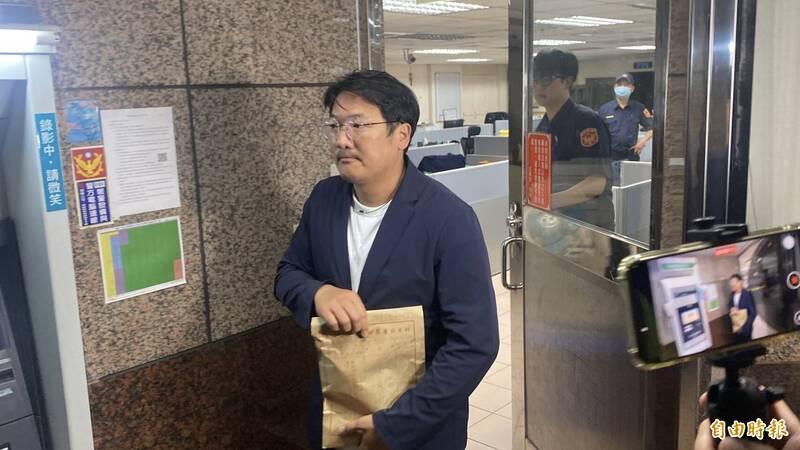
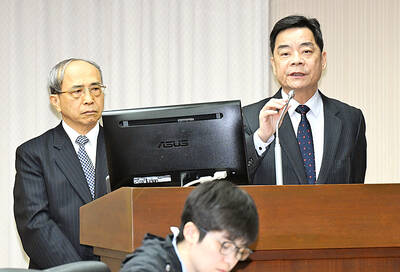
Photo: Lin Chia-tung, Taipei Times
The seven indicted are: Wu, Chang, Renai District (仁愛) KMT committee director Chang Chin-fa (張金發), recall campaign leaders Chi Wen-chuan (紀文荃) and Yu Cheng-yi (游正義), Jhongjheng District (中正) Household Registration Office Director Chiang Chien-yu (江鑒育) and Anle District (安樂) Household Registration Office Director Lin Fen-yun (林芬芸).
Eight other people confessed to their crimes and are facing suspended sentences and fines of NT$50,000 to NT$180,000, prosecutors said.
Due to a lack of evidence, Hsu Shao-yeh (許紹業), one of the recall campaign leaders, former KMT Keelung chapter deputy secretary Han Chi-yuan (韓元吉) and Keelung City Government advisor Hsieh Wei-jen (謝偉仁) were not charged, prosecutors said.
The scheme began when Wu realized that their recall campaigns might not have enough signatures and instructed Chang Chin-fa to find volunteers to forge the remaining ones, prosecutors said.
Wu had Chang Yuan-hsiang use the city’s household registration system to identify people who had changed households, prosecutors said, adding that they instructed Chiang and Lin Hsin-hong to assist in those efforts.
Prosecutors said they would be seeking heavier sentences for some people, including Chang Chin-fa and Chi, as they had given vague statements.
This afternoon, Wu, Yu, Chang Chin-fa and Chang Yuan-hsiang were transferred to the Keelung District Court where a hearing was to be held at 6pm to decide whether their detention would be extended.
The Keelung City Government today said it respects the results of the investigation.
The city government would act in accordance with the law and would not tolerate the abuse of personal information, it said, adding that reforms would be implemented and those involved in the case have left the government.
The city's Department of Civil Affairs and Civil Service Ethics Office have completed an inter-departmental review, the city government said.
The issue of whether to add a section for “reason of inquiry” in the household registration system would be discussed, it said.
The city government has implemented systematic internal adjustments and training, it said, adding that it would perform gatekeeping stringently to improve the protection of personal information and ensure administrative neutrality.
Additional reporting by CNA, Yu Chao-fu and Fion Khan
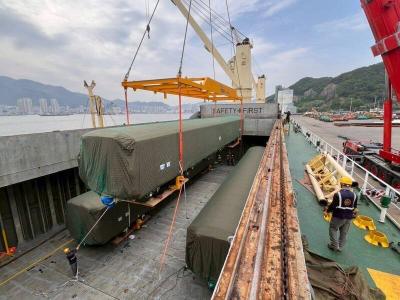
The first of 10 new high-capacity trains purchased from South Korea’s Hyundai Rotem arrived at the Port of Taipei yesterday to meet the demands of an expanding metro network, Taipei Rapid Transit Corp (TRTC) said yesterday. The train completed a three-day, 1,200km voyage from the Port of Masan in South Korea, the company said. Costing NT$590 million (US$18.79 million) each, the new six-carriage trains feature a redesigned interior based on "human-centric" transportation concepts, TRTC said. The design utilizes continuous longitudinal seating to widen the aisles and optimize passenger flow, while also upgrading passenger information displays and driving control systems for a more comfortable
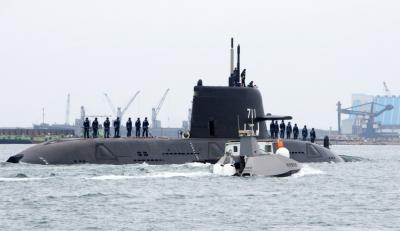
Taiwan's first indigenous defense submarine, the SS-711 Hai Kun (海鯤, or Narwhal), departed for its 13th sea trial at 7am today, marking its seventh submerged test, with delivery to the navy scheduled for July. The outing also marked its first sea deployment since President William Lai (賴清德) boarded the submarine for an inspection on March 19, drawing a crowd of military enthusiasts who gathered to show support. The submarine this morning departed port accompanied by CSBC Corp’s Endeavor Manta (奮進魔鬼魚號) uncrewed surface vessel and a navy M109 assault boat. Amid public interest in key milestones such as torpedo-launching operations and overnight submerged trials,
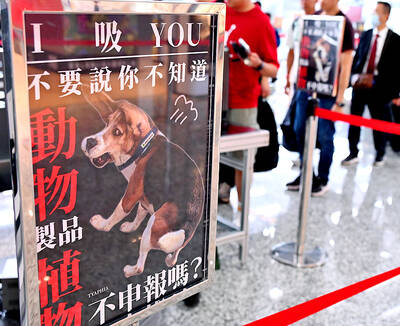
Quarantine awareness posters at Taiwan Taoyuan International Airport have gone viral for their use of wordplay. Issued by the airport branch of the Animal and Plant Health Inspection Agency, the posters feature sniffer dogs making a range of facial expressions, paired with advisory messages built around homophones. “We update the messages for holidays and campaign needs, periodically refreshing materials to attract people’s attention,” quarantine officials said. “The aim is to use the dogs’ appeal to draw focus to quarantine regulations.” A Japanese traveler visiting Taiwan has posted a photo on X of a poster showing a quarantine dog with a
SECURITY RISK: A university student sent a general alarm signal to THSRC’s control center on April 5, causing four operating trains to temporarily halt services The Ministry of Transportation and Communications yesterday pledged to submit a report on ways to harden the communication security of railway systems after a university student hacked into Taiwan High Speed Rail Corp’s (THSRC) radio communications system and disrupted operations of four high-speed rail trains last month. Investigation by the police and prosecutors found that the university student and radio enthusiast, surnamed Lin (林), first used a software-defined radio (SDR) filter to analyze THSRC signals, downloaded the data to a computer, cracked the parameters and then programmed the codes into his radio devices. Lin then sent a general alarm signal to


 RSS
RSS