


An extreme sports enthusiast from Switzerland made history last week by becoming the first person to kitesurf across the Taiwan Strait.
Geza Scholtz, 43, said he set out from Taiwan’s Dongju Island (東莒島), one of the Matsu Islands, on Wednesday last week and headed to Yongan Fishing Port in Taoyuan.
Standing on a surfboard and holding onto his kite, pushed forward only by the wind, he traversed 165km in 10 hours.
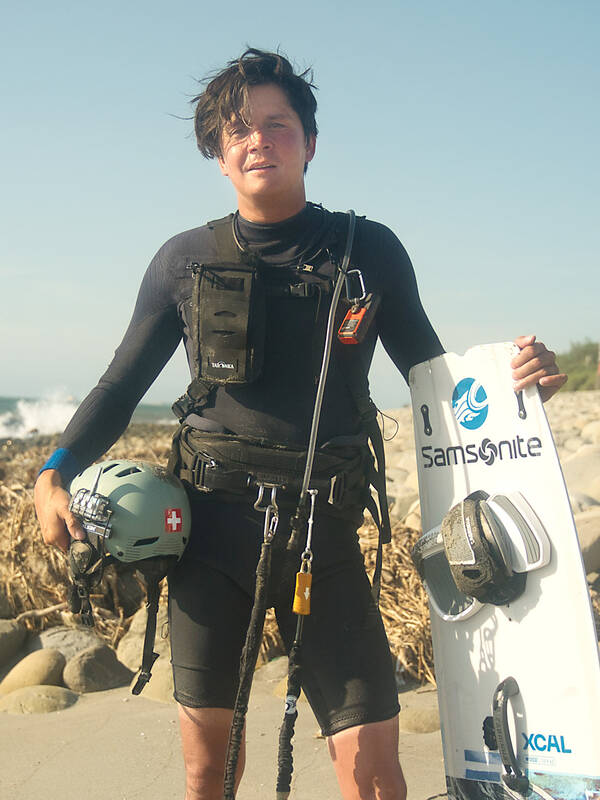
Photo courtesy of Geza Sholtz’s team
He said he wanted to conquer the Taiwan Strait after learning about the demise of windsurfing pioneer Arnaud de Rosnay, who disappeared during a similar attempt across the Strait in 1984.
“That’s exactly what drove me,” Scholtz said.
Scholtz said he initially wanted to kitesurf from China to Taiwan, but given the complicated application procedure that would entail due to political tensions across the Strait, he settled for the next best thing. However, that also meant surfing an extra 40km.
The weather that day was calm, and northern winds were blowing instead of the southern winds that were prevalent during summer, providing him with what seemed like a perfect window of opportunity to kitesurf southbound from Dongju to Taiwan proper, Scholtz said in an interview on Wednesday.
The stars seemed to have aligned, but little did Scholtz know that the expedition would test his limits.
He had taken an hour-long boat ride from Nangan Island (南竿) to the starting point, during which he became seasick. The nausea persisted during his kitesurfing journey.
“After half an hour, I still felt really ill... I decided to stop for a moment, as I had just vomited twice into the ocean,” he said.
Frustrated, Scholtz said he began to criticize himself.
“It took me two years [of preparation] to get to this point. The weather, the wind, everything is correct. And now you feel ill?” he recalled saying to himself.
Nevertheless, he forged ahead, and he felt better after about an hour.
However, he had to face another challenge, which nearly jeopardized his journey.
“We suddenly had 2.5m waves and 20 to 25 knots [37kph to 46kph] of winds, which were quite strong,” Scholtz said.
To surf at high speeds, Scholtz said he had picked a 12m2 kite, the second-biggest in his arsenal, but it was being overpowered by the strong winds.
“It was at its limits... If the wind speeds had been one or two knots higher, it would not have been possible anymore,” he said.
Asked why he did not stop to change the kite, Scholtz said he decided to keep going, rather than navigate through the potential pitfalls associated with a kite swap that could cut the journey short, including pulling in the kite amid strong winds and roaring waves without getting the line caught in the propeller, and launching a new kite in that condition.
“I just switched my mind off and continued, continued and continued,” he said.
Scholtz said he felt very “emotional” and exhausted when he finally reached the shores of Taoyuan, and that he was glad he had achieved his goal.
“Not a day passed over the past two years that I did not think about this day. ‘Where will I arrive?’ How will it look like?’” he said.
Scholtz had a message to young people after he set the record.
“I want to show that life does not happen on screens — it happens outside,” Scholtz said. “I hope my project inspires young people, in particular, to believe in their dreams, plan them and make them a reality.”
Asked what his impressions of Taiwan were during the two-and-a-half weeks he spent in the country before and after the expedition, Scholtz said: “Taiwanese people are some of the kindest, warmest and most heartfelt people I’ve met in this world.”
Scholtz said he would like to thank all the “little helpers” who voluntarily assisted him with logistics throughout his project.
“I’ve traveled to somewhere between 80 and 90 countries. I have been everywhere in the world, and I have to say that the support and the help I got from the Taiwanese people was just amazing,” he said.
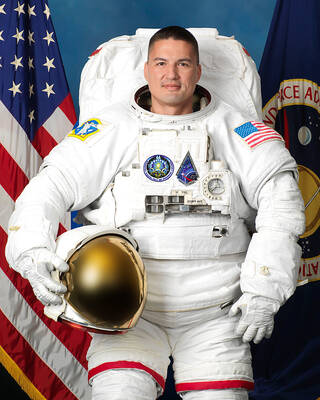
SPACE VETERAN: Kjell N. Lindgren, who helps lead NASA’s human spaceflight missions, has been on two expeditions on the ISS and has spent 311 days in space Taiwan-born US astronaut Kjell N. Lindgren is to visit Taiwan to promote technological partnerships through one of the programs organized by the US for its 250th national anniversary. Lindgren would be in Taiwan from Tuesday to Saturday next week as part of the US Bureau of Educational and Cultural Affairs’ US Speaker Program, organized to celebrate the 250th anniversary of the signing of the Declaration of Independence, the American Institute in Taiwan (AIT) said in a statement yesterday. Lindgren plans to engage with key leaders across the nation “to advance cutting-edge technological partnerships and inspire the next generation of scientists and engineers,”

UNREASONABLE SURVEILLANCE: A camera targeted on an road by a neighbor captured a man’s habitual unsignaled turn into home, netting him dozens of tickets The Taichung High Administrative Court has canceled all 45 tickets given to a man for failing to use a turn signal while driving, as it considered long-term surveillance of his privacy more problematic than the traffic violations. The man, surnamed Tseng (曾), lives in Changhua County and was reported 45 times within a month for failing to signal while driving when he turned into the alley where his residence is. The reports were filed by his neighbor, who set up security cameras that constantly monitored not only the alley but also the door and yard of Tseng’s house. The surveillance occurred from July

A Japan Self-Defense Forces vessel entered the Taiwan Strait yesterday, Japanese media reported. After passing through the Taiwan Strait, the Ikazuchi was to proceed to the South China Sea to take part in a joint military exercise with the US and the Philippines, the reports said. Japan Self-Defense Force vessels were first reported to have passed through the strait in September, 2024, with two further transits taking place in February and June last year, the Asahi Shimbun reported. Yesterday’s transit also marked the first time since Japanese Prime Minister Sanae Takaichi took office that a Japanese warship has been sent through the Taiwan

‘SAME OLD TRICK’: Even if Beijing resumes individual travel to Taiwan, it would only benefit Chinese tourism companies, the Economic Democracy Union convener said China’s 10 new “incentives” are “sugar-coated poison,” an official said yesterday, adding that Taiwanese businesses see them clearly for what they are, but that Beijing would inevitably find some local collaborators to try to drums up support. The official, speaking on condition of anonymity, made the remark ahead of a news conference the General Chamber of Commerce is to hold today. The event, titled “Industry Perspectives on China’s Recent Pro-Taiwan Policies,” is expected to include representatives from industry associations — such as those in travel, hotels, food and agriculture — to request the government cooperate with China’s new measures, people familiar with


 RSS
RSS