


Starting this month, active military personnel would be given priority boarding when taking international flights on national airlines, Premier Cho Jung-tai (卓榮泰) said yesterday.
Cho also announced that relevant ministries and agencies would coordinate other perks for active-duty service members to be launched in conjunction with private enterprises and venues.
Despite China’s continued harassment of Taiwan and its people, life continues as normal due to the armed forces defending the nation around the clock, Cho said.
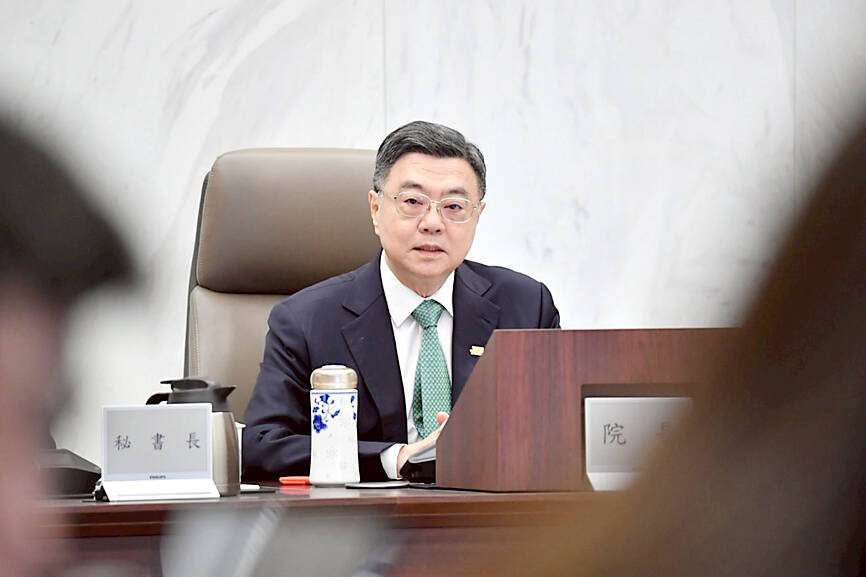
Photo courtesy of the Executive Yuan.
Their contributions deserve the respect and support of the public, Cho said.
Cho thanked the Ministry of Transportation and Communications for its engagement with the aviation industry to provide personnel priority boarding and upgrades to business class, if seats are available.
This is a concrete action to express thanks for the armed forces’ dedication to the country, he said.
Giving soldiers these perks reflects President William Lai’s (賴清德) philosophy to encourage civil-military cooperation, Cho added.
Minister of Transportation and Communications Chen Shih-kai (陳世凱) has communicated that China Airlines is coordinating and encouraging other airlines to participate, Executive Yuan spokesperson Michelle Lee (李慧芝) said.
Eleven people have already used this service, Chen said.
Providing upgrades to business class for active-duty personnel is more complex than it seems, the labor unions of China Airlines and EVA Airways said yesterday in a joint statement.
Implementing it might damage the interests of ordinary people, shareholders and flight operators, the statement said.
If only specific companies cooperate with the policy, it would be detrimental to fair market competition and airlines’ sustainable operations, it said.
Providing perks for active-duty personnel is legitimate, the statement said, but the government should fully consider the industry’s operational challenges, and provide reasonable incentives and assistance, rather than requiring companies to cooperate.
The government should not act unilaterally to avoid unnecessary conflict and division, it added.

Considering that most countries issue more than five denominations of banknotes, the central bank has decided to redesign all five denominations, the bank said as it prepares for the first major overhaul of the banknotes in more than 24 years. Central bank Governor Yang Chin-lung (楊金龍) is expected to report to the Legislative Yuan today on the bank’s operations and the redesign’s progress. The bank in a report sent to the legislature ahead of today’s meeting said it had commissioned a survey on the public’s preferences. Survey results showed that NT$100 and NT$1,000 banknotes are the most commonly used, while NT$200 and NT$2,000

The Centers for Disease Control (CDC) yesterday reported the first case of a new COVID-19 subvariant — BA.3.2 — in a 10-year-old Singaporean girl who had a fever upon arrival in Taiwan and tested positive for the disease. The girl left Taiwan on March 20 and the case did not have a direct impact on the local community, it said. The WHO added the BA.3.2 strain to its list of Variants Under Monitoring in December last year, but this was the first imported case of the COVID-19 variant in Taiwan, CDC Deputy Director-General Lin Ming-cheng (林明誠) said. The girl arrived in Taiwan on

South Korea is planning to revise its controversial electronic arrival card, a step Taiwanese officials said prompted them to hold off on planned retaliatory measures, a South Korean media report said yesterday. A Yonhap News Agency report said that the South Korean Ministry of Foreign Affairs is planning to remove the “previous departure place” and “next destination” fields from its e-arrival card system. The plan, reached after interagency consultations, is under review and aims to simplify entry procedures and align the electronic form with the paper version, a South Korean ministry official said. The fields — which appeared only on the electronic form

The Ministry of Foreign Affairs (MOFA) is suspending retaliation measures against South Korea that were set to take effect tomorrow, after Seoul said it is updating its e-arrival system, MOFA said today. The measures were to be a new round of retaliation after Taiwan on March 1 changed South Korea's designation on government-issued alien resident certificates held by South Korean nationals to "South Korea” from the "Republic of Korea," the country’s official name. The move came after months of protests to Seoul over its listing of Taiwan as "China (Taiwan)" in dropdown menus on its new online immigration entry system. MOFA last week


 RSS
RSS