


Vice President Hsiao Bi-khim (蕭美琴) yesterday said that Taiwan and the US are having some "bumps" due to the potential imposition of sweeping tariffs on Taiwanese goods by Washington, but both sides are still talking in the hopes of reaching a mutually acceptable solution.
"The economic relationship between Taiwan and the United States is an important pillar of our partnership, though we have had a few bumps along the way, including the complicated dynamics of tariffs," Hsiao said at a reception hosted by the American Institute in Taiwan (AIT) to celebrate the 249th anniversary of US Independence Day on July 4.
"Negotiators from both sides are working diligently and closely to pave a pathway toward a common goal of progress and prosperity for both our countries," Hsiao said in her address at the event.
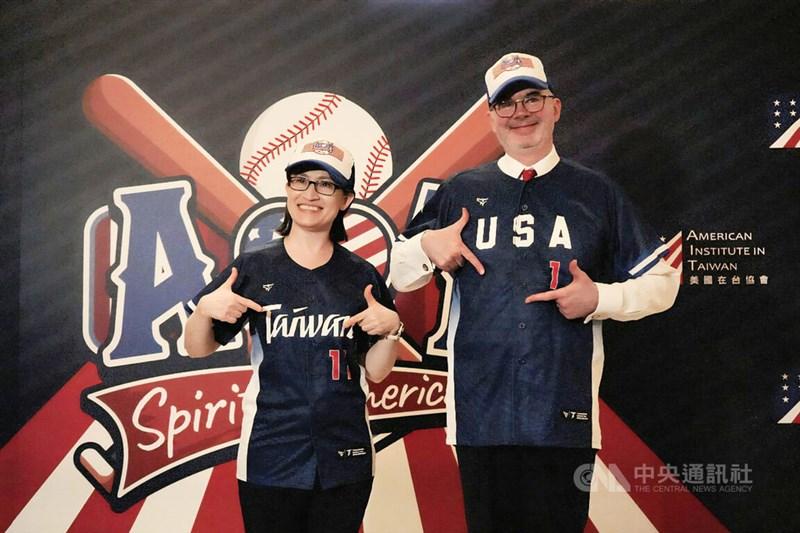
Photo: CNA
The close trade and investment ties between the two countries are "deep and mutually complementary," including in sectors ranging from semiconductors and high-value manufacturing to digital services and clean energy innovation, she said.
"We believe a strong Taiwan will be better capable of contributing to global prosperity, including America's goals of reindustrialization and technological leadership, particularly in AI [artificial intelligence] and frontier industries," she said.
Noting the baseball theme of this year's event, Hsiao said that the sport is a passion shared by Taiwanese and Americans.
"We have a partnership that is built inning after inning. We have faced fastballs, curveballs and sometimes sliders, but we keep stepping up to the plate with determination and teamwork," she said, adding that "together, we are a champion team."
AIT Director Raymond Greene said in his address that the economies of Taiwan and the US are "well-positioned to help each other thrive, especially in new and critical technologies" in this moment of "historic economic transformation."
He praised Taiwan's expertise in high-tech, large-scale production, saying it is "the perfect match for innovative US drone companies."
"As with AI, the United States and Taiwan are perfectly positioned to dominate this dynamic sector where innovation and secure supply chains will define success," Greene said.
"Whether it is shaping the technologies of the 21st century, ensuring resilient supply chains and communities, or keeping the peace in the Indo-Pacific, America and Taiwan working together with our democratic teammates are poised to knock it out of the park every time," he said.
Hsiao and Greene exchanged signed baseball jerseys, while Legislative Speaker Han Kuo-yu (韓國瑜) and Deputy Legislative Speaker Johnny Chiang (江啟臣) presented Greene with a Taiwan-made baseball bat engraved with the words: "A home run for Taiwan-US relations."
Meanwhile, Executive Yuan Secretary-General Kung Ming-hsin (龔明鑫) projected a positive outlook for Taiwan's economy, citing the country's central role in the global development of AI.
As long as Taiwan maintains its edge in the manufacture of information and communications technology (ICT) and AI-related products, it would remain a mainstay in the global supply chain, Kung told a forum on trade and economic relations between Taiwan and the US.
"No country can afford to exclude Taiwan ... unless it wishes to abandon its AI ambitions in the next five years," Kung said, adding that Taiwan provides the "firepower" needed for the global battle.
He was possibly referring to advanced semiconductor production.
Kung touched briefly on potential US tariffs on Taiwanese goods, including semiconductors, saying that Taiwan had weathered past disruptions — particularly the US-China trade dispute in 2017 and the COVID-19 pandemic — and adapted to changing circumstances.
Taiwan had previously overcome greater challenges and exceeded experts' expectations with regard to its economic performance, he said.
"This is why I remain optimistic," Kung said, adding that there would be "good opportunities" in the second half of this year "regardless of any changes that may come."
In early April, US President Donald Trump announced the imposition of "reciprocal" tariffs on imports from dozens of countries and territories, including a blanket levy on Taiwanese goods of 32 percent.
Trump later suspended the tariffs for 90 days and imposed a reduced 10 percent duty on most countries. The temporary pause is set to expire on Wednesday next week.
Taiwanese officials and their counterparts in the US completed a second round of tariff talks at the end of last month, the Executive Yuan's Office of Trade Negotiations has said.
However, it provided little detail about the negotiations, saying only that both sides had achieved "constructive progress.”
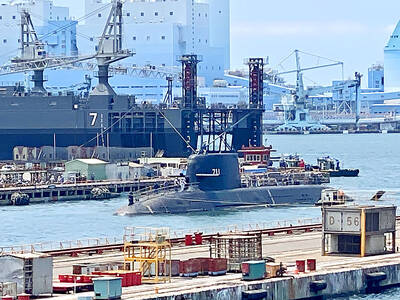
AGING: While Japan has 22 submarines, Taiwan only operates four, two of which were commissioned by the US in 1945 and 1946, and transferred to Taiwan in 1973 Taiwan would need at least 12 submarines to reach modern fleet capabilities, CSBC Corp, Taiwan chairman Chen Cheng-hung (陳政宏) said in an interview broadcast on Friday, citing a US assessment. CSBC is testing the nation’s first indigenous defense submarine, the Hai Kun (海鯤, Narwhal), which is scheduled to be delivered to the navy next month or in July. The Hai Kun has completed torpedo-firing tests and is scheduled to undergo overnight sea trials, Chen said on an SET TV military affairs program. Taiwan would require at least 12 submarines to establish a modern submarine force after assessing the nation’s operational environment and defense
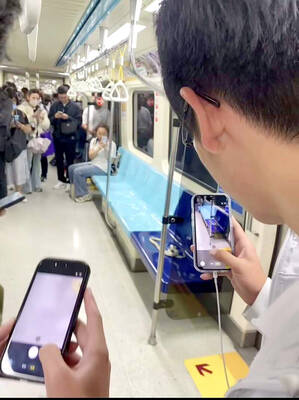
A white king snake that frightened passengers and caused a stir on a Taipei MRT train on Friday evening has been claimed by its owner, who would be fined, Taipei Rapid Transit Corp (TRTC) said yesterday. A person on Threads posted that he thought he was lucky to find an empty row of seats on Friday after boarding a train on the Bannan (Blue) Line, only to spot a white snake with black stripes after sitting down. Startled, he jumped up, he wrote, describing the encounter as “terrifying.” “Taipei’s rat control plan: Release snakes on the metro,” one person wrote in reply, referring
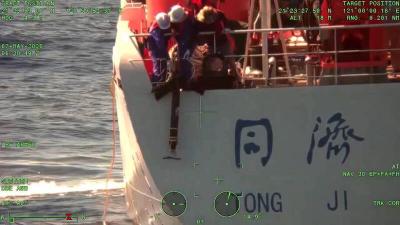
The coast guard today said that it had disrupted "illegal" operations by a Chinese research ship in waters close to the nation and driven it away, part of what Taipei sees a provocative pattern of China's stepped up maritime activities. The coast guard said that it on Thursday last week detected the Chinese ship Tongji (同濟號), which was commissioned only last year, 29 nautical miles (54km) southeast of the southern tip of Taiwan, although just outside restricted waters. The ship was observed lowering ropes into the water, suspected to be the deployment of scientific instruments for "illegal" survey operations, and the coast
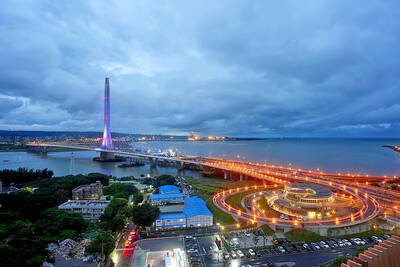
An inauguration ceremony was held yesterday for the Danjiang Bridge, the world’s longest single-mast asymmetric cable-stayed bridge, ahead of its official opening to traffic on Tuesday, marking a major milestone after nearly three decades of planning and construction. At the ceremony in New Taipei City attended by President William Lai (賴清德), Premier Cho Jung-tai (卓榮泰), Minister of Transportation and Communications Chen Shih-kai (陳世凱) and New Taipei City Mayor Hou Yu-ih (侯友宜), the bridge was hailed as both an engineering landmark and a long-awaited regional transport link connecting Tamsui (淡水) and Bali (八里)


 RSS
RSS