


Taiwanese should be careful when using Chinese mobile applications due to potential security breaches, the National Security Bureau (NSB) said today, after it recently inspected five of those apps, including TikTok and Xiaohongshu (小紅書, known as RedNote in English).
The inspections by Taiwan's top intelligence agency of the five social media platforms, which also included Sina Weibo, WeChat and Baidu Cloud, found serious violations of users' communication security across several indicators, the NSB said in a statement.
The inspections, conducted jointly with the Ministry of Justice Investigation Bureau and the Criminal Investigation Bureau, covered 15 indicators in five categories: personal data collection, excess of usage permission, data transmission and sharing, system information extraction, and access to biometric data.
Photo: CNA
All five apps showed breaches across many of the indicators, with RedNote, the Chinese equivalent of Facebook, failing to meet all 15 of them, the NSB said.
Sina Weibo and TikTok did not meet 13 of the 15 indicators, while WeChat failed 10 and Baidu Cloud nine.
"These findings suggest that the China-made apps present cybersecurity risks far beyond the reasonable expectations for data-collection requirements taken by ordinary apps," the NSB wrote in English.
All five apps had security issues related to excessive collection of personal data and abuse of system permissions, with breaches including unauthorized access to screenshots, clipboard content, contact lists and location data, as well as inadequate protection of personal information rights.
All five apps collected users' application lists and device parameters (in the system information extraction category), and four of the five collected facial recognition data, which the NSB said might be deliberately harvested and stored by those apps.
The five apps also sent packets back to servers in China, raising serious concerns about the potential misuse of personal data by third parties, the agency said.
Under China's Cybersecurity Law and National Intelligence Law, Chinese companies are obligated to turn over user data to authorities if it involves national security, public security or intelligence, the NSB said.
Such a practice would significantly breach the privacy of Taiwanese users and could support data collection by specific Chinese agencies, it said.
People must "remain vigilant regarding mobile device security and avoid downloading China-made apps that pose cybersecurity risks, to protect personal data privacy and corporate business secrets," the NSB said.
Since 2019, Taiwan has banned TikTok, Douyin (the Chinese version of TikTok) and RedNote from government devices and official premises over national security concerns.
However, there is no ban on the private use of the apps.
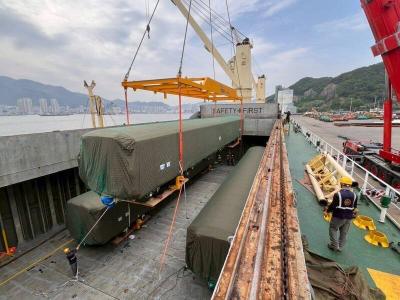
The first of 10 new high-capacity trains purchased from South Korea’s Hyundai Rotem arrived at the Port of Taipei yesterday to meet the demands of an expanding metro network, Taipei Rapid Transit Corp (TRTC) said yesterday. The train completed a three-day, 1,200km voyage from the Port of Masan in South Korea, the company said. Costing NT$590 million (US$18.79 million) each, the new six-carriage trains feature a redesigned interior based on "human-centric" transportation concepts, TRTC said. The design utilizes continuous longitudinal seating to widen the aisles and optimize passenger flow, while also upgrading passenger information displays and driving control systems for a more comfortable
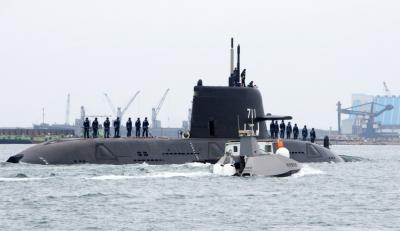
Taiwan's first indigenous defense submarine, the SS-711 Hai Kun (海鯤, or Narwhal), departed for its 13th sea trial at 7am today, marking its seventh submerged test, with delivery to the navy scheduled for July. The outing also marked its first sea deployment since President William Lai (賴清德) boarded the submarine for an inspection on March 19, drawing a crowd of military enthusiasts who gathered to show support. The submarine this morning departed port accompanied by CSBC Corp’s Endeavor Manta (奮進魔鬼魚號) uncrewed surface vessel and a navy M109 assault boat. Amid public interest in key milestones such as torpedo-launching operations and overnight submerged trials,
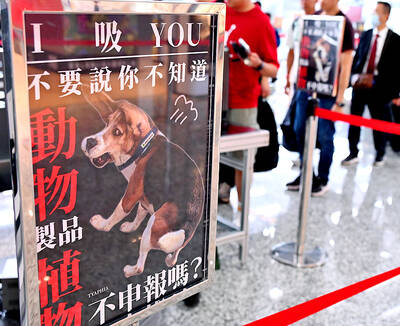
Quarantine awareness posters at Taiwan Taoyuan International Airport have gone viral for their use of wordplay. Issued by the airport branch of the Animal and Plant Health Inspection Agency, the posters feature sniffer dogs making a range of facial expressions, paired with advisory messages built around homophones. “We update the messages for holidays and campaign needs, periodically refreshing materials to attract people’s attention,” quarantine officials said. “The aim is to use the dogs’ appeal to draw focus to quarantine regulations.” A Japanese traveler visiting Taiwan has posted a photo on X of a poster showing a quarantine dog with a

Taiwan’s coffee community has launched a “one-person-one-e-mail” campaign, calling for people to send a protest-e-mail to the World Coffee Championships (WCC) urging it to redesignate Taiwanese competitors as from “Taiwan,” rather than “Chinese Taipei.” The call followed sudden action last week after the WCC changed all references to Taiwanese competitors from “Taiwan” to “Chinese Taipei,” including recent World Latte Art champion Bala (林紹興), who won the World Latte Art Championship in San Diego earlier this month. When Bala received the trophy, he was referred to as representing Taiwan, as well as in the announcement on the WCC’s Web site, until it


 RSS
RSS