


The Taichung branch of the High Court today sentenced retired military officer Chu Hung-i (屈宏義), chairman of the Rehabilitation Alliance Party, to 10 years in prison for recruiting retired military officers to spy for China.
Chu was found guilty of using Chinese funds to recruit retired military officers to take photographs, draw maps and collect the GPS coordinates of the American Institute in Taiwan (AIT) and Taiwanese military bases for Chinese intelligence.
Chu and six other retired officers, who were also sentenced today, were indicted in August last year for contravening the National Security Act (國家安全法) and the Anti-infiltration Act (反滲透法).
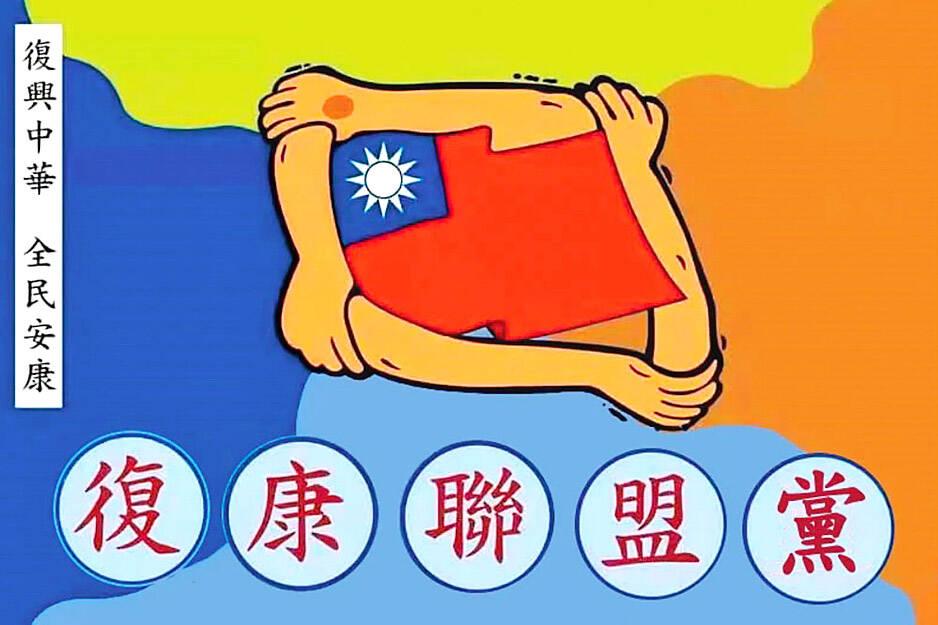
Photo: screen grab from the Ministry of the Interior's Web site
Huang Kuei-kun (黃桂坤), a Miaoli County councilor candidate in 2022, was sentenced to eight years and six months in prison. Tai Hsueh-wen (戴學文) and Lin Chien-hua (林健華) each received eight years, Chu Hsien-huan (朱賢寰) and Yu Tien-min (余天民) were each sentenced to seven years, and Liao Yung-ching (廖永清) was given three years and six months.
All of today’s verdicts can be appealed to the Supreme Court.
In 2022, the Miaoli District Prosecutors' Office investigated Huang for allegedly receiving funds from Chinese sources during the county councilor election campaign, in contravention of the Anti-infiltration Act. Miaoli prosecutors then investigated the Rehabilitation Alliance Party, and found that Huang and other party members were suspected of contravening the National Security Act.
The case was transferred to the Taichung branch of the High Prosecutors’ Office.
Prosecutors found that 62-year-old Chu, a Republic of China Army Academy graduate, had conducted business in China after retiring as an army officer.
In 2019, he became acquainted with military intelligence agencies from the People’s Liberation Army and was offered funding in exchange for forming a spy network of former military officials, prosecutors said.
Chu recruited six officers, including Huang, they said.
In 2023, Chu established the Rehabilitation Alliance Party, appointing himself as chairman.
He personally wrote the operation guidelines for the party, planning to expand it and build an internal armed force, and drafted guidelines for “unification” combat operations, prosecutors said.
Chu then recruited two locals and actor Liu Shang-chien (劉尚謙) to run for legislative seats.
They were unaware of the situation, prosecutors said.
Chu calculated the campaign budget and requested funding from his Chinese contacts, who transferred NT$2 million (US$68,390) via WeChat and an additional NT$670,000 from unregistered remittance services, prosecutors said.
Liu and the other candidates lost the local elections.
Chu then instructed his recruits to collect a list of officers ranked major general or higher and to photograph and record the GPS coordinates of military installations, prosecutors said.
The locations included the AIT, the Alishan Radar Station (阿里山), Pingtung County’s Jialutang Beach (加祿堂) and the Baoli camps (保力) of the Hengchun Joint Operations Training Base Command (恆春三軍聯合訓練基地), they said.
He sent the information to contacts in China via WeChat, prosecutors said.

NATIONAL SECURITY: Authorities are working to confirm the identities of the military personnel involved and investigating possible illegal conduct and regulatory violations Authorities are probing possible national security implications after Kinmen police and immigration officers on Sunday found a Chinese woman allegedly posing as a tourist while engaging in prostitution involving more than 10 military personnel. The woman, surnamed Chen (陳), has since been deported, authorities said, adding that investigators are still working to confirm the identities of those implicated, as the records only listed code names and aliases. The case stemmed from a report received by the Kinmen District Prosecutors’ Office on Friday last week from the Jinhu Precinct of the Kinmen County Police Bureau. On Sunday, police, along with the National Immigration

GLOBALGIVING: ‘ Caving to external pressure is not acceptable for an organization that has cultivated justice reform and human rights for 30 years,’ one NGO said A slew of non-government organizations (NGOs) have withdrawn from the GlobalGiving fundraising platform after it announced it would use “Chinese Taipei” instead of “Taiwan” from next month. The Taiwan Good Rice Association wrote on Facebook on Friday that it was informed on April 28 via a teleconference call of the change, which was made because the platform wanted to operate in China. Taiwan Good Rice is to terminate all cooperative relationships with GlobalGiving in response to the platform’s “unilateral and non-negotiable” decision to remove references to Taiwan, the NGO said. “Taiwan is in the official name of Taiwan Good Rice Association and the
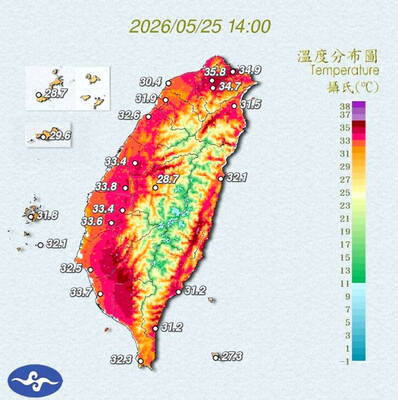
STAY COOL: The HPA recommended that people stay hydrated, use air-conditioning or fans while indoors, wear loose-fitting clothes and walk in the shade while outdoors Employers must implement measures such as installing cooling equipment, and providing drinking water and rest breaks for outdoor workers starting from Monday next week, the Taipei Department of Labor said on Sunday. Employers who fail to comply could face fines of NT$30,000 to NT$300,000 under the Occupational Safety and Health Act (職業安全衛生法), the department said. Businesses in Taipei employing fewer than 100 workers, as well as registered self-employed workers with labor insurance coverage, could receive on-site assessments and guidance from occupational safety consultants to help them apply for central government subsidies to implement or improve heat-protection measures, it said. Under the Ministry of

Chinese Nationalist Party (KMT) Chairwoman Cheng Li-wun (鄭麗文) yesterday briefed her party’s Central Standing Committee regarding her scheduled visit to the US between Monday next week and June 16, saying that her purpose would be to persuade the US that the Republic of China (ROC) Constitution was a “one China” constitution that would foster stable and peaceful cross-strait relations. The ROC Constitution is the most important defense for all Taiwanese citizens, as it upholds our democracy and has contributed to our robust economy, which aligns with international and US interests, she said. “We would not be troublemakers and drag the US under,”


 RSS
RSS