


Israel’s top envoy to Taiwan yesterday defended her country’s decision to attack Iran, saying the ongoing military actions are an “act of self-defense” on Israel’s part before Iran builds atomic bombs.
“For us, defending our country is something that we must do, and we needed to act on time before it’s too late, before they [Iran] have a nuclear atomic bomb,” Israeli Economic and Cultural Office in Taipei Representative Maya Yaron told a news briefing in Taipei.
The ongoing Operation Rising Lion aims to neutralize Tehran’s nuclear and ballistic missile programs so that Israel no longer has an existential immediate threat, she said.
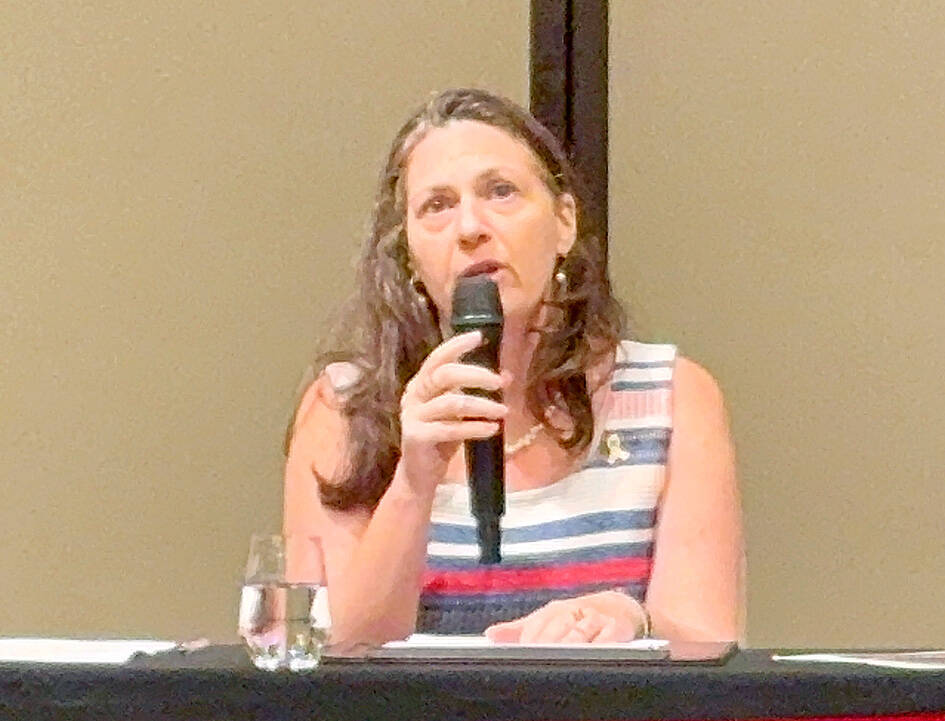
Photo: Huang Chin-hsuan, Taipei Times
Israel is smaller in size and has a smaller population than Taiwan, and is facing a threat from Iran with 10,000 missiles being built against it, she said.
Iran is a “radical Islamist regime,” “a dictatorship” and “the most repressive government in the world,” she added.
“Everything that you know about Taiwan’s way of life, about Taiwan’s vibrant democracy, does not exist in Iran. No women’s rights, no LGBTQi, no freedom of press, no freedom of speech. There is no democracy. There is only oppression. This is a terrorist regime that is acting against its own people,” she said.
“If we who belong to the free world and we are in this community together, we must remain aware and we must be united in front of any tactics that try to distort us from this truth,” she said, while commenting on the misinformation campaigns on the Israel-Iran war.
“There is no other alternative. We cannot have this regime have nuclear weapons,” she added.
Since 1992, Israeli Prime Minister Benjamin Netanhayu has made multiple claims about the “imminent threat” of Iran developing nuclear weapons.
On March 25, US National Intelligence Director Tulsi Gabbard, speaking at the US Senate Select Committee on Intelligence hearing for the Annual Threat Assessment of the US Intelligence Community, said Iran was not building nuclear weapons and had not resumed its suspended 2003 nuclear weapons program.
Asked whether Iran was developing nuclear weapons, International Atomic Energy Agency (IAEA) Director-General Rafael Grossi said in a recent interview with CNN: “We did not have any proof of a systematic effort to move into a nuclear weapon.”
Israel is widely believed to have its own extensive nuclear weapons program, but unlike Iran has not signed the Treaty on the Non-Proliferation of Nuclear Weapons.
In Taipei, Presidential Office spokesperson Karen Kuo (郭雅慧) on Sunday said that the government’s national security team has been keeping close tabs on the escalating tensions in the Middle East and is regularly briefing President William Lai (賴清德) about the latest developments.
Lai has instructed the national security team and the executive branch to continue to pay close attention to possible developments and respond effectively to potential impacts on the global political and economic markets, she added.

Considering that most countries issue more than five denominations of banknotes, the central bank has decided to redesign all five denominations, the bank said as it prepares for the first major overhaul of the banknotes in more than 24 years. Central bank Governor Yang Chin-lung (楊金龍) is expected to report to the Legislative Yuan today on the bank’s operations and the redesign’s progress. The bank in a report sent to the legislature ahead of today’s meeting said it had commissioned a survey on the public’s preferences. Survey results showed that NT$100 and NT$1,000 banknotes are the most commonly used, while NT$200 and NT$2,000

The Centers for Disease Control (CDC) yesterday reported the first case of a new COVID-19 subvariant — BA.3.2 — in a 10-year-old Singaporean girl who had a fever upon arrival in Taiwan and tested positive for the disease. The girl left Taiwan on March 20 and the case did not have a direct impact on the local community, it said. The WHO added the BA.3.2 strain to its list of Variants Under Monitoring in December last year, but this was the first imported case of the COVID-19 variant in Taiwan, CDC Deputy Director-General Lin Ming-cheng (林明誠) said. The girl arrived in Taiwan on

South Korea is planning to revise its controversial electronic arrival card, a step Taiwanese officials said prompted them to hold off on planned retaliatory measures, a South Korean media report said yesterday. A Yonhap News Agency report said that the South Korean Ministry of Foreign Affairs is planning to remove the “previous departure place” and “next destination” fields from its e-arrival card system. The plan, reached after interagency consultations, is under review and aims to simplify entry procedures and align the electronic form with the paper version, a South Korean ministry official said. The fields — which appeared only on the electronic form

The Ministry of Foreign Affairs (MOFA) is suspending retaliation measures against South Korea that were set to take effect tomorrow, after Seoul said it is updating its e-arrival system, MOFA said today. The measures were to be a new round of retaliation after Taiwan on March 1 changed South Korea's designation on government-issued alien resident certificates held by South Korean nationals to "South Korea” from the "Republic of Korea," the country’s official name. The move came after months of protests to Seoul over its listing of Taiwan as "China (Taiwan)" in dropdown menus on its new online immigration entry system. MOFA last week


 RSS
RSS