


Isolated incidents of scuffles and verbal altercations occurred over the weekend as citizen groups and political party officials organized events to either rally support for or oppose recall votes next month targeting 24 Chinese Nationalist Party (KMT) lawmakers.
In New Taipei City, police detained a woman after she confronted citizen group volunteers working on the recall campaign in Jhonghe (中和) and Yonghe (永和) districts. The woman allegedly slapped a volunteer on the back.
The woman, reportedly a KMT supporter, was escorted to a police station in Jhonghe to give a statement. She might face assault charges if the volunteer files a formal complaint.

Photo: Chen Yi-shan, Taipei Times
Volunteers from citizen groups, mostly young people, held placards reading: “Defend democracy, support recall vote,” as they stood across from a community center in Jhonghe which hosted a KMT “anti-recall” rally in support of party lawmakers Chang Chih-lun (張智倫) and Lin Te-fu (林德福).
People at the event said that pro-recall workers at the scene received positive nods and thumbs-ups during the KMT event, but also jeers and thumbs-downs from passersby.
Later, the woman in question approached and began arguing before allegedly slapping a female worker on the back. People nearby called the police and restrained the woman to prevent her from fleeing.
Separately, violence, blackmail and intimidation were reported in other constituencies.
In New Taipei City’s Sindian District (新店), gang members allegedly threatened a recall movement leader. Political pundit Lee Cheng-hao (李正皓) was attacked with pepper spray, and Democratic Progressive Party Taipei City Councilor Lin Liang-chun (林亮君) said that she had been blackmailed last week by people claiming to possess nude photos of her, demanding US$50,000 to return the images.
Lin said that the threats and blackmail might be aiming to silence her support for the recall vote.
“With the rise of deepfake technology, people can create forged images that, if not checked closely, could deceive viewers into thinking they are real,” she said.

Yangmingshan National Park authorities yesterday urged visitors to respect public spaces and obey the law after a couple was caught on a camera livestream having sex at the park’s Qingtiangang (擎天崗) earlier in the day. The Shilin Police Precinct in Taipei said it has identified a suspect and his vehicle registration number, and would summon him for questioning. The case would be handled in accordance with public indecency charges, it added. The couple entered the park at about 11pm on Thursday and began fooling around by 1am yesterday, the police said, adding that the two were unaware of the park’s all-day live

A former soldier and an active-duty army officer were yesterday indicted for allegedly selling classified military training materials to a Chinese intelligence operative for a total of NT$79,440. The Taipei District Prosecutors’ Office indicted Chen Tai-yin (陳泰尹) and Lee Chun-ta (李俊達) for contravening the National Security Act (國家安全法) and the Anti-Corruption Act (貪污治罪條例). Chen left the military in September 2013 after serving alongside then-staff sergeant Lee, now an army lieutenant, at the 21st Artillery Command of the army’s Sixth Corps from 2011 to 2013, according to the indictment. Chen met a Chinese intelligence operative identified as “Wang” (王) through a friend in November

Minister of Digital Affairs Lin Yi-ching (林宜敬) yesterday cited regulatory issues and national security concerns as an expert said that Taiwan is among the few Asian regions without Starlink. Lin made the remarks on Facebook after funP Innovation Group chief executive officer Nathan Chiu (邱繼弘) on Friday said Taiwan and four other countries in Asia — China, North Korea, Afghanistan and Syria — have no access to Starlink. Starlink has become available in 166 countries worldwide, including Ukraine, Malaysia, the Philippines and Vietnam, in the six years since it became commercial, he said. While China and North Korea block Starlink, Syria is not
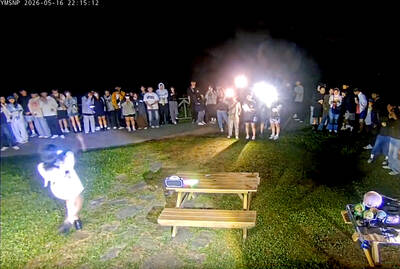
Yangmingshan National Park’s Qingtiangang (擎天崗) nature area has gone viral after a park livestream camera observed a couple in the throes of intimate congress, which was broadcast live on YouTube, drawing large late-night crowds and sparking a backlash over noise, bright lights and disruption to wildlife habitat. The area’s livestream footage appeared to show a couple engaging in sexual activity on a picnic table in the park on Friday last week, with the uncensored footage streamed publicly online. The footage quickly spread across social media, prompting a tide of visitors to travel to the site to “check in” and recreate the


 RSS
RSS