

Chinese Nationalist Party (KMT) Legislator Cheng Cheng-chien (鄭正鈐), who represents Hsinchu City, is the subject of a High Prosecutors’ Office investigation over allegations of leaking government information to Beijing, the office said yesterday.
The office said that it accepted a complaint by Lin Chih-chieh (林志潔), the spokeswoman of a group working to recall Cheng and Hsinchu City Mayor Ann Kao (高虹安), who accused Cheng of accepting Chinese funding for election campaigns and leaking government information.
A former assistant in Cheng’s office alleged that during his time as an elected representative, Cheng accepted funding from the Chinese Communist Party, the criminal complaint filed by Lin said.

Photo: Liu Wan-lin, Taipei Times
Lin also accused the 56-year-old Cheng of instructing the assistant to use his mobile phone to reply to messages from China’s Taiwan Affairs Office (TAO) and transmit official government documents to it via the social media app WeChat, the complaint said.
The office said that it has accepted Lin’s complaint and its team responsible for “major national security and social order threats” is investigating.
Cheng on Tuesday said in a statement that he has never accepted funding from China in his political career and never handed any confidential materials related to national security to the TAO.
The recall campaign against him “has clearly fallen into disarray and is now resorting to smears and red-baiting,” Cheng said, adding that anyone with real evidence is welcome to file charges.
In light of the “repeated false accusations,” he said he would pursue legal action and not show any leniency.
In addition, Lin, a member of the Democratic Progressive Party and a legal academic, on Wednesday filed a complaint with the Taipei District Prosecutors’ Office accusing Cheng of contravening the Political Donations Act (政治獻金法), the National Security Act (國家安全法) and the Anti-Corruption Act (貪汙治罪條例).
The Taipei office has accepted the compliant and listed Cheng as a suspect, tasking its special anti-corruption team to investigate the allegations.
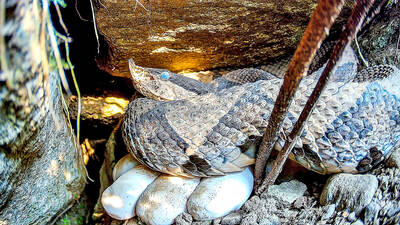
NATURE TAKES ITS COURSE: The agency’s head said he felt a sense of loss watching red-banded snakes eat the babies, as they had decided on non-intervention The Forestry and Nature Conservation Agency yesterday released a documentary on a hundred-pace viper that had incubated 16 eggs, all of which hatched, but only a baby viper escaped after they were attacked by red-banded snakes. The agency’s Taichung branch last year launched the viper reproduction monitoring project soon after forest rangers Lin Chun-yu (林俊佑) and Chou Chia-cheng (周家成) spotted a pregnant hundred-pace viper in a grass-covered burrow near a parking lot in Tbulan Village (松鶴部落). The Atayal village, in Taichung’s Heping District (和平), is headed by Ecyang Yapu, who was positive about the project and assisted in access control and power

The Coast Guard Administration (CGA) yesterday said that it had deployed vessels to “monitor” Chinese ships operating in waters off the east coast. The CGA said it dispatched vessels in response to a China Coast Guard announcement that it had carried out another “routine law-enforcement patrol” in waters off the east coast. “The CGA firmly rejects China’s cognitive warfare campaign of ‘law enforcement in name, jurisdictional expansion in practice,’” it said on X. As of 11am yesterday, two China Coast Guard ships were “loitering and drifting” about 105 nautical miles (195km) and 74 nautical miles east of Green Island (綠島) respectively, it said. It

A sharp rise in compensation to be paid by air force officers who leave before completing their required service could indicate an increase in pilots leaving the military early, an analyst said on Friday, warning that the trend could worsen a shortage of experienced personnel. Chieh Chung (揭仲), a researcher at the Association for Strategic Foresight, issued the warning even though the number of volunteer military personnel is expected to increase next year. The planned headcount for volunteer military personnel, covering officers, noncommissioned officers (NCO) and enlisted soldiers, is 158,223 for next year, up 4,258 from 153,965 this year, Chieh said. The increase
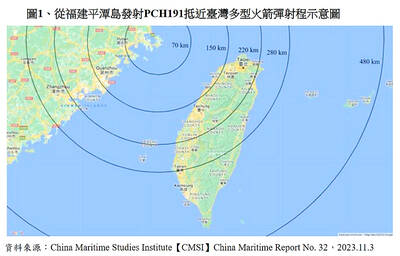
Potential improvements to munitions used by China’s long-range rocket-artillery units could extend their range to cover the entire Miyako Strait, which might give the Chinese People’s Liberation Army (PLA) the ability to secure the strategic waterway, the Mainland Affairs Council (MAC) said in a report. The PLA’s long-range rocket-artillery units deployed along the Taiwan Strait are concentrated along the coast of Fujian Province, including Changle, Pingtan and Shishi, the quarterly report on China said. The artillery brigades of the PLA’s 71st, 72nd and 73rd group armies have been deployed, with preparations for potential battlefield operations under way since August 2022, the report


 RSS
RSS