


Taiwan’s proposed “new immigrant development agency” will have a budget of around NT$700 million (US$23.62 million) and around 100 full-time employees if it is launched in 2026, Deputy Minister of the Interior Wu Tang-an (吳堂安) said yesterday.
According to the New Immigrants Basic Act (新住民基本法) passed in July 2024, the Ministry of the Interior (MOI) oversees the establishment of the agency, which will be a subordinate agency of the MOI.
In a joint committee meeting yesterday, lawmakers reviewed a proposal to amend the Organization Act of the Ministry of the Interior (內政部組織法) and the draft organization act of the new immigration development agency, which pertained to the creation of the agency, and inquired Wu about the progress.
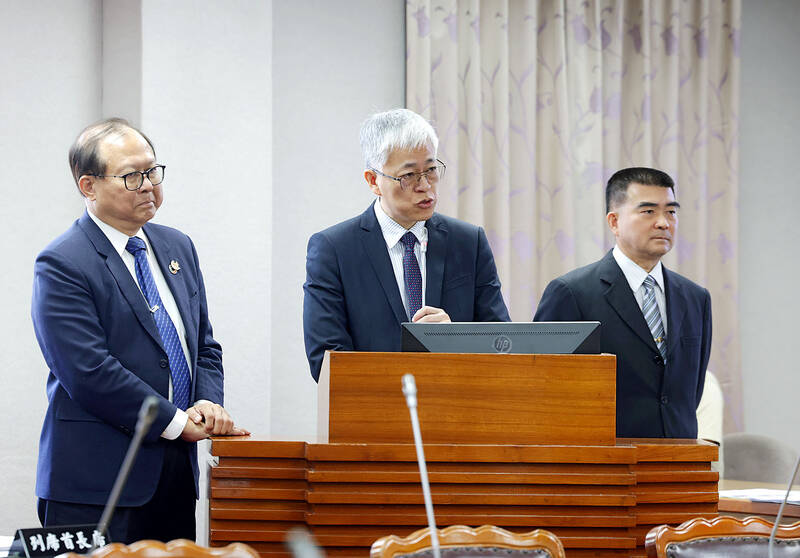
Photo: CNA
According to a written report by the MOI, the agency will oversee planning, research, consultation, coordination, and promotion of services related to education, employment, empowerment, care, and other services as needed by new immigrants.
The MOI has formed a preparatory group for the agency and continues to hold regular meetings to move the establishment forward, according to the report.
However, Wu did not give a definite answer when asked by Taiwan People’s Party Legislator Huang Kuo-chang (黃國昌) and Chinese Nationalist Party (KMT) Legislator Chang Chih-lun (張智倫) when preparations for the agency’s establishment will be finalized.
Wu said that if the agency is launched next year, it will have a near-100-strong staff and an annual budget of around NT$700 million.
He also said it would be close to Cabinet-level agencies, and that several locations in Taipei and New Taipei City are being considered.
“New immigrants” as specified in the act are defined as foreign nationals or stateless individuals who have been afforded residence through marriage with a Taiwanese national, foreign professionals who have been granted a work permit and approved for residence, or Chinese nationals who are granted residency through ad hoc programs.
They also include naturalized stateless persons or foreign nationals, foreigners who obtained residency through their jobs in Taiwan, or foreigners who are afforded residency under certain special circumstances specified in the Immigration Act (入出國及移民法) or the Act Governing Relations Between the People of the Taiwan Area and the Mainland Area (臺灣地區與大陸地區人民關係條例).
In addition, they encompass the children of members of the above-mentioned groups.

Kenting National Park service technician Yang Jien-fon (楊政峰) won a silver award in World Grand Prix Photography Awards Spring Season for his photograph of two male rat snakes intertwined in combat. Yang’s colleagues at Kenting National Park said he is a master of nature photography who has been held back by his job in civil service. The awards accept entries in all four seasons across six categories: architectural and urban photography, black-and-white and fine art photography, commercial and fashion photography, documentary and people photography, nature and experimental photography, and mobile photography. Awards are ranked according to scores and divided into platinum, gold and

More than half of the bamboo vipers captured in Tainan in the past few years were found in the city’s Sinhua District (新化), while other districts had smaller catches or none at all. Every year, Tainan captures about 6,000 snakes which have made their way into people’s homes. Of the six major venomous snakes in Taiwan, the cobra, the many-banded krait, the brown-spotted pit viper and the bamboo viper are the most frequently captured. The high concentration of bamboo vipers captured in Sinhua District is puzzling. Tainan Agriculture Bureau Forestry and Nature Conservation Division head Chu Chien-ming (朱健明) earlier this week said that the

The Chinese Nationalist Party (KMT) caucus yesterday said it opposes the introduction of migrant workers from India until a mechanism is in place to prevent workers from absconding. Minister of Labor Hung Sun-han (洪申翰) on Thursday told the Legislative Yuan that the first group of migrant workers from India could be introduced as early as this year, as part of a government program. The caucus’ opposition to the policy is based on the assessment that “the risk is too high,” KMT caucus secretary-general Lin Pei-hsiang (林沛祥) said. Taiwan has a serious and long-standing problem of migrant workers absconding from their contracts, indicating that

SPACE VETERAN: Kjell N. Lindgren, who helps lead NASA’s human spaceflight missions, has been on two expeditions on the ISS and has spent 311 days in space Taiwan-born US astronaut Kjell N. Lindgren is to visit Taiwan to promote technological partnerships through one of the programs organized by the US for its 250th national anniversary. Lindgren would be in Taiwan from Tuesday to Saturday next week as part of the US Bureau of Educational and Cultural Affairs’ US Speaker Program, organized to celebrate the 250th anniversary of the signing of the Declaration of Independence, the American Institute in Taiwan (AIT) said in a statement yesterday. Lindgren plans to engage with key leaders across the nation “to advance cutting-edge technological partnerships and inspire the next generation of scientists and engineers,”


 RSS
RSS