


The National Development Council (NDC) is developing 10 major artificial intelligence (AI) projects to advance the nation’s AI infrastructure, Executive Yuan Secretary-General Kung Ming-hsin (龔明鑫) said yesterday at the Business Today Taiwan Future International Summit in Taipei.
The projects, which are to be announced soon, are to focus on three aspects of AI: strategic thinking for applications; forward-looking development of new technologies such as quantum computing; and developing AI infrastructure, Kung said.
The summit also featured a prerecorded speech by President William Lai (賴清德), in which he outlined the three strategies chosen by the government to meet the needs of the AI era.
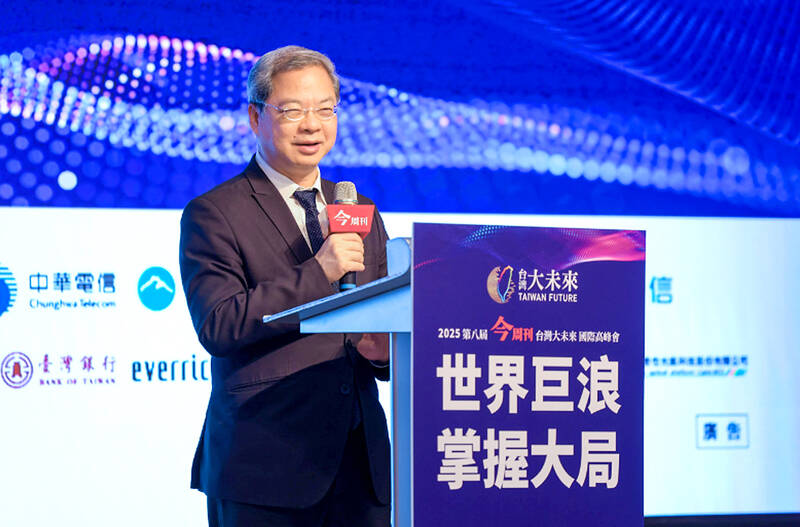
Photo: screen grab from the Business Today Web site
First, it would establish a national fund to create a new investment platform, with the government taking the lead in utilizing the nation’s comparative advantages and capital to link key markets, Lai said.
Second, the government would partner with institutions to develop AI prototype production lines to help companies develop new products, he said.
Third, it would promote international cooperation and setting standards, such as joint efforts with Japan, the EU and the US, he added.
The Industrial Technology Research Institute last month announced plans to build an AI trial production line to help manufacturers reduce risks, verify technologies and bring products to market more quickly.
The NDC and the National Science and Technology Council are working together on developing the 10 AI projects, and the councils reported their plans for the projects — three smart applications, three key technologies and four infrastructure plans — to Premier Cho Jung-tai (卓榮泰) on Tuesday.
Up to NT$100 billion (US$3.39 billion) is expected to be used from a national development fund to enable AI transformations across all industries, their plans showed.
In addition, Kung said the goal of reaching net zero carbon emissions by 2050 remains unchanged.
The government would continue to develop the solar and offshore wind sectors, he said, adding that it would begin to plan the incorporation of geothermal energy and some hydropower to diversify energy sources.
The government would also continue to push for households to replace appliances with more efficient models and help manufacturers save electricity, he added.

Considering that most countries issue more than five denominations of banknotes, the central bank has decided to redesign all five denominations, the bank said as it prepares for the first major overhaul of the banknotes in more than 24 years. Central bank Governor Yang Chin-lung (楊金龍) is expected to report to the Legislative Yuan today on the bank’s operations and the redesign’s progress. The bank in a report sent to the legislature ahead of today’s meeting said it had commissioned a survey on the public’s preferences. Survey results showed that NT$100 and NT$1,000 banknotes are the most commonly used, while NT$200 and NT$2,000

The Centers for Disease Control (CDC) yesterday reported the first case of a new COVID-19 subvariant — BA.3.2 — in a 10-year-old Singaporean girl who had a fever upon arrival in Taiwan and tested positive for the disease. The girl left Taiwan on March 20 and the case did not have a direct impact on the local community, it said. The WHO added the BA.3.2 strain to its list of Variants Under Monitoring in December last year, but this was the first imported case of the COVID-19 variant in Taiwan, CDC Deputy Director-General Lin Ming-cheng (林明誠) said. The girl arrived in Taiwan on

South Korea is planning to revise its controversial electronic arrival card, a step Taiwanese officials said prompted them to hold off on planned retaliatory measures, a South Korean media report said yesterday. A Yonhap News Agency report said that the South Korean Ministry of Foreign Affairs is planning to remove the “previous departure place” and “next destination” fields from its e-arrival card system. The plan, reached after interagency consultations, is under review and aims to simplify entry procedures and align the electronic form with the paper version, a South Korean ministry official said. The fields — which appeared only on the electronic form

The Ministry of Foreign Affairs (MOFA) is suspending retaliation measures against South Korea that were set to take effect tomorrow, after Seoul said it is updating its e-arrival system, MOFA said today. The measures were to be a new round of retaliation after Taiwan on March 1 changed South Korea's designation on government-issued alien resident certificates held by South Korean nationals to "South Korea” from the "Republic of Korea," the country’s official name. The move came after months of protests to Seoul over its listing of Taiwan as "China (Taiwan)" in dropdown menus on its new online immigration entry system. MOFA last week


 RSS
RSS