


The Taiwan High Court yesterday rejected former Democratic Progressive Party lawmaker Chen Ou-po’s (陳歐珀) appeal against a ruling by a lower court ordering his detention and that he be held incommunicado over corruption allegations.
The Taipei District Court on June 4 ordered Chen’s detention after the Taipei District Prosecutors’ Office questioned Chen and requested he be detained over suspicions he received improper benefits or bribes from United Logistics International Co (ULIC) during his second term of office from 2016 to 2020.
Chen allegedly attempted to assist the company by holding meetings and conducting legislative hearings to support favorable legal amendments, potentially violating the Anti-Corruption Act (貪汙治罪條例), according to prosecutors.
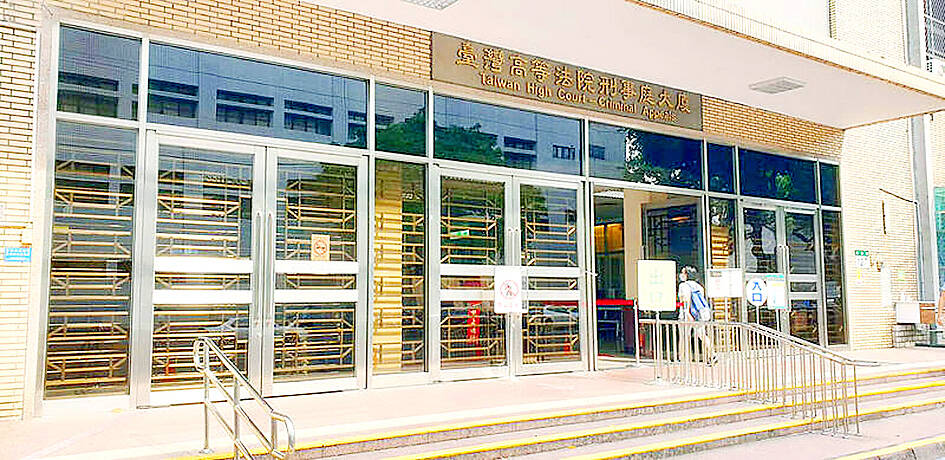
Photo: Yang Kuo-wen, Taipei Times
The district court then approved that Chen be detained incommunicado for two months starting June 4, citing strong suspicions of corruption and risk of flight and concerns over collusion or evidence tampering.
The district court said that based on Chen’s testimony, the detention request by prosecutors and the evidence included in the case files, he is strongly suspected of committing offenses such as accepting bribes and making unlawful gains in connection with his official duties under the Anti- Corruption Act and money laundering.
The district court also noted that the offenses Chen is suspected of committing carry a minimum prison sentence of five years.
The High Court yesterday decided to uphold the ruling handed down by the Taipei District Court, saying it found no error or impropriety in the original ruling.
The case dates back to a 2018 incident in which a cargo ship rammed into containers and equipment belonging to the logistics company at the Port of Keelung, causing major damage.
At the time, Taiwan’s Commercial Port Law did not cover private logistics firms, prompting ULIC to seek help from the lawmaker, according to investigators.

Yangmingshan National Park authorities yesterday urged visitors to respect public spaces and obey the law after a couple was caught on a camera livestream having sex at the park’s Qingtiangang (擎天崗) earlier in the day. The Shilin Police Precinct in Taipei said it has identified a suspect and his vehicle registration number, and would summon him for questioning. The case would be handled in accordance with public indecency charges, it added. The couple entered the park at about 11pm on Thursday and began fooling around by 1am yesterday, the police said, adding that the two were unaware of the park’s all-day live

Fast food chain McDonald's is to raise prices by up to NT$5 on some products at its restaurants across Taiwan, starting on Wednesday next week, the company announced today. The prices of all extra value meals and sharing boxes are to increase by NT$5, while breakfast combos and creamy corn soup would go up by NT$3, the company said in a statement. The price of the main items of those meals, if ordered individually, would remain the same. Meanwhile, the price of a medium-sized lemon iced tea and hot cappuccino would rise by NT$3, extra dipping sauces for chicken nuggets would go up

Yangmingshan National Park’s Qingtiangang (擎天崗) nature area has gone viral after a park livestream camera observed a couple in the throes of intimate congress, which was broadcast live on YouTube, drawing large late-night crowds and sparking a backlash over noise, bright lights and disruption to wildlife habitat. The area’s livestream footage appeared to show a couple engaging in sexual activity on a picnic table in the park on Friday last week, with the uncensored footage streamed publicly online. The footage quickly spread across social media, prompting a tide of visitors to travel to the site to “check in” and recreate the

Minister of Digital Affairs Lin Yi-ching (林宜敬) yesterday cited regulatory issues and national security concerns as an expert said that Taiwan is among the few Asian regions without Starlink. Lin made the remarks on Facebook after funP Innovation Group chief executive officer Nathan Chiu (邱繼弘) on Friday said Taiwan and four other countries in Asia — China, North Korea, Afghanistan and Syria — have no access to Starlink. Starlink has become available in 166 countries worldwide, including Ukraine, Malaysia, the Philippines and Vietnam, in the six years since it became commercial, he said. While China and North Korea block Starlink, Syria is not


 RSS
RSS