


Taiwanese who have obtained or currently hold “border tourism passports (邊境旅遊護照)” issued by the Chinese authorities for short-term travel in China’s border regions will lose their “Taiwan status,” according to the Mainland Affairs Council (MAC).
“In 2017, someone [referring to a Taiwanese] applied for a three-month ‘border tourism passport’ issued by China in order to travel to the China-Russia border region,” said MAC deputy head and spokesperson Liang Wen-chieh (梁文傑).
“By the time we discovered it, the passport’s three-month validity had already expired ... But the fact that you once held it is, from our perspective, already a violation of the law,” Liang said, referring to the individual’s violation of the cross-strait law, which resulted in the loss of their “Taiwan status.”

Photo: Reuters
Article 9-1 of the Act Governing Relations Between the People of the Taiwan Area and the Mainland Area (臺灣地區與大陸地區人民關係條例) stipulates that “people of the Taiwan Area may not have household registrations in the Mainland Area or hold passports issued by the Mainland Area.”
Those who violate the provision “shall be deprived of its status as the people of the Taiwan Area and its rights,” meaning they will lose their Republic of China (Taiwan’s official name) citizenship, including household registration and associated civil rights, according to the MAC.
It was the first time the MAC pointed out that in addition to a regular Chinese passport, holding or having held a “border tourism passport” will also result in the loss of “Taiwan status.”
The full name of the “border tourism passport” issued by China is the “People’s Republic of China Exit and Entry Permit (for border tourism use).”
With a validity of three months, the “border tourism passport” is a single-entry-exit permit issued by China’s National Immigration Administration or its designated public security bureau offices to Chinese citizens participating in government-approved border tourism programs.
An unnamed source said yesterday that some border ports between China and Russia offer a service allowing Taiwanese tourists to apply for a one-time “border tourism passport” issued by Chinese authorities to travel to Russia.
As the application fee for a “border tourism passport” is significantly lower than that of a Russian visa for Taiwanese citizens, some Taiwanese tourists applied for the China- issued travel document at Manzhouli in Inner Mongolia last winter to visit Lake Baikal in Russia, the source said.
Meanwhile, Liang said that if a Taiwanese is found to have held an expired regular Chinese passport -- which is valid for 10 years from the date of issue -- they cannot argue that its expiration nullifies the violation of the Act Governing Relations Between the People of the Taiwan Area and the Mainland Area.
From the standpoint of the Taiwanese government, whether a Chinese passport is expired or not “makes no difference” as it still constitutes a violation of the law, he added.
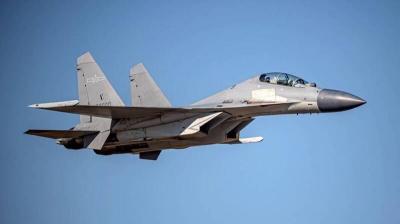
Eight Chinese naval vessels and 24 military aircraft were detected crossing the median line of the Taiwan Strait between 6am yesterday and 6am today, the Ministry of National Defense said this morning. The aircraft entered Taiwan’s northern, central, southwestern and eastern air defense identification zones, the ministry said. The armed forces responded with mission aircraft, naval vessels and shore-based missile systems to closely monitor the situation, it added. Eight naval vessels, one official ship and 36 aircraft sorties were spotted in total, the ministry said.
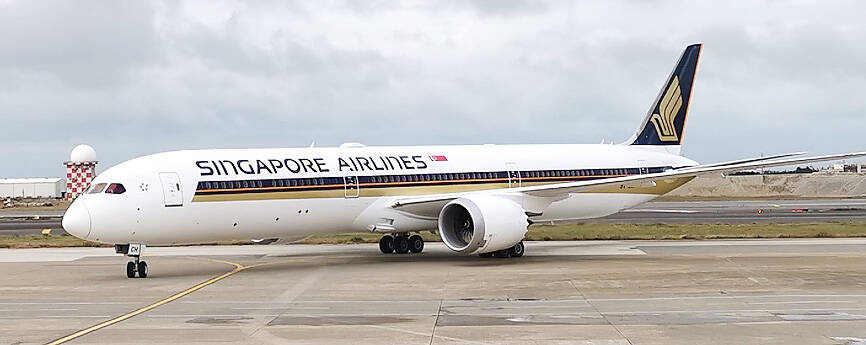
INCREASED CAPACITY: The flights on Mondays, Wednesdays, Fridays and Sundays would leave Singapore in the morning and Taipei in the afternoon Singapore Airlines is adding four supplementary flights to Taipei per week until May to meet increased tourist and business travel demand, the carrier said on Friday. The addition would raise the number of weekly flights it operates to Taipei to 18, Singapore Airlines Taiwan general manager Timothy Ouyang (歐陽漢源) said. The airline has recorded a steady rise in tourist and business travel to and from Taipei, and aims to provide more flexible travel arrangements for passengers, said Ouyang, who assumed the post in July last year. From now until Saturday next week, four additional flights would depart from Singapore on Monday, Wednesday, Friday
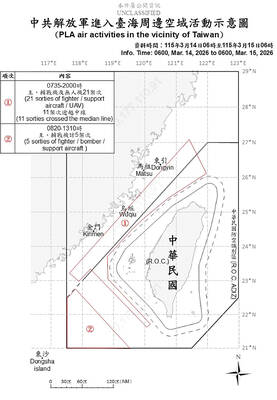
The Ministry of National Defense yesterday reported the return of large-scale Chinese air force activities after their unexplained absence for more than two weeks, which had prompted speculation regarding Beijing’s motives. China usually sends fighter jets, drones and other military aircraft around the nation on a daily basis. Interruptions to such routine are generally caused by bad weather. The Ministry of National Defense said it had detected 26 Chinese military aircraft in the Taiwan Strait over the previous 24 hours. It last reported that many aircraft on Feb. 25, when it spotted 30 aircraft, saying Beijing was carrying out another “joint combat

Taiwan successfully defended its women’s 540 kilogram title and won its first-ever men’s 640 kg title at the 2026 World Indoor Tug of War Championships in Taipei yesterday. In the women’s event, Taiwan’s eight-person squad reached the final following a round-robin preliminary round and semifinals featuring teams from Ukraine, Japan, Thailand, Vietnam, the Basque Country and South Korea. In the finals, they swept the Basque team 2-0, giving the team composed mainly of National Taiwan Normal University students and graduates its second championship in a row, and its fourth in five years. Team captain


 RSS
RSS